Woodbourne in Sullivan County, New York — The American Northeast (Mid-Atlantic)
Borscht Belt - Woodbourne
Photographed by Isaac Jeffreys, August 23, 2025
1. Borscht Belt - Woodbourne Marker
Borscht Belt - Woodbourne
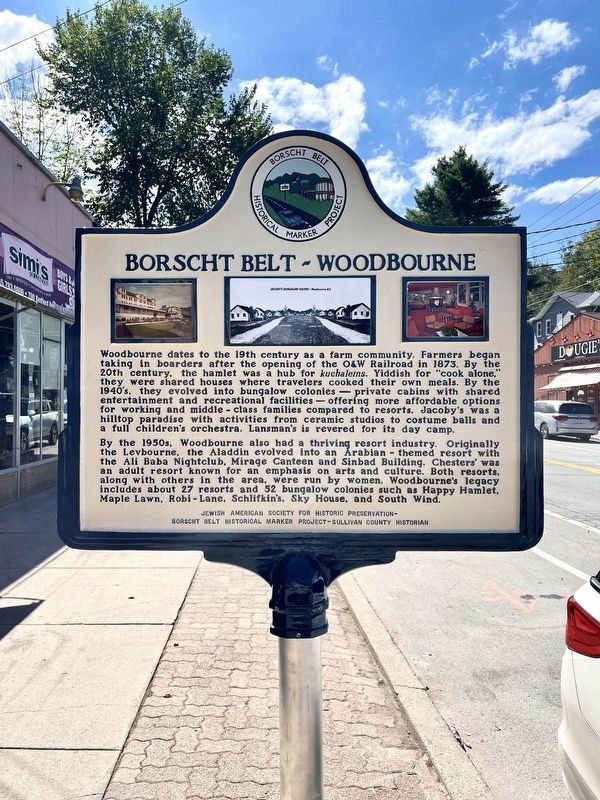
Woodbourne dates to the 19th century as a farm community. Farmers began taking in boarders after the opening of the O&W Railroad in 1873. By the 20th century, the hamlet was a hub for kuchaleins. Yiddish for “cook alone,” they were shared houses where travelers cooked their own meals. By the 1940’s, they evolved into bungalow colonies—private cabins with shared entertainment and recreational facilities—offering more affordable options for working and middle-class families compared to resorts. Jacoby’s was a hilltop paradise with ceramic studios, costume balls and a full children's orchestra. Lansman's is revered for its day camp.
By the 1950s, Woodbourne also had a thriving resort industry. Originally the Levbourne, the Aladdin evolved into an Arabian-themed resort with the Ali Baba Nightclub, Mirage Canteen and Sinbad Building. Chesters’ was an adult resort known for an emphasis on arts and culture. Both resorts, along with others in the area, were run by women. Woodbourne’s legacy includes about 27 resorts and 52 bungalow colonies such as Furman’s, Happy Hamlet, Salhara, Schlifkin’s,
this page online
Borscht Belt
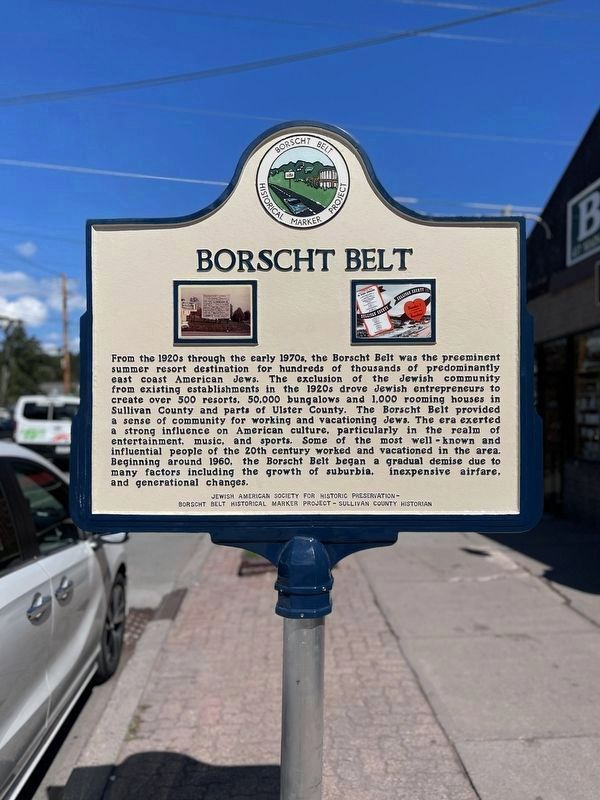
From the early 1920s through the 1970s, the Borscht Belt was the preeminent summer resort destination for hundreds of thousands of predominantly East Coast American Jews. The exclusion of the Jewish community from existing establishments in the 1920s drove Jewish entrepreneurs to create over 500 resorts, 50,000 bungalows, and 1,000 rooming houses in Sullivan County and parts of Ulster County. The Borscht Belt provided a sense of community for working and vacationing Jews. The era exerted a strong influence on American culture, particularly in the realm of entertainment, music, and sports. Some of the most well-known and influential people of the 20th century worked and vacationed in the areas. Beginning around 1960, the Borscht Belt began a gradual demise due to many factors, including the growth of suburbia, inexpensive airfare, and generational changes.
Erected 2025 by Jewish American Society for Historic Preservation, Borscht Belt Historical Marker Project.
Topics and series. This historical marker is listed in these topic lists: Arts, Letters, Music •
Photographed by Isaac Jeffreys, 2025
2. Borscht Belt - Woodbourne Marker
Location. 41° 45.55′ N, 74° 36.064′ W. Marker is in Woodbourne, New York, in Sullivan County. It is on Main Street, on the right when traveling east. Touch for map. Marker is at or near this postal address: 437 Main Street, Woodbourne NY 12788, United States of America. Touch for directions.

Regionally, this marker is in Upstate New York and in the Hudson Valley. It is also in the American Northeast, in the Mid-Atlantic, in Appalachia, and specifically in Northern Appalachia. Globally, it is in North America, the Western Hemisphere, the Western World, and the Anglosphere. Historically, it finds itself in what was once New Netherland and also one of the original Thirteen Colonies.
Other nearby markers. At least 8 other markers are within 4 miles of this marker, measured as the crow flies: Borscht Belt - Fallsburg (approx. 2 miles away); World Wide Daffodil Project (approx. 2.8 miles away); Borscht Belt - Loch Sheldrake (approx. 3 miles away); In Memory (approx. 3.6 miles away); Mayors of the Village of Woodridge (approx. 3.6 miles away); Borscht Belt - Woodridge (approx. 3.7 miles away); Borscht Belt - South Fallsburg (approx. 3.8 miles away); Methodist Church (approx. 3.9 miles away).
Also see . . .
1. The Alladin Hotel.
The Aladdin Hotel in Woodbourne, New York was a well-known stop in the Borscht Belt, the stretch of Catskills resorts where thousands of East Coast American Jews once spent their summers.(Submitted on August 25, 2025, by Jerry Klinger of Boynton Beach, Florida.)
For nearly 70 years, the Aladdin was run by Carrie Komito, a woman whose name became almost as well-known as the hotel itself.
2. The Borscht Belt Was a Haven for Generations of Jewish Americans.
These hardscrabble farmers and other Jews who relocated to the country adapted to a more hospitable solution to make ends meet: taking in boarders during the summertime.(Submitted on August 25, 2025, by Jerry Klinger of Boynton Beach, Florida.)
Early advertising played a role in developing the burgeoning restoration spot, as visitors originally came up to the Catskills by railroad. The New York & Ontario Railway published a guidebook series called “Summer Homes” that promoted stays within the Catskills; one Jewish farmer named Yana “John” Gerson listed one of the publication’s first advertisements for a Jewish boarding house in the 1890s.
3. Borscht Belt 101 -- The Brief History of the Catskills Resort Era.
Short YouTube Video History of the Borscht Belt(Submitted on August 25, 2025, by Jerry Klinger of Boynton Beach, Florida.)
4. Borscht Belt Historic Marker - Woodbourne: Jacoby’s Bungalow Colony (Youtube 14:25). “ A look back, and look forward of Jacoby's Bungalow Colony, in Woodbourne, New York. Written and narrated by Annice Jacoby.” (Submitted on January 26, 2026.)
Credits. This page was last revised on January 26, 2026. It was originally submitted on August 25, 2025, by Jerry Klinger of Boynton Beach, Florida. This page has been viewed 223 times since then and 86 times this year. Photos: 1, 2. submitted on August 25, 2025, by Jerry Klinger of Boynton Beach, Florida. • Andrew Ruppenstein was the editor who published this page.
