Greenville in Hunt County, Texas — The American South (West South Central)
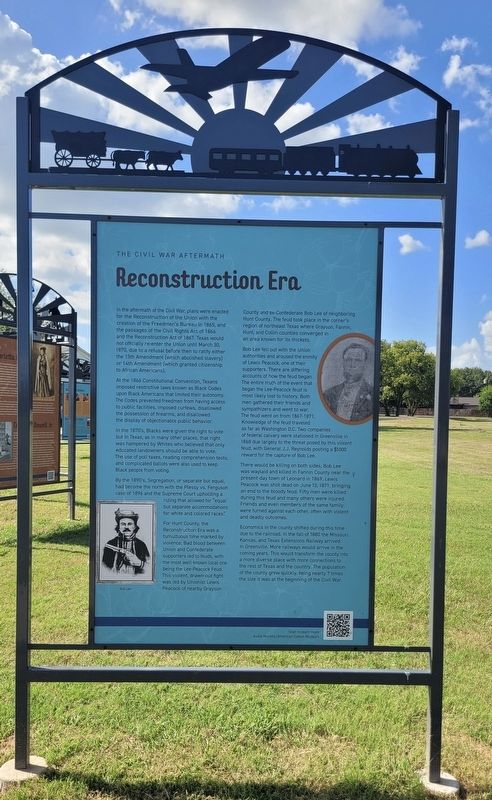
Reconstruction Era
The Civil War Aftermath
⎯⎯⎯
People
Photographed by James Hulse, July 28, 2025
1. Reconstruction Era Marker
At the 1866 Constitutional Convention, Texans imposed restrictive laws known as Black Codes upon Black Americans that limited their autonomy. The Codes prevented freedmen from having access to public facilities, imposed curfews, disallowed the possession of firearms, and disallowed the display of objectionable public behavior.
In the 1870's, Blacks were given the right to vote but in Texas, as in many other places, that right was hampered by Whites who believed that only educated landowners should be able to vote. The use of poll taxes, reading comprehension tests, and complicated ballots were also used to keep Black people from voting.
By the 1890's, Segregation, or separate but equal, had become the norm with the Plessy vs. Ferguson case of 1896 and the Supreme Court upholding a ruling that allowed for "equal but separate accommodations for white and colored races".
For Hunt County, the Reconstruction Era was a tumultuous time marked by violence. Bad blood between Union and Confederate supporters led to feuds, with the most well-known local one being the Lee-Peacock Feud. This violent, drawn-out fight was led by Unionist Lewis Peacock of nearby Grayson County and ex-Confederate Bob Lee of neighboring Hunt County. The feud took place in the corner's region of northeast Texas where Grayson, Fannin, Hunt, and Collin counties converged in an area known
this page online
Bob Lee fell out with the Union authorities and aroused the enmity of Lewis Peacock, one of their supporters. There are differing accounts of how the feud began. The entire truth of the event that began the Lee-Peacock feud is most likely lost to history. Both men gathered their friends and sympathizers and went to war. The feud went on from 1867-1871. Knowledge of the feud traveled as far as Washington D.C. Two companies of federal calvary were stationed in Greenville in 1868 due largely to the threat posed by this violent feud, with General J.J. Reynolds posting a $1000 reward for the capture of Bob Lee.
There would be killing on both sides; Bob Lee was waylaid and killed in Fannin County near the present-day town of Leonard in 1869. Lewis Peacock was shot dead on June 13, 1871, bringing an end to the bloody feud. Fifty men were killed during this feud and many others were injured. Friends and even members of the same family were turned against each other, often with violent and deadly outcomes.
Economics in the county shifted during this time due to the railroad. In the fall of 1880 the Missouri, Kansas,
Photographed by James Hulse, July 28, 2025
2. Reconstruction Era Marker - Reverse
Captions
(Photo #1) Bob Lee
(Photo #2) Lewis Peacock
Reverse Side
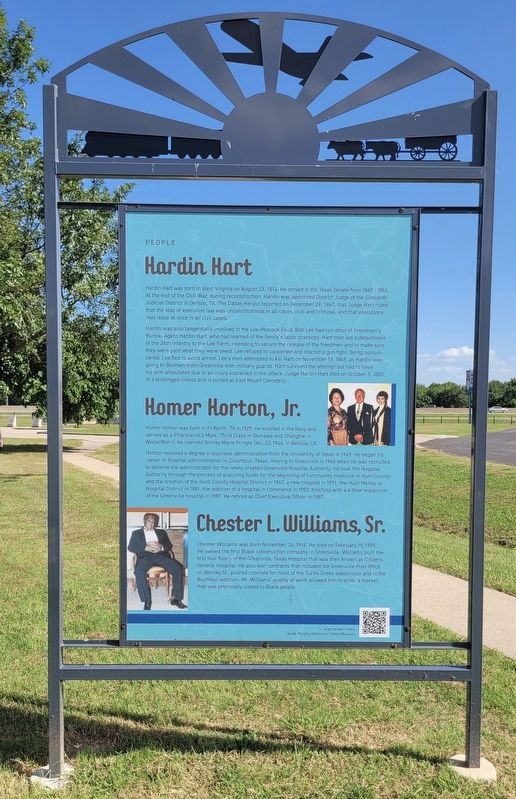
Hardin Hart
Hardin Hart was born in West Virginia on August 23, 1814. He served in the Texas Senate from 1849-1855. At the end of the Civil War, during reconstruction, Hardin was appointed District Judge of the Sixteenth Judicial District in Denton, TX. The Dallas Herald reported on December 29, 1867, that Judge Hart ruled that the stay of execution law was unconstitutional in all cases, civil and criminal, and that executions may issue at once in all civil cases.
Hardin was also tangentially involved in the Lee-Peacock Feud. Bob Lee had run afoul of Freedmen's Bureau Agent Hardin Hart, who had learned of the family's labor practices. Hart then led a detachment of the 26th Infantry to the Lee Farm, intending to secure the release
Photographed by James Hulse, July 28, 2025
3. Reconstruction Era Marker (blue marker)
Homer Horton, Jr.
Homer Horton was born in Ft Worth, TX in 1925. He enlisted in the Navy and served as a Pharmacist's Mate, Third Class in Okinawa and Shanghai in World War II. He married Shirley Marie Pringle Dec. 23, 1946, in Benicia, CA.
Horton received a degree in business administration from the University of Texas in 1949. He began his career in hospital administration in Columbus, Texas, moving to Greenville in 1960 when he was recruited to become the administrator for the newly created Greenville Hospital Authority. He took the Hospital Authority through the process of acquiring funds for the beginning of community medicine in Hunt County and the creation of the Hunt County Hospital District in 1967, a new hospital in 1971, the Hunt Memorial Hospital District in 1981, the addition of a hospital in Commerce in 1983, finishing with a 4-floor expansion of the Greenville hospital in 1987. He retired as Chief Executive Officer in 1987.
Chester L. Williams, Sr.
Chester Williams was born November 24, 1916. He died on February 19, 1995. He owned the first Black construction company in Greenville. Williams built the first four floors of the Greenville, Texas Hospital that was then known as Citizens General Hospital. He also won contracts that included the Greenville Post Office on Wesley St., poured concrete for most of the Turtle Creek subdivision and in the Raytheon addition. Mr. Williams' quality of work allowed him to enter a market that was previously closed to Black people
Erected by Audie Murphy / American Cotton Museum.
Topics. This historical marker is listed in these topic lists: African Americans • War, US Civil. A significant historical date for this entry is March 30, 1870.
Location. 33° 7.5′ N, 96° 5.338′ W. Marker is in Greenville, Texas, in Hunt County. It is on Interstate 30 Frontage Road ¼ mile west of Division Street, on the right when traveling west. The marker is located on the grounds of the Audie Murphy / American Cotton Museum. Touch for map. Marker is at or near this postal address: 600 I-30 Frontage Rd, Greenville TX 75401, United States of America. Touch for directions.

Regionally, this marker is in the Prairies & Lakes Region and in the Dallas-Fort Worth Metropolitan Area. It is also in the American South. Globally, it is in North America, a Gulf of Mexico state, the Western Hemisphere, the Western World, and the Anglosphere. Historically, it finds itself in what was once New Spain, the Republic of Texas, one of the Confederate States of America, and the Antebellum South.
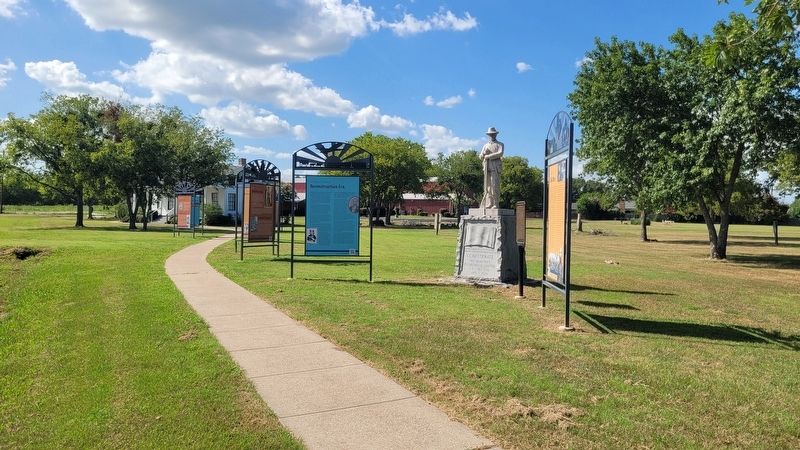
Other nearby markers. At least 8 other markers are within walking distance of this marker: Early Twentieth Century (here, next to this marker); Greenville Confederate Memorial (here, next to this marker); Aztec Eagles (here, next to this marker); 1926 Confederate Soldier Statue (here, next to this marker); Civil War (here, next to this marker); African American Community (a few steps from this marker); Black Education (a few steps from this marker); Early Industry & Business (within shouting distance of this marker). Touch for a list and map of all markers in Greenville.
Also see . . .
1. Reconstruction Era. Audie Murphy / American Cotton Museum (Submitted on August 26, 2025, by James Hulse of Medina, Texas.)
2. Hardin Hart, Homer Horton and Chester Williams. Audie Murphy / American Cotton Museum (Submitted on August 26, 2025, by James Hulse of Medina, Texas.)
Credits. This page was last revised on August 27, 2025. It was originally submitted on August 26, 2025, by James Hulse of Medina, Texas. This page has been viewed 118 times since then and 46 times this year. Photos: 1, 2, 3. submitted on August 27, 2025, by James Hulse of Medina, Texas.
