Greenville in Hunt County, Texas — The American South (West South Central)
Aztec Eagles
Majors Field
⎯⎯⎯
People
Photographed by James Hulse, July 28, 2025
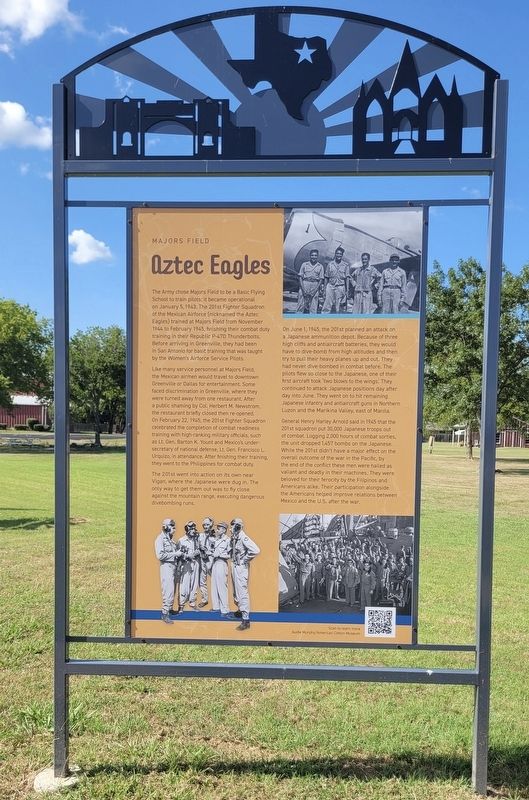
1. Aztec Eagles Marker
Like many service personnel at Majors Field, the Mexican airmen would travel to downtown Greenville or Dallas for entertainment. Some faced discrimination in Greenville, where they were turned away from one restaurant. After a public shaming by Col. Herbert M. Newstrom, the restaurant briefly closed then re-opened. On February 22, 1945, the 201st Fighter Squadron celebrated the completion of combat readiness training with high-ranking military officials, such as Lt. Gen. Barton K. Yount and Mexico's under-secretary of national defense, Lt. Gen. Francisco L. Urquizo, in attendance. After finishing their training. they went to the Philippines for combat duty.
The 201st went into action on its own near Vigan, where the Japanese were dug in. The only way to get them out was to fly close against the mountain range, executing dangerous divebombing runs.
On June 1, 1945, the 201st planned an attack on a Japanese ammunition depot. Because of three high cliffs and antiaircraft batteries, they would have to dive-bomb from high altitudes and then try to pull their heavy planes up and out. They had never dive-bombed in combat before. The pilots flew so close to the Japanese, one of their first aircraft took two blows to the wings. They continued to attack Japanese positions day after day into June. They went on to hit remaining Japanese infantry and antiaircraft
this page online
General Henry Harley Arnold said in 1945 that the 201st squadron put 30,000 Japanese troops out of combat. Logging 2,000 hours of combat sorties, the unit dropped 1,457 bombs on the Japanese. While the 201st didn't have a major effect on the overall outcome of the war in the Pacific, by the end of the conflict these men were hailed as valiant and deadly in their machines. They were beloved for their ferocity by the Filipinos and Americans alike. Their participation alongside the Americans helped improve relations between Mexico and the U.S. after the war.
Reverse Side
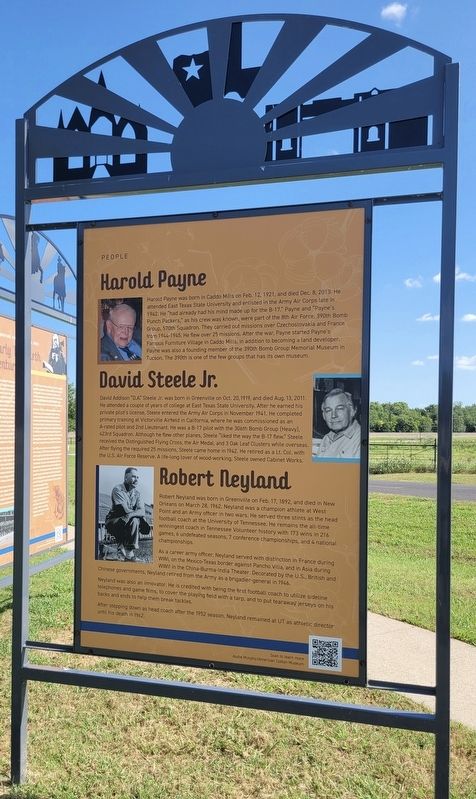
Harold Payne
Harold Payne was born in Caddo Mills on Feb. 12, 1921, and died Dec. 8, 2013. He attended East Texas State University and enlisted in the Army Air Corps late in 1942. He "had already had his mind made up for the B-17." Payne and "Payne's Punch Packers," as his crew was known, were part of the 8th Air Force, 390th Bomb Group, 570th Squadron. They carried out missions over Czechoslovakia and France from 1944-1945. He flew over 25 missions. After the war, Payne started Payne's Famous Furniture
Photographed by James Hulse, July 28, 2025
2. Aztec Eagles Marker - Reverse Side
David Steele Jr.
David Addison "D.A." Steele Jr. was born in Greenville on Oct. 20, 1919, and died Aug. 13, 2011. He attended a couple of years of college at East Texas State University. After he earned his private pilot's license, Steele entered the Army Air Corps in November 1941. He completed primary training at Victorville Airfield in California, where he was commissioned as an A-rated pilot and 2nd Lieutenant. He was a B-17 pilot with the 306th Bomb Group (Heavy), 423rd Squadron. Although he flew other planes, Steele "liked the way the B-17 flew." Steele received the Distinguished Flying Cross, the Air Medal, and 3 Oak Leaf Clusters while overseas. After flying the required 25 missions, Steele came home in 1942. He retired as a Lt. Col. with the U.S. Air Force Reserve. A life-long lover of wood-working, Steele owned Cabinet Works.
Robert Neyland
Robert Neyland was born in Greenville on Feb. 17, 1892, and died in New
Photographed by James Hulse, July 28, 2025
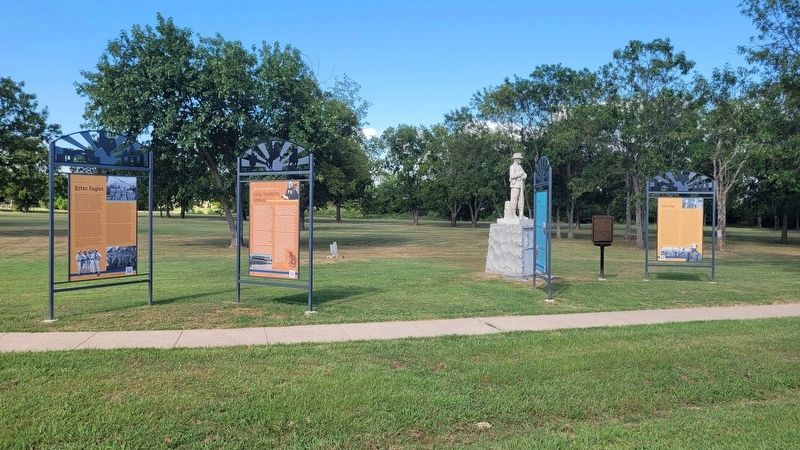
3. Aztec Eagles Marker (left side)
As a career army officer, Neyland served with distinction in France during WWI, on the Mexico-Texas border against Pancho Villa, and in Asia during WWII in the China-Burma-India Theater. Decorated by the U.S., British and Chinese governments, Neyland retired from the Army as a brigadier-general in 1946.
Neyland was also an innovator. He is credited with being the first football coach to utilize sideline telephones and game films, to cover the playing field with a tarp, and to put tearaway jerseys on his backs and ends to help them break tackles.
After stepping down as head coach after the 1952 season, Neyland remained at UT as athletic director until his death in 1962.
Erected by Audie Murphy / American Cotton Museum.
Topics. This historical marker is listed in these topic lists: Hispanic Americans • War, World II. A significant historical date for this entry is January 5, 1943.
Location. 33° 7.502′ N, 96° 5.34′ W. Marker is in Greenville, Texas, in Hunt County. It is on Interstate 30 Frontage Road ¼ mile Division Street, on the right when traveling west. The marker is located on the grounds of the Audie Murphy / American Cotton Museum. Touch for map. Marker is at or near this postal address: 600 I-30 Frontage Rd, Greenville TX 75401, United States of America. Touch for directions.

Regionally, this marker is in the Prairies & Lakes Region and in the Dallas-Fort Worth Metropolitan Area. It is also in the American South. Globally, it is in North America, a Gulf of Mexico state, the Western Hemisphere, the Western World, and the Anglosphere. Historically, it finds itself in what was once New Spain, the Republic of Texas, one of the Confederate States of America, and the Antebellum South.
Other nearby markers. At least 8 other markers are within walking distance of this marker: Early Twentieth Century (here, next to this marker); Reconstruction Era (here, next to this marker); Greenville Confederate Memorial (a few steps from this marker); 1926 Confederate Soldier Statue (a few steps from this marker); Civil War (a few steps from this marker); African American Community (a few steps from this marker); Black Education (a few steps from this marker); Early Industry & Business (a few steps from this marker). Touch for a list and map of all markers in Greenville.
Also see . . .
1. Harold Payne, David Steele and Robert Neyland. Audie Murphy / American Cotton Museum (Submitted on August 26, 2025, by James Hulse of Medina, Texas.)
2. Aztec Eagles. Audie Murphy / American Cotton Museum (Submitted on August 26, 2025, by James Hulse of Medina, Texas.)
Credits. This page was last revised on August 27, 2025. It was originally submitted on August 26, 2025, by James Hulse of Medina, Texas. This page has been viewed 130 times since then and 38 times this year. Photos: 1, 2, 3. submitted on August 27, 2025, by James Hulse of Medina, Texas.
