River Arts District in Asheville in Buncombe County, North Carolina — The American South (South Atlantic)
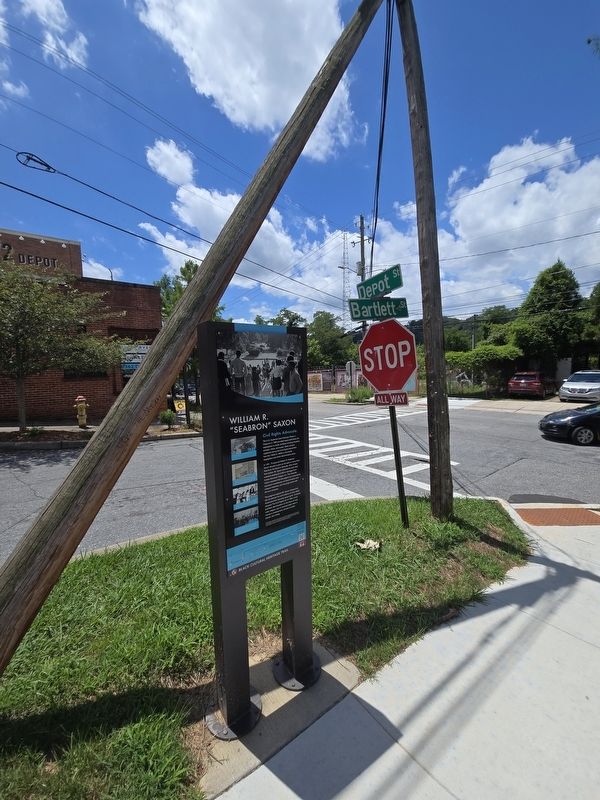
William R. "Seaborn" Saxon
Civil Rights Advocate
| — | Black Cultural Heritage Trail | — |

Photographed by Mark Parker, July 18, 2025
1. William R. "Seaborn" Saxon Marker
In 1951, 75-year-old William R. "Seabron" Saxon refused to give up his seat on a bus from Atlanta to his home in Asheville. After threats from police, Mr. Saxon relented but later a lawsuit seeking $15,000 in damages from Smoky Mountain Stages, Inc. The Asheville Citizen reported that the judge's jury instructions bypassed consideration of discrimination and unequal treatment, and the judge sided with the bus company.
The judgment against Mr. Saxon delayed but did not prevent him and millions of other Black Americans from securing equal rights. Congress adopted The Civil Rights Act of 1964, which prohibits discrimination on the basis of race, color, religion, sex or national origin when it comes to employment, access to public places, and voting.
(captions)
Top: The fight for equality didn't end after public schools in America integrated. Black students protested unequal treatment in their newly integrated Asheville High School in 1969. The students staged a walkout to show solidarity and support for the demands. ©Roger Ball/Charlotte/NC
1940: Photo of Colored waiting area sign at a bus station in Durham, North Carolina (1940). Library of Congress
1948 an architectural rendering of the Paramount Theater at 118 E. College Street. The front entrance, shown on the right, was for White patrons. A door shown on the other side of the building, shown on the left, was for Black patrons. Black people set in the balcony. White people set in the audience closer to the stage. renovations of the Paramount Theater, 1848, Henry Irven Gaines, Six Associates, Western Regional Archives.
1960s before integration, the Asheville colored library was the only public library available to Black Ashevillians. Irene O. Hendrick, pictured here, helping three young patrons, was The first and only librarian. She served from 1927 until 1961. The library was renamed The Eagle-Market Street Branch. Buncombe County Special Collections, Pack Memorial Public Library Asheville North Carolina.
1960s Civil rights leaders met with President John F. Kennedy in the Oval Office of the White House after the March on Washington, D. C. Third from the left is civil rights leader Martin Luther King, Jr. To his right is John Lewis, Chairman of the Student Nonviolent Coordinating Committee, who later served in the United States House of Representatives for 33 years. Seventh from the left is A. Philip Randolph, organizer of the demonstration and a labor leader who helped found The Brotherhood of The Sleeping Car Porters (August 28th, 1963) National Archives and Records Administration
Erected by Black
this page online
Topics. This historical marker is listed in these topic lists: African Americans • Civil Rights. A significant historical year for this entry is 1951.
Location. 35° 34.876′ N, 82° 33.856′ W. Marker is in Asheville, North Carolina, in Buncombe County. It is in the River Arts District. It is at the intersection of Bartlett Street and Depot Street, on the left when traveling east on Bartlett Street. Touch for map. Marker is at or near this postal address: 183 Bartlett St, Asheville NC 28801, United States of America. Touch for directions.

Regionally, this marker is in the Mountains. It is also in the American South, specifically in the Upper South, in Appalachia, and specifically in Southern Appalachia. Globally, it is in North America, the Western Hemisphere, the Western World, and the Anglosphere. Historically, it finds itself in what was once the original Cherokee Nation, the territory of the Mississippian Culture, one of the original Thirteen Colonies, one of the Confederate States of America, and the Antebellum South.
Other nearby markers. At least 8 other markers are
Photographed by Mark Parker, July 18, 2025
2. Wide view of William R. "Seaborn" Saxon Marker at Bartlett & Depot Streets
Also see . . . William R. “Seabron” Saxon.
Learn about Mr. William R. “Seabron” Saxon who refused to give up his seat on a bus from Atlanta to his home in Asheville, four years before Rosa Parks did the same during the Montgomery bus boycott.(Submitted on August 27, 2025, by Mark Parker of Hickory, North Carolina.)
Credits. This page was last revised on August 28, 2025. It was originally submitted on August 27, 2025, by Mark Parker of Hickory, North Carolina. This page has been viewed 137 times since then and 57 times this year. Photos: 1, 2. submitted on August 27, 2025, by Mark Parker of Hickory, North Carolina. • Bernard Fisher was the editor who published this page.
