Regierungsvierte in Berlin in Mitte, Germany — Northeast German Plain (The European Plain)
Leonhard Euler
Photographed by Andrew Ruppenstein, August 27, 2025
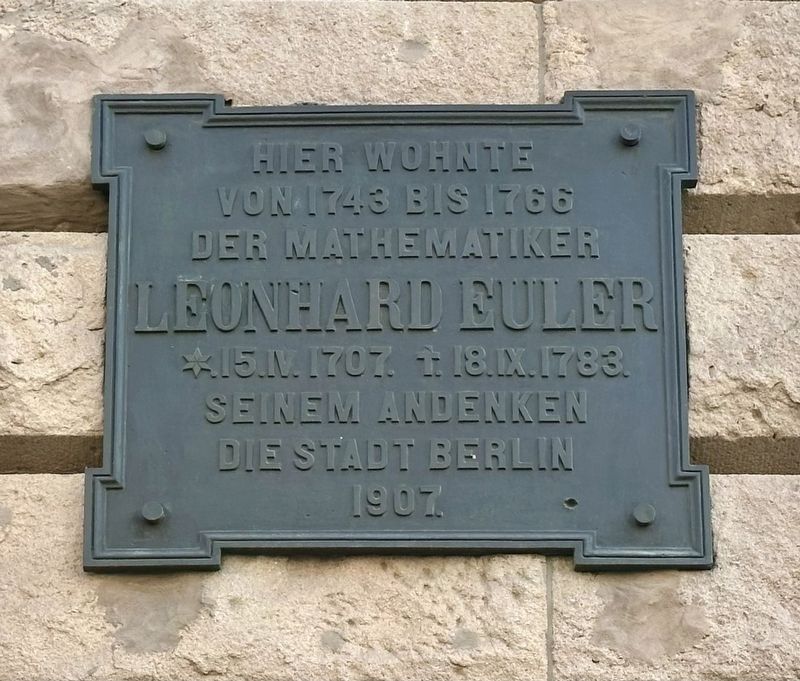
1. Leonhard Euler Marker

von 1743 bis 1766
der mathematiker
Leonhard Euler
✶.15.IV.1707. †.18.IX.1783.
Seinem Andenken
Die Stadt Berlin
1907
Here from 1743 to 1766 lived the mathematician Leonhard Euler (born April 15, 1707, died September 18, 1783). Erected in his memory by the City of Berlin, 1907.
Erected 1907 by Stadt Berlin.
Topics. This historical marker is listed in this topic list: Science & Medicine. A significant historical date for this entry is April 15, 1707.
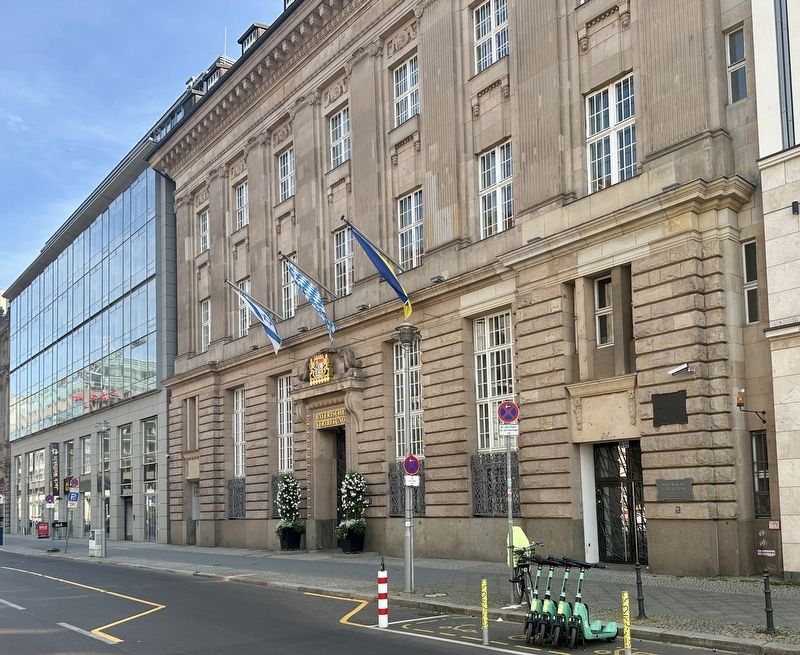
Location. 52° 30.926′ N, 13° 23.247′ E. Marker is in Berlin, in Mitte. It is in Regierungsvierte. It is on Behrenstraße west of Friedrichstraße, on the right when traveling east. Touch for map. Marker is at or near this postal address: Behrenstraße 21-22, Berlin 10117, Germany. Touch for directions.

Regionally, it is in Europe, the European Union, Atlantic Europe, Central Europe, the Schengen Area, Western Europe, and the Western World. Historically, it finds itself in what was once the Holy Roman Empire, the former East Germany, and at the Berlin Wall.
Other nearby markers. At least 8 other markers are within walking distance of this
this page online
Also see . . . Leonhard Euler (Wikipedia). Excerpt:
Leonhard Euler (15 April 1707 – 18 September 1783) was a Swiss polymath who was active as a mathematician, physicist, astronomer, logician, geographer, and engineer. He founded the studies of graph theory and topology and made influential discoveries in many other branches of mathematics, such as analytic number theory, complex analysis, and infinitesimal calculus. He also introduced(Submitted on August 27, 2025.)much of modern mathematical terminology and notation, including the notion of a mathematical function. He is known for his work in mechanics, fluid dynamics, optics, astronomy, and music theory. Euler has been called a "universal genius" who "was fully equipped with almost unlimited powers of imagination, intellectual gifts and extraordinary memory". He spent most of his adult life in Saint Petersburg, Russia, and in Berlin, then the capital of Prussia.Photographed by Andrew Ruppenstein, August 27, 20252. Leonhard Euler Marker - wide view
Euler is credited for popularizing the Greek letter π to denote the ratio of a circle's circumference to its diameter, as well as first using the notation ƒ(x) for the value of a function, the letter i to express the imaginary unit of the square root of -1, the Greek letter Σ to express summations, the Greek letter Δ for finite differences, and lowercase letters to represent the sides of a triangle while representing the angles as capital letters. He gave the current definition of the constant e, the base of the natural logarithm, now known as Euler's number…
Additional keywords. Gedenktafel
Credits. This page was last revised on October 26, 2025. It was originally submitted on August 27, 2025, by Andrew Ruppenstein of Lamorinda, California. This page has been viewed 105 times since then and 29 times this year. Photos: 1, 2. submitted on August 27, 2025, by Andrew Ruppenstein of Lamorinda, California.
