River Arts District in Asheville in Buncombe County, North Carolina — The American South (South Atlantic)
Asheville's Southside
1920s-1960s
| — | Black Cultural Heritage Trail | — |
Photographed by Mark Parker, July 18, 2025
1. Asheville's Southside Marker
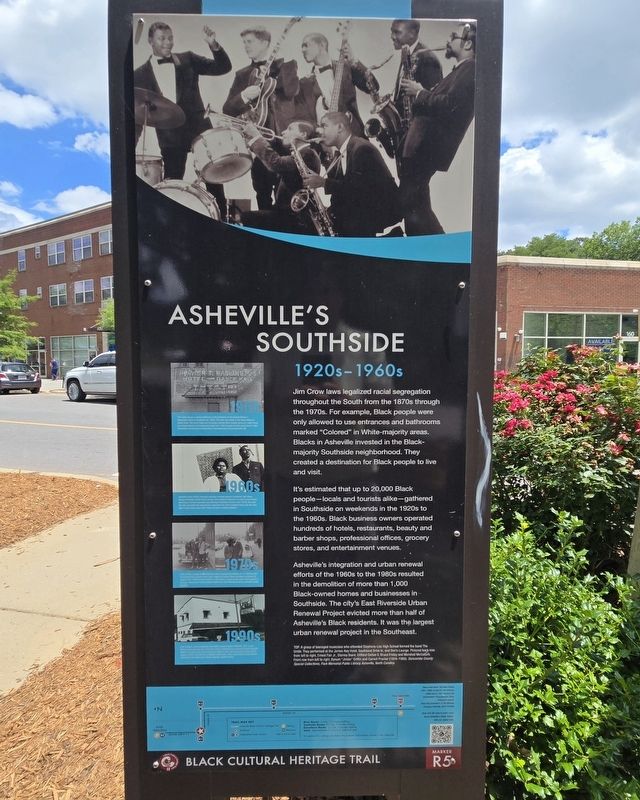
It's estimated that up to 20,000 Black people—locals and tourists alike—gathered in Southside on weekends in the 1920s to the 1960s. Black business owners operated hundreds of hotels, restaurants, beauty and barber shops, professional offices, grocery stores, and entertainment venues.
Asheville's integration and urban renewal efforts of the 1960s to the 1980s resulted in the demolition of more than 1,000 Black-owned homes and businesses in Southside. The city's East Riverside Urban Renewal Project evicted more than half of Asheville's Black residents. It was the largest urban renewal project in the Southeast.
(cpations)
Top: A group of teenaged musicians who attended Stevens-Lee High School formed the band The Untils. They performed at the James-Key Hotel, Southland Drive-In, and Owl's Lounge. Pictured back row from left to right, Ernest Fair, Jr. Stanley Baird, Clifford Cotton II, Bruce Friday and Marshall McCallum. Front row from left to right, Bynum "Jimbo" Griffin and the Cornell Proctor (1959-1960). Buncombe County Special Collections, pack Memorial Public Library, Asheville, North Carolina
(Captions)
1968 This picture shows a painted billboard on the brickwork of the original Booker T. Washington Hotel in Southside. (ca. 1960.) The hotel was listed in The Negro Motorist Green Book. The Green Book, as it is known, offered Black people options for safer travel and entertainment in the American South from 1936 through its final publication in 1967.Buncombe County Special Collections, Pack Memorial Public Library, Asheville, North Carolina
1960s Asheville native Shirley Hemphill attended comedy shows in Southside. Her father, George Hemphill, owned Owl's Lounge. She attended Stephens-Lee High School before becoming a famous comedian and starring in television shows in the 1970s,'80s, and '90s. Miss Hemphill was awarded the superlative for most congenial along with Mr. Alvin Byrd in their senior year book. Photo courtesy of Alberta Williams
1970s in the 1970s, A series of R&B and soul clubs occupied the building at 101 Biltmore Ave. The Orange Peel, pictured here, was a nightclub where Black teenagers socialized. It closed in the 1980s but was reborn in 2002 when a venue by the same named open in its place. Buncombe County Special Collections, Park Memorial Public Library, Asheville, North Carolina
1990s Fred Simpson, whose nickname was Rabbit, opened Rabbit's Motel in 1947. It was Black-owned and was one of the few motels in Asheville that welcomed Black travelers. Rabbit's included a bar and a restaurant, Rabbit's Cafe, which served soul food until it closed in 2004. Pictured here is Rabbit's Motel (late 1990s).Buncombe County Special Collections, Pack Memorial Public Library, Asheville, North Carolina
Erected by Black
this page online
Topics. This historical marker is listed in these topic lists: African Americans • Civil Rights • Entertainment • Industry & Commerce. A significant historical year for this entry is 1968.
Location. 35° 34.78′ N, 82° 33.859′ W. Marker is in Asheville, North Carolina, in Buncombe County. It is in the River Arts District. It is on Depot Street 0.1 miles south of Bartlett Street, on the right when traveling south. Touch for map. Marker is at or near this postal address: 401 Depot St, Asheville NC 28801, United States of America. Touch for directions.

Regionally, this marker is in the Mountains. It is also in the American South, specifically in the Upper South, in Appalachia, and specifically in Southern Appalachia. Globally, it is in North America, the Western Hemisphere, the Western World, and the Anglosphere. Historically, it finds itself in what was once the original Cherokee Nation, the territory of the Mississippian Culture, one of the original Thirteen Colonies, one of the Confederate States of America, and the Antebellum South.
Other nearby markers. At least 8 other markers are within walking distance of this marker: William R. "Seaborn" Saxon (about 600 feet away, measured in a direct line); America's First Black Union Represents Ashevillians (approx. 0.2 miles away); Unsung Builders of the Swannanoa Tunnel (approx. 0.3 miles away); The Asheville Black Cultural Heritage Trail / Asheville's Black Newspapers / The Flood of 1916 (approx. 0.4 miles away); Welcome to the River Arts District (approx. 0.4 miles away); Electric Streetcars (approx. half a mile away); St. Genevieve ~ Of ~ The ~ Pines (approx. ¾ mile away); Smith-McDowell House (approx. ¾ mile away). Touch for a list and map of all markers in Asheville.
Also see . . .
1. Asheville’s Southside 1920s-1960s.
Learn about the historical Asheville Black neighborhood, "Southside." It is estimated that up to 20,000 Black people - locals and tourists alike - gathered in Southside on weekends in the 1920s to the 1960s.(Submitted on August 27, 2025, by Mark Parker of Hickory, North Carolina.)
2. The Evolution of Asheville’s Rabbit’s Motel and Restaurant. More about Rabbit's Motel and Restaurant, as mentioned in the marker's sidebar
Rabbit’s Motel and Restaurant is an important part of Asheville’s history and was considered one of the crown jewels of Black-owned tourist courts when it opened. Owner Fred “Rabbit” Simpson played host to a who’s who of Black travelers at the motel, including Richard Pryor and Duke Ellington, while also serving his local community in the Southside neighborhood.(Submitted on August 27, 2025, by Mark Parker of Hickory, North Carolina.)
Credits. This page was last revised on August 28, 2025. It was originally submitted on August 27, 2025, by Mark Parker of Hickory, North Carolina. This page has been viewed 108 times since then and 33 times this year. Photo 1. submitted on August 27, 2025, by Mark Parker of Hickory, North Carolina. • Bernard Fisher was the editor who published this page.
Editor’s want-list for this marker. Wide shot of marker and its surroundings. • Can you help?
