Staunton, Virginia — The American South (Mid-Atlantic)
Farming and Freedom at Montgomery Hall
| — | The Long Road To Freedom | — |
Photographed by Bradley Owen, July 21, 2025
1. Farming and Freedom at Montgomery Hall Marker
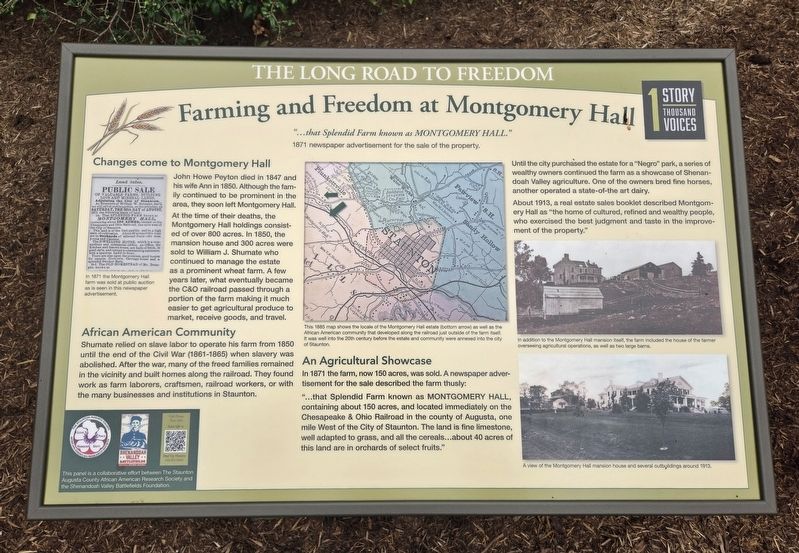
"...that Splendid Farm known as MONTGOMERY HALL."
1871 newspaper advertisement for the sale of the property.
Changes come to Montgomery Hall
John Howe Peyton died in 1847 and his wife Ann in 1850. Although the family continued to be prominent in the area, they soon left Montgomery Hall.
At the time of their deaths, the Montgomery Hall holdings consisted of over 800 acres. In 1850, the mansion house and 300 acres were sold to William J. Shumate who continued to manage the estate as a prominent wheat farm. A few years later, what eventually became the C&O railroad passed through a portion of the farm making it much easier to get agricultural produce to market, receive goods, and travel.
African American Community
Shumate relied on slave labor to operate his farm from 1850 until the end of the Civil War (1861-1865) when slavery was abolished. After the war, many of the freed families remained in the vicinity and built homes along the railroad. They found work as farm laborers, craftsmen, railroad workers, or with the many businesses and institutions in Staunton.
An Agricultural Showcase
In 1871 the
this page online
"...that Splendid Farm known as MONTGOMERY HALL, containing about 150 acres, and located immediately on the Chesapeake & Ohio Railroad in the county of Augusta, one mile West of the City of Staunton. The land is fine limestone, well adapted to grass, and all the cereals...about 40 acres of this land are in orchards of select fruits."
Until the city purchased the estate for a "Negro" park, a series of wealthy owners continued the farm as a showcase of Shenandoah Valley agriculture. One of the owners bred fine horses, another operated a state-of-the art dairy.
About 1913, a real estate sales booklet described Montgomery Hall as "the home of cultured, refined and wealthy people, who exercised the best judgment and taste in the improvement of the property."
(Captions):
In 1871 the Montgomery Hall farm was sold at public auction as is seen in this newspaper advertisement.
This 1885 map shows the locale of the Montgomery Hall estate (bottom arrow) as well as the African American community that developed along the railroad just outside of the farm itself. It was well into the 20th century before the estate and community were annexed into the city of Staunton.
In addition to the Montgomery Hall mansion itself, the farm included the house of the farmer overseeing agricultural operations, as well as two large barns.
A view of the Montgomery Hall mansion house and several outbuildings around 1913.
Erected 2025
Photographed by Bradley Owen, July 21, 2025
2. Farming and Freedom at Montgomery Hall Marker
Marker is in the center.
Topics. This historical marker is listed in these topic lists: African Americans • Agriculture • Industry & Commerce • Railroads & Streetcars. A significant historical year for this entry is 1871.
Location. 38° 8.73′ N, 79° 5.52′ W. Marker is in Staunton, Virginia. It is on Kenneth Jones Drive 0.2 miles west of Montgomery Avenue, on the left when traveling west. Marker is located in Montgomery Hall Park. Touch for map. Marker is at or near this postal address: 1100 Montgomery Avenue, Staunton VA 24401, United States of America. Touch for directions.

Regionally, this marker is in the Shenandoah Valley. It is also in the American South and specifically in the Upper South. Globally, it is in North America, the Western Hemisphere, the Western World, and the Anglosphere. Historically, it finds itself in what was once the territory of the Mississippian Culture, one of the original Thirteen Colonies, one of the Confederate States of America, and the Antebellum South.
Other nearby markers. At least 8 other markers are within walking distance of this marker: A Mansion in the New Republic: (here, next to this marker); Montgomery Hall (here, next to this marker); The Long Road to Freedom (a few steps from this marker); Held in Bondage (a few steps from this marker); Shining Light on Their Humanity (a few steps from this marker); An African American Haven Becomes Reality (a few steps from this marker); The Montgomery Hall Park Recreation Committee (within shouting distance of this marker); A Beacon of Light Across Virginia (within shouting distance of this marker). Touch for a list and map of all markers in Staunton.
Credits. This page was last revised on August 30, 2025. It was originally submitted on August 28, 2025, by Bradley Owen of Morgantown, West Virginia. This page has been viewed 108 times since then and 32 times this year. Photos: 1, 2. submitted on August 30, 2025, by Bradley Owen of Morgantown, West Virginia.
