Staunton, Virginia — The American South (Mid-Atlantic)
Montgomery Hall
(The Irene Givens Building)
| — | The Long Road To Freedom | — |
Photographed by Bradley Owen, July 21, 2025
1. Montgomery Hall Marker
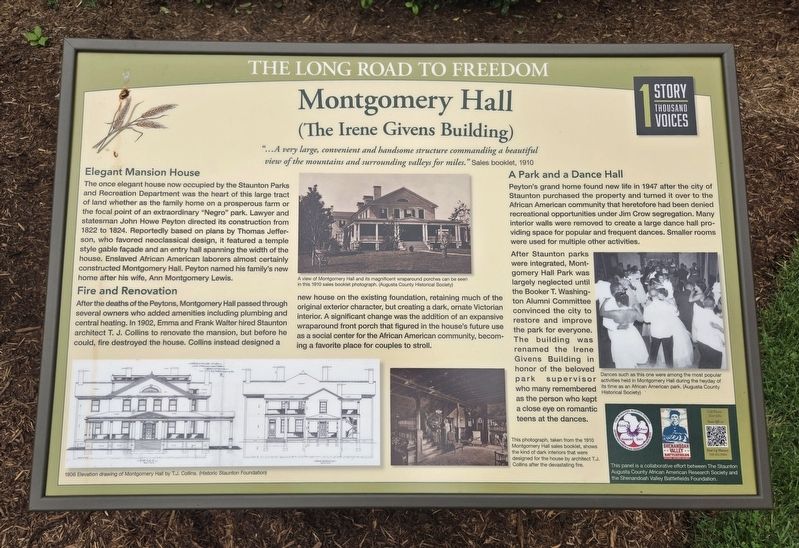
"...A very large, convenient and handsome structure commanding a beautiful view of the mountains and surrounding valleys for miles." Sales booklet, 1910
Elegant Mansion House
The once elegant house now occupied by the Staunton Parks and Recreation Department was the heart of this large tract of land whether as the family home on a prosperous farm or the focal point of an extraordinary "Negro" park. Lawyer and statesman John Howe Peyton directed its construction from 1822 to 1824. Reportedly based on plans by Thomas Jefferson, who favored neoclassical design, it featured a temple style gable façade and an entry hall spanning the width of the house. Enslaved African American laborers almost certainly constructed Montgomery Hall. Peyton named his family's new home after his wife, Ann Montgomery Lewis.
Fire and Renovation
After the deaths of the Peytons, Montgomery Hall passed through several owners who added amenities including plumbing and central heating. In 1902, Emma and Frank Walter hired Staunton architect T. J. Collins to renovate the mansion, but before he could, fire destroyed the house. Collins instead
this page online
A Park and a Dance Hall
Peyton's grand home found new life in 1947 after the city of Staunton purchased the property and turned it over to the African American community that heretofore had been denied recreational opportunities under Jim Crow segregation. Many interior walls were removed to create a large dance hall providing space for popular and frequent dances. Smaller rooms were used for multiple other activities.
After Staunton parks were integrated, Montgomery Hall Park was largely neglected until the Booker T. Washington Alumni Committee convinced the city to restore and improve the park for everyone. The building was renamed the Irene Givens Building in honor of the beloved park supervisor who many remembered as the person who kept a close eye on romantic
Photographed by Bradley Owen, July 21, 2025
2. Montgomery Hall Marker
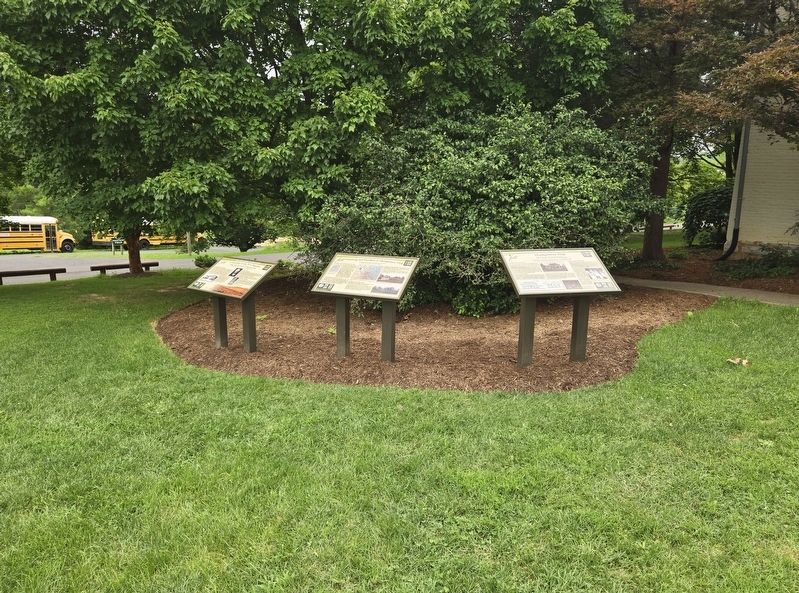
Marker is on the right.
(Captions):
1906 Elevation drawing of Montgomery Hall by T.J. Collins. (Historic Staunton Foundation)
A view of Montgomery Hall and its magnificent wraparound porches can be seen in this 1910 sales booklet photograph. (Augusta County Historical Society)
Dances such as this one were among the most popular activities held in Montgomery Hall during the heyday of its time as an African American park. (Augusta County Historical Society)
This photograph, taken from the 1910 Montgomery Hall sales booklet, shows the kind of dark interiors that were designed for the house by architect T.J. Collins after the devastating fire.
Erected 2025 by Shenandoah Valley Battlefields Foundation. (Marker Number 3.)
Topics. This historical marker is listed in these topic lists: African Americans • Architecture • Notable Buildings • Parks & Recreational Areas. A significant historical year for this entry is 1910.
Location. 38° 8.729′ N, 79° 5.519′ W. Marker is in Staunton, Virginia. It is on Kenneth Jones Drive 0.2 miles west of Montgomery Avenue, on the left when traveling west. Marker is located in Montgomery Hall Park. Touch for map. Marker is at or near this postal address: 1100 Montgomery Avenue, Staunton VA 24401, United States of America. Touch for directions.

Regionally, this marker is in the Shenandoah Valley. It is also in the American South and specifically in the Upper South. Globally, it is in North America, the Western Hemisphere, the Western World, and the Anglosphere. Historically, it finds itself in what was once the territory of the Mississippian Culture, one of the original Thirteen Colonies, one of the Confederate States of America, and the Antebellum South.
Other nearby markers. At least 8 other markers are within walking distance of this marker: Farming and Freedom at Montgomery Hall (here, next to this marker); A Mansion in the New Republic: (here, next to this marker); The Long Road to Freedom (a few steps from this marker); Held in Bondage (a few steps from this marker); Shining Light on Their Humanity (a few steps from this marker); An African American Haven Becomes Reality (a few steps from this marker); The Montgomery Hall Park Recreation Committee (within shouting distance of this marker); A Beacon of Light Across Virginia (within shouting distance of this marker). Touch for a list and map of all markers in Staunton.
Credits. This page was last revised on August 30, 2025. It was originally submitted on August 28, 2025, by Bradley Owen of Morgantown, West Virginia. This page has been viewed 100 times since then and 36 times this year. Photos: 1, 2. submitted on August 30, 2025, by Bradley Owen of Morgantown, West Virginia.
