Shonkin in Chouteau County, Montana — The American West (Mountains)
Land of Many Uses
⎯⎯⎯
Sulphur Springs Hiking Trail
⎯⎯⎯
Lewis and Clark Reach the Rapids
Photographed by Barry Swackhamer, July 26, 2025
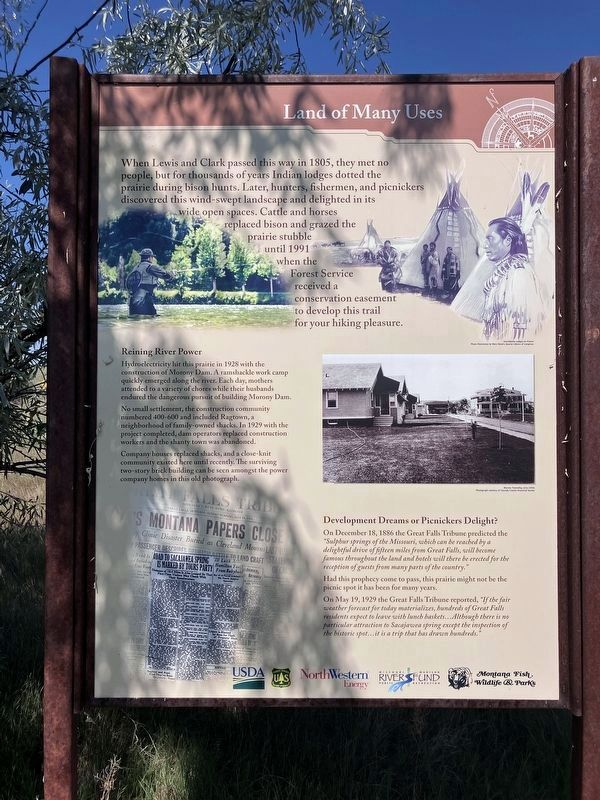
1. Land of Many Uses marker (panel on the left)
Captions: (upper right) Assinoboine Lodges on the Prairiew; (middle right) Morony Township circa 1930s; (bottom left) Newspaper article of "Sacajawea Springs."
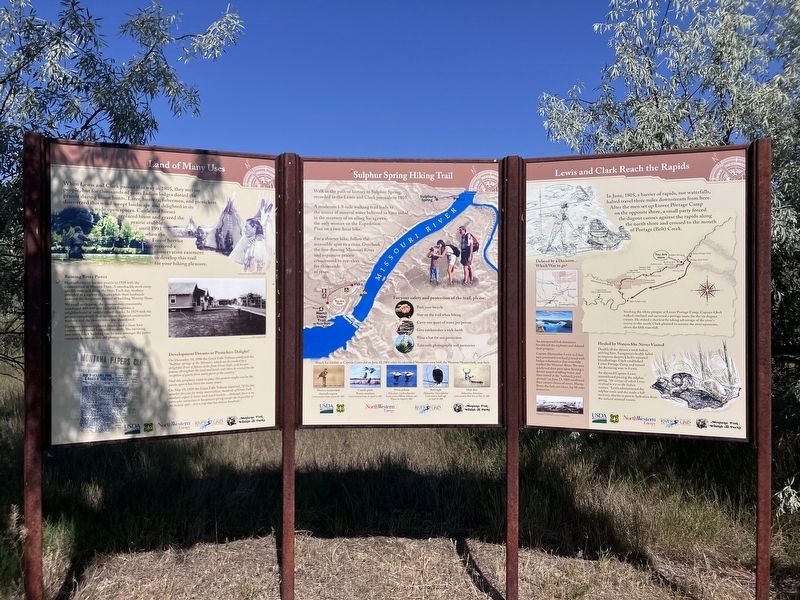
When Lewis and Clark passed this way in 1805, they met no people but for thousands of years Indian lodges dotted the prairie during bison hunts. Later, hunters, fishermen, and picnickers discovered this wind-swept landscape and delighted in its wide open spaces. Cattle and horses replaced bison and grazed the prairie stubble until 1991 when the Forest Service received a conservation easement to develop this trail for your hiking pleasure.
Reining River Power
Hydroelectricity hit this prairie in 1928 with the construction of Morony Dam. A ramshackle work camp quickly emerged along the river. Each day, mothers attended to a variety of chores while their husbands endured the dangerous pursuit of building Morony Dam.
No small settlement, the construction community numbered 400-600 and included Ragtown, a neighborhood of family-owned shacks. In 1929 with the dam project completed, dam operators replace construction workers and the shanty town was abandoned.
Company houses replaced shacks, and
this page online
Development Dreams or Picnickers Delight?
On December 18, 1886 the Great Falls Tribune predicted the "Sulphur springs of the Missouri, which can be reached by a delightful drive of fifteen miles from Great Falls, will become famous through the land and hotels be erected for the reception of guests from many parts of the country."
Had this prophecy come to pass, this prairie might not be the picnic spot it has been for many years.
On May 19, 1929 the Great Falls Tribune reported, "if the fair weather forecast for today materializes, hundreds of Great Falls residents expect to leave with baskets,…Although there is no particular attraction to Sacajawea spring except the inspection of the historic spot…it is a trip that has drawn hundreds."
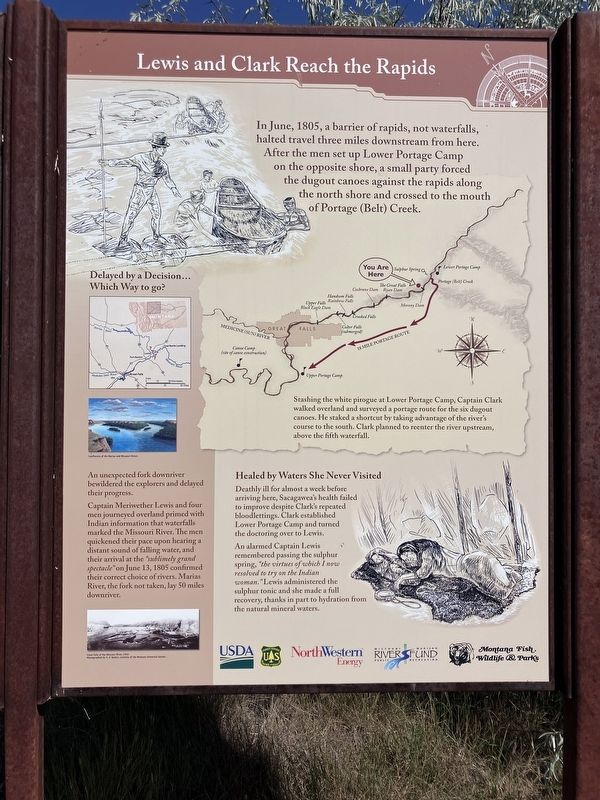
In June, 1805, a barrier of rapids, not waterfalls, halted travel three miles downstream from here. After the men set up Lower Portage Camp on the opposite shore, a small party forced
Photographed by Barry Swackhamer, July 26, 2025
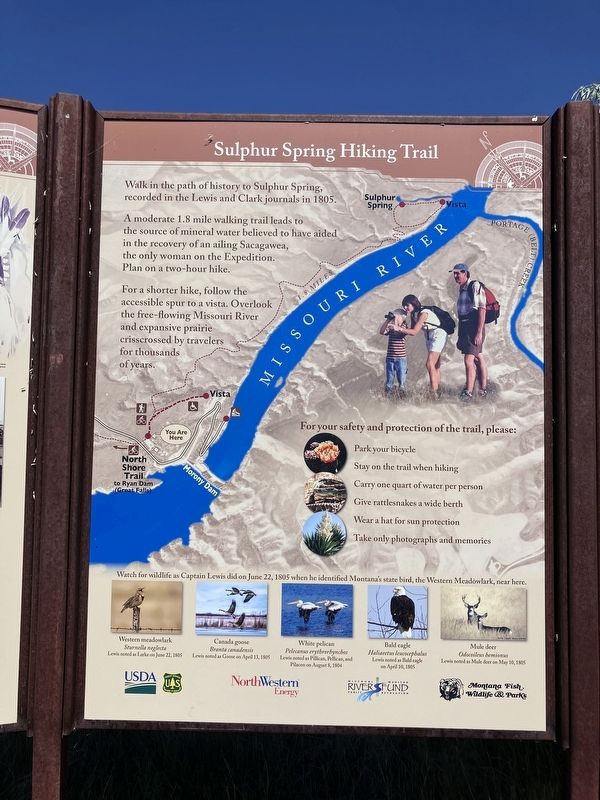
2. Sulphur Springs Hiking Trail marker (center panel)
Healed by Waters She Never Visited
Deathly ill for almost a week before arriving here, Sacagawea's health failed to improve despite Clark's related bloodlettings. Clark established Lower Portage Camp and turned the doctoring over to Lewis.
An alarmed Captain Lewis remembered passing the sulphur spring, "the virtues of which I now resolved to try on the Indian woman." Lewis administered the sulphur tonic and she made a full recovery, thanks in part to hydration from the natural mineral waters.
(sidebar on left:)
Delayed by a Decision…Which Way to go?
An unexpected fork downriver bewildered the explorers and delayed their progress.
Captain Meriwether Lewis and four men journeyed overland primed with Indian information that waterfalls marked the Missouri River. The men quickened their pace upon hearing a distant sound of falling water, and their arrival at the :sublimely grand spectacle" on June 13, 1805 confirmed their correct choice of rivers. Marias River, the fork not taken, lay 50 miles downriver.
Erected by U.S.
Photographed by Barry Swackhamer, July 26, 2025
3. Lewis and Clark Reach the Rapids mrker (panel on the right)
(arrow pointing to:) At the mouth of Portage (Belt) Creek, the men felled a lone cottonwood tree and cut solid wheels for carts to transport the canoes over the portage.
Topics and series. This historical marker is listed in these topic lists: Exploration • Man-Made Features. In addition, it is included in the Lewis & Clark Expedition series list. A significant historical date for this entry is May 19, 1929.
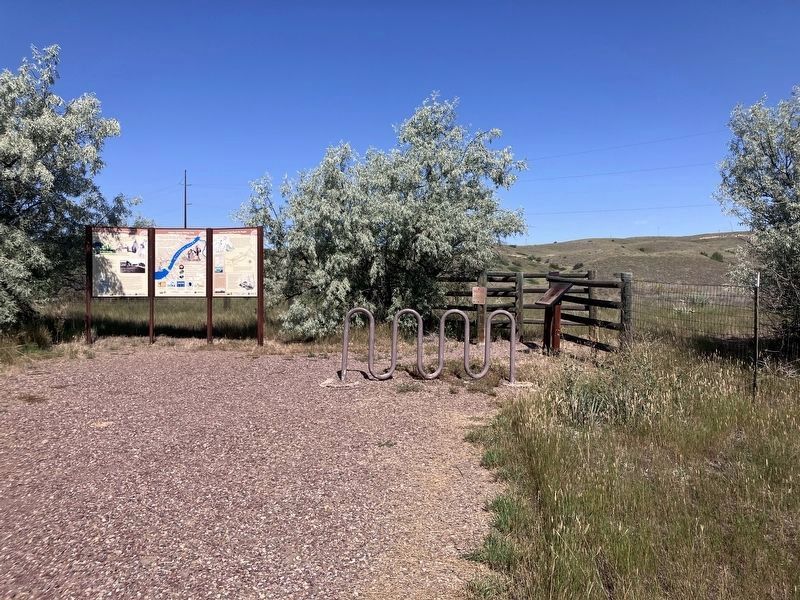
Location. 47° 34.933′ N, 111° 3.88′ W. Marker is in Shonkin, Montana, in Chouteau County. It is on Morony Dam Road near Sulphur Springs Road, on the left when traveling south. The marker(s) are located at the Sulphur Springs Trail trailhead. Touch for map. Marker is in this post office area: Highwood MT 59450, United States of America. Touch for directions.

Regionally, this marker is in Central Montana, in Missouri River Country, and specifically in Russell Country. It is also in the American Mountain West and in the Lewis & Clark Corridor. Globally, it is in North America, the Western Hemisphere, the Western World, and the Anglosphere. Historically, it finds itself in what was once Rupert’s Land and also the Louisiana Purchase.
Other nearby markers. At least 8 other markers are within 3 miles of this marker,
Photographed by Barry Swackhamer, July 26, 2025
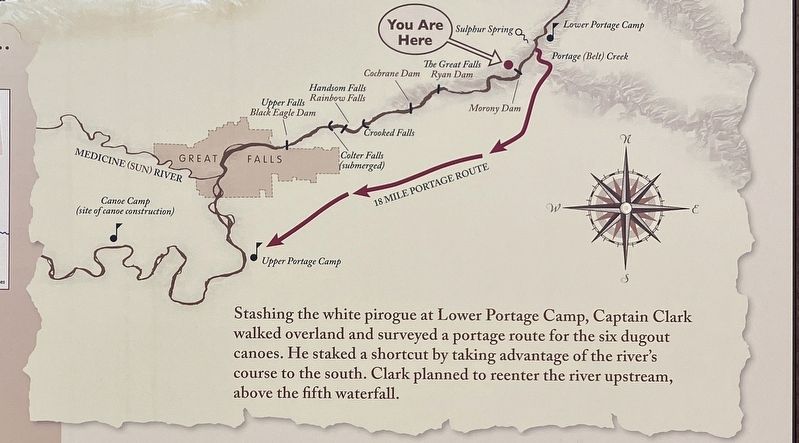
4. Lewis and Clark Reach the Rapids Marker, insert of portage route
Caption: Stashing the white pirogue at Lower Portage Camp, Captain Clark walked overland and surveyed a portage route for the six dugout canoes. He staked a shortcut by taking advantage of the river's course to the south. Clark planned to reenter the river system, above the fifth waterfall.
Photographed by Barry Swackhamer, July 26, 2025
5. Land of Many Uses / Sulphur Springs Hiking Trail / Lewis and Clark Reach the Rapids Marker
Photographed by Barry Swackhamer, July 26, 2025
6. Sulphur Springs Hiking Trail Marker and trailhead
Credits. This page was last revised on August 28, 2025. It was originally submitted on August 28, 2025, by Barry Swackhamer of Brentwood, California. This page has been viewed 117 times since then and 38 times this year. Photos: 1, 2, 3, 4, 5, 6. submitted on August 28, 2025, by Barry Swackhamer of Brentwood, California.
