South Slope Brewing District in Asheville in Buncombe County, North Carolina — The American South (South Atlantic)
The National Housing Act of 1934
Urban Renewal in Asheville
| — | Black Cultural Heritage Trail | — |
Photographed by Mark Parker, July 18, 2025
1. The National Housing Act of 1934 Marker
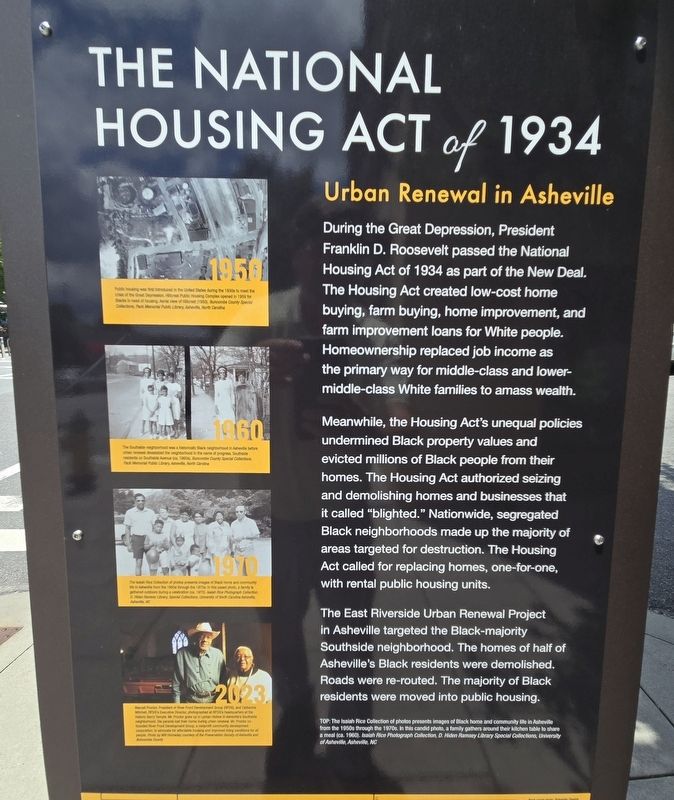
Meanwhile, the Housing Act's unequal policies undermined Black property values and evicted millions of Black people from their homes. The Housing Act authorized seizing and demolishing homes and businesses that it called "blighted." Nationwide, segregated Black neighborhoods made up the majority of areas targeted for destruction. The Housing Act called for replacing homes, one-for-one, with rental public housing units.
The East Riverside Urban Renewal Project in Asheville targeted the Black-majority Southside neighborhood. The homes of half of Asheville's Black residents were demolished. Roads were re-routed. The majority of Black residents were moved into public housing.
(captions)
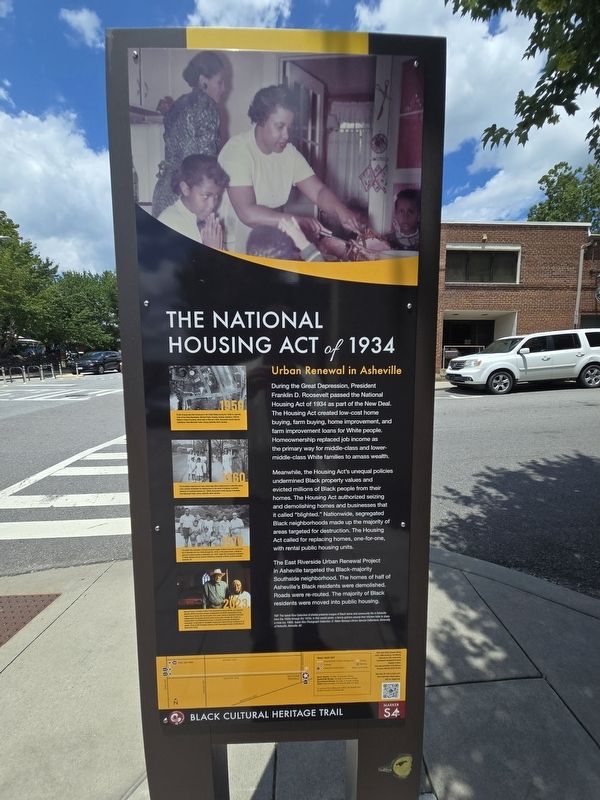
Top: The Isaiah Rice Collection of photos presents images of Black home and community life in Asheville from the 1950s through the 1970s. In this candid photo, a family gathers around their kitchen table to share a meal (ca. 1960). Isaiah Rice Photograph Colection, D. Hiden Ramsey Library Special Collections, University of Asheville, Asheville, NC
1950 Public housing was first introduced in the United States during the 1930s to meet the crisis of the Great Depression. Hillcrest Public Housing Complex opened in 1959 for Blacks in need of housing. Aerial view of Hillcrest (1950). Buncombe County Special Collections, Pack Memorial Public Library, Asheville, North Carolina
1960 The Southside neighborhood was a historically Black neighborhood in Asheville before urban renewal devastated the neighborhood in the name of progress. Southside residents on Southside Avenue (ca. 1960s). Buncombe County Special Collections, Pack Memorial Public Library, Asheville, North Carolina
1970 The Isaiah Rice Collection of photos presents images of Black home and community life in Asheville from the 1950s through the 1970s. In this posed photo, a family is gathered outdoors during a celebration. (ca. 1970s). Isaiah Rice Photograph Collection, D. Hiden Ramsey Library, Special Collections, University of North Carolina Asheville, Asheville, NC
2023 Marcell Proctor, President of River Front Development Group (RFDG), and Caroline Mitchell RFDG's Executive Director, photographed at RFDG's headquarters at the historic Berry Temple. Mr. Proctor grew up in Lyman Hollow in Asheville's Southside neighborhood. His parents lost their home during urban renewal. Mr. Proctor co-founded River Front Development Group, a nonprofit community development corporation, to advocate for affordable housing and improved living conditions for all people. Photo by William Hornaday courtesy of the Preservation Society of Asheville and Buncombe County
Erected by Black
this page online
Topics. This historical marker is listed in these topic lists: African Americans • Charity & Public Work • Civil Rights. A significant historical year for this entry is 1934.
Location. 35° 35.353′ N, 82° 33.283′ W. Marker is in Asheville, North Carolina, in Buncombe County. It is in the South Slope Brewing District. It is at the intersection of Coxe Avenue and Banks Avenue, on the right when traveling north on Coxe Avenue. Touch for map. Marker is at or near this postal address: 150 Coxe Ave, Asheville NC 28801, United States of America. Touch for directions.

Regionally, this marker is in the Mountains. It is also in the American South, specifically in the Upper South, in Appalachia, and specifically in Southern Appalachia. Globally, it is in North America, the Western Hemisphere, the Western World, and the Anglosphere. Historically, it finds itself in what was once the original Cherokee Nation, the territory of the Mississippian Culture, one of the original Thirteen Colonies, one of the Confederate States of America, and the Antebellum South.
Other nearby markers. At
Photographed by Mark Parker, July 18, 2025
2. Full view of The National Housing Act of 1934 Marker
Another marker is no longer nearby. Daniel K. Moore (was approx. ¼ mile away but has been confirmed missing).
Photographed by Mark Parker, July 18, 2025
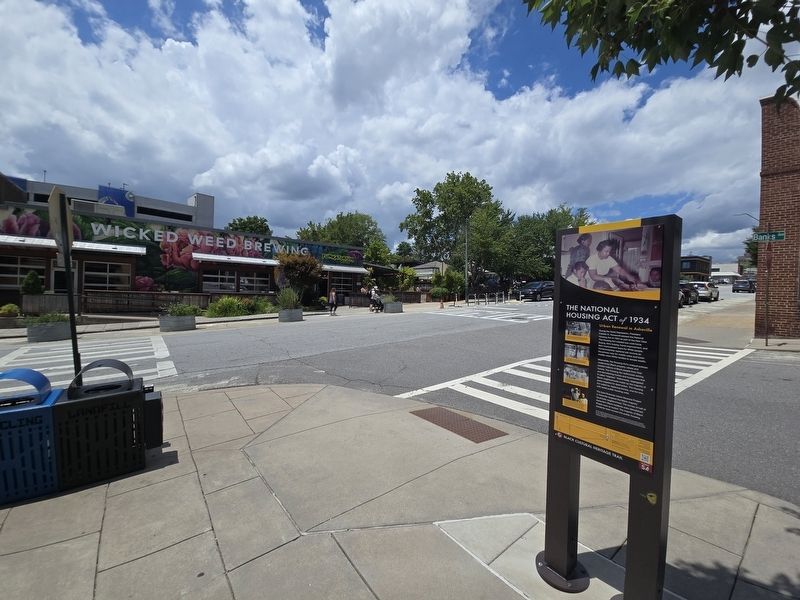
3. Wide view The National Housing Act of 1934 Marker at Coxe/ Banks Aves.
Credits. This page was last revised on August 29, 2025. It was originally submitted on August 28, 2025, by Mark Parker of Hickory, North Carolina. This page has been viewed 67 times since then and 15 times this year. Photos: 1, 2, 3. submitted on August 28, 2025, by Mark Parker of Hickory, North Carolina. • Bernard Fisher was the editor who published this page.
