Niagara-on-the-Lake in Niagara Region, Ontario — Central Canada (North America)
Niagara-on-the-Lake Historical District
L'Arrondissement Historique de Niagara-on-the-Lake
Photographed by Lora Szloh, November 14, 2009
1. Niagara On The Lake Historical District Marker

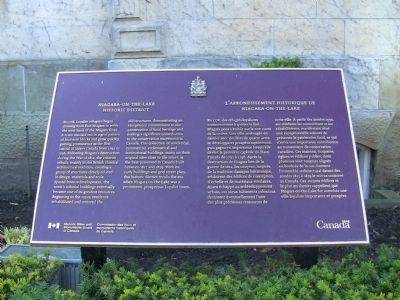
Niagara-on-the-Lake Historical District
In 1778, Loyalist refugees began crossing from Fort Niagara to settle the west bank of the Niagara River. A town was laid out in a grid pattern of four-acre blocks and grew quickly, gaining prominence as the first capital of Upper Canada from 1792 to 1796. Following Niagara’s destruction during the War of 1812, the citizens rebuilt, mainly in the British classical architectural tradition, creating a group of structures closely related in design, materials and scale. Spared from redevelopment, the town’s colonial buildings eventually became one of its greatest resources. Beginning in the 1950s, residents rehabilitated and restored the old structures, demonstrating an exceptional commitment to the preservation of local heritage and making a significant contribution to the conservation movement in Canada. This collection of residential, commercial, ecclesiastical and institutional buildings, many on their original sites close to the street, is the best-preserved in Canada built between 1815 and 1859. With its early buildings and grid street plan, this historic district recalls
this page online
En 1778, des réfugiés loyalistes commencèrent à quitter le fort Niagara pour s'établir sur la rive ouest de la rivière. Une ville aménagée en damier avec de îlots de quatre acres se développa et prospéra rapidement, puis gagna en importance lorsqu'elle devint la première capitale du Haut-Canada de 1792 à 1796. Après la destruction de Niagara lors de la guerre de 1812, les citoyens, inspirés de la tradition classique britannique, rebâtirent des édifices de conception, d'échelle et de matériaux similaires. Ayant échappé au redéveloppement urbain, ces vieux bâtiments coloniaux devinrent éventuellement l'une de plus précieuses ressources de cette ville. À partir des années 1950, ses résidants les restaurèrent et les réhabilitèrent, manifestant ainsi une exceptionnelle volonté de préserver la patrimoine local, ce qui s'avéra une importante contribution au mouvement de la conservation canadien.Ces maisons, magasins, églises et édifaces publics, dont plusieurs sont toujours alignés en bordure de la rue, forment
Photographed by Lora Szloh, November 14, 2009
2. Niagara On The Lake Historical District Marker
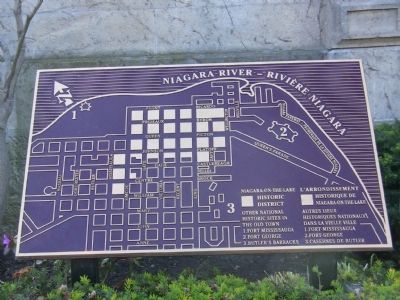
This bilingual map is just to the left of same marker on Courthouse saying historical district.
Erected by Historic Sites and Monuments Board of Canada.
Topics and series. This historical marker is listed in these topic lists: Government & Politics • Landmarks • Notable Buildings. In addition, it is included in the Canada, Historic Sites and Monuments Board series list. A significant historical year for this entry is 1778.
Location. 43° 15.301′ N, 79° 4.306′ W. Marker is in Niagara-on-the-Lake, Ontario, in Niagara Region. It is on Queen Street, on the right when traveling east. The marker, a maroon plaque mounted on posts, is 2 metres west of the stairway to the front entrance of the old courthouse. Touch for map. Marker is at or near this postal address: 26 Queen Street, Niagara-on-the-Lake ON L0S 1J0, Canada. Touch for directions.

Regionally, this marker is on the Golden Horseshoe and in Niagara Canada. It is also in Central Canada. Globally, it is in North America, on the Great Lakes,
Photographed by Lora Szloh, November 14, 2009
3. Niagara On The Lake Historical District Marker
Since someone planted a tree in front of this, I can't tell what it is or reads. But it is on the left side of court house building to the left of main marker.
Other nearby markers. At least 8 other markers are within walking distance of this marker: Niagara District Court House / Le palais de justice du district de Niagara (here, next to this marker); Niagara Court House (here, next to this marker); In Grateful Memory Of Henry Paffard 1824-1912 (here, next to this marker); Near This Spot Stood The Government House (here, next to this marker); William Kirby (here, next to this marker); Niagara Light Dragoons Memorial (a few steps from this marker); Town of Niagara-on-the-Lake Official Flag (a few steps from this marker); Niagara-on-the-Lake Cenotaph and Clock Tower (a few steps from this marker). Touch for a list and map of all markers in Niagara-on-the-Lake.
Regarding Niagara-on-the-Lake Historical District. This plaque describes the federal designation of Niagara-on-the-Lake's "old town" as a "historical place". This designation has no legal impact
Photographed by Kevin Westell, June 2, 2025
4. Niagara on the Lake Historical District - Marker in context
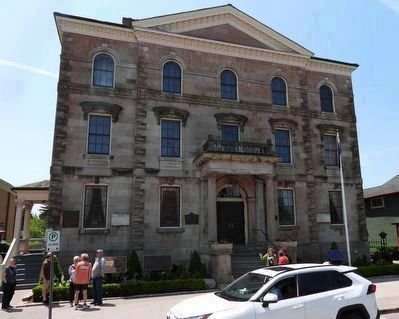
Both this maroon plaque and its "map plaque" are 2 metres left of the stairs to the building entrance.
The Old Courthouse is *festooned* with historic plaques - 6 left of the doors, and 2 on the right. There is another (not visible in photo) near an entrance door on the left exterior wall.
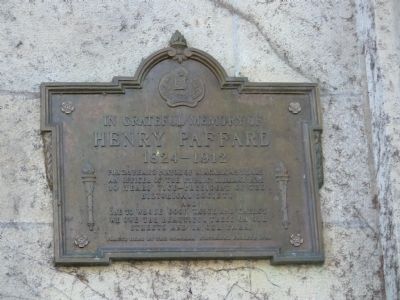
Photographed by Lora Szloh, November 14, 2009
5. In Grateful Memory Of Henry Paffard
1824-1912
For 26 years Mayor of Niagara 45 years. An officer of the public library and 10 years vice-president of the historyical society and to whos good taste and energy owe the beautiful trees on our streets and in our park. Placed here by the Niagara Historical Society 1924
Credits. This page was last revised on September 29, 2025. It was originally submitted on November 15, 2009, by Lora Szloh of Berea, Ohio. This page has been viewed 1,553 times since then and 35 times this year. Last updated on August 28, 2025, by Kevin Westell of St. Catharines, Ontario. Photos: 1, 2, 3. submitted on November 15, 2009, by Lora Szloh of Berea, Ohio. 4. submitted on August 28, 2025, by Kevin Westell of St. Catharines, Ontario. 5. submitted on November 15, 2009, by Lora Szloh of Berea, Ohio. • Devry Becker Jones was the editor who published this page.
