Telluride in San Miguel County, Colorado — The American Mountains (Southwest)
Transportation
| — | Telluride Local History Series | — |
Photographed by Cosmos Mariner, July 18, 2025
1. Transportation Marker
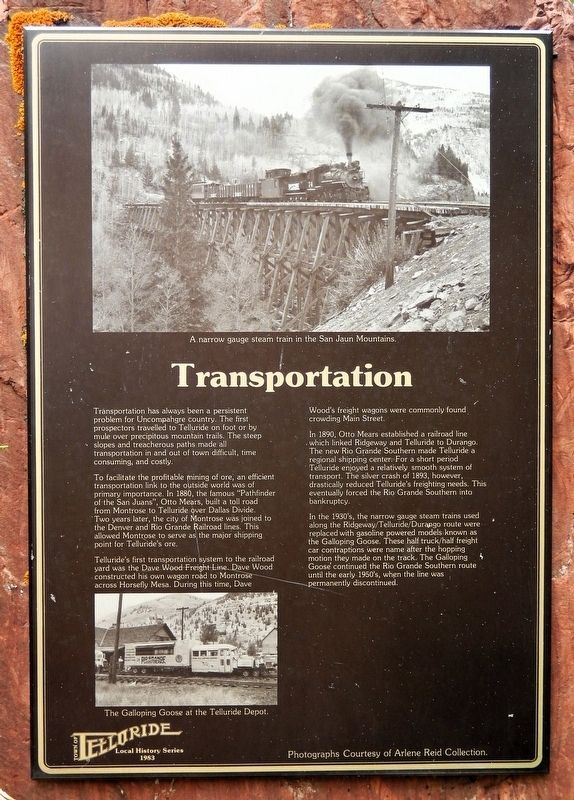
Transportation has always been a persistent problem for Uncompahgre country. The first prospectors travelled to Telluride on foot or by mule over precipitous mountain trails. The steep slopes and treacherous paths made all transportation in and out of town difficult, time consuming, and costly.
To facilitate the profitable mining of ore, an efficient transportation link to the outside world was of primary importance. In 1880, the famous “Pathfinder of the San Juans”, Otto Mears, built a toll road from Montrose to Telluride over Dallas Divide. Two years later, the city of Montrose was joined to the Denver and Rio Grande Railroad lines. This allowed Montrose to serve as the major shipping point for Telluride's ore.
Telluride's first transportation system to the railroad yard was the Dave Wood Freight Line. Dave Wood constructed his own wagon road to Montrose across Horsefly Mesa. During this time, Dave Wood's freight wagons were commonly found crowding Main Street.
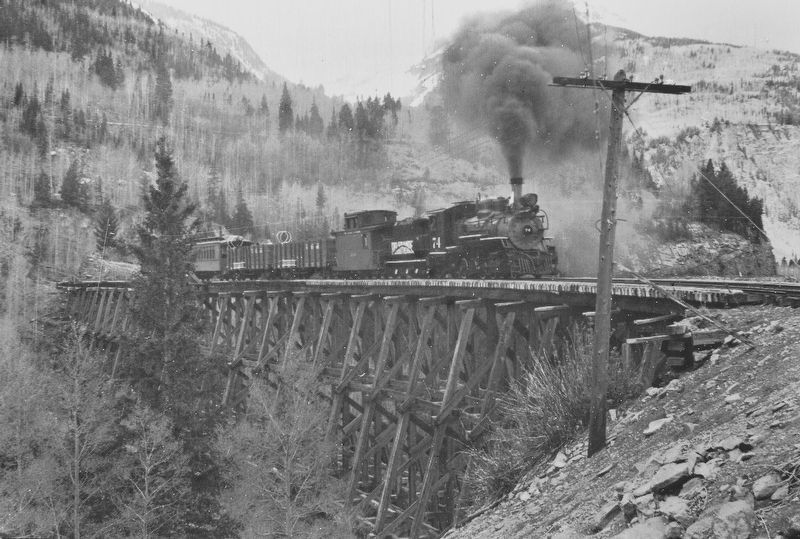
In 1890, Otto Mears established a railroad line which linked Ridgeway and Telluride to Durango. The new Rio Grande Southern made Telluride a regional shipping
this page online
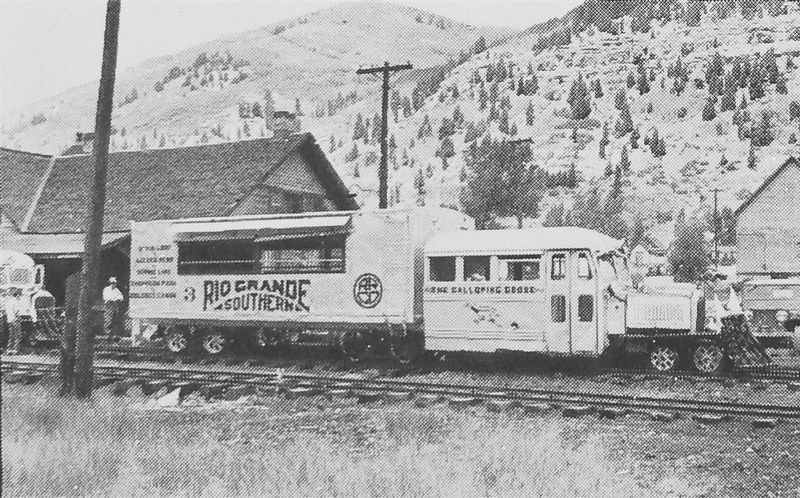
In the 1930's, the narrow gauge steam trains used along the Ridgeway/Telluride/Durango route were replaced with gasoline powered models known as the Galloping Goose. These half truck/half freight car contraptions were named after the hopping motion they made on the track. The Galloping Goose continued the Rio Grande Southern route until the early 1950's, when the line was permanently discontinued.
Erected 1983 by Town of Telluride.
Topics. This historical marker is listed in these topic lists: Industry & Commerce • Railroads & Streetcars • Roads & Vehicles. A significant historical year for this entry is 1880.
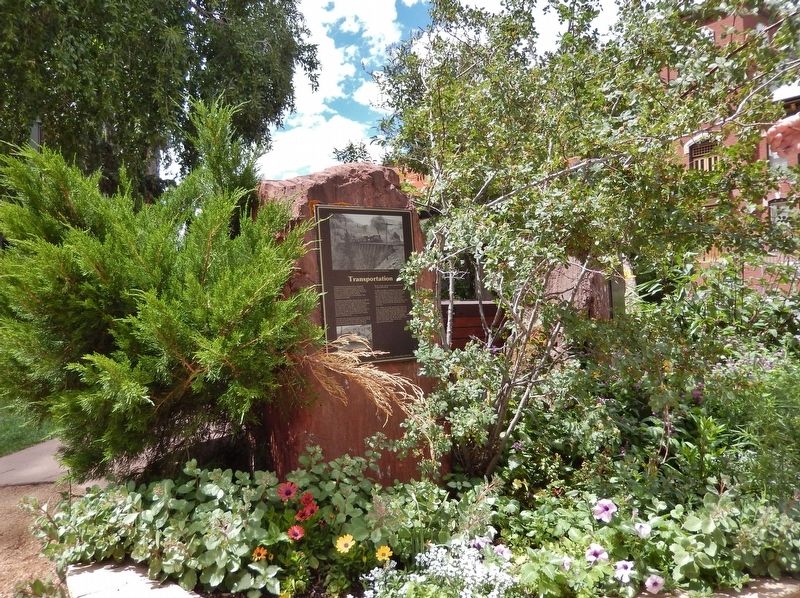
Location. 37° 56.251′ N, 107° 48.772′ W. Marker is in Telluride, Colorado, in San Miguel County. It is at the intersection of West Colorado Avenue and Oak Street (now a pedestrian walkway), on the right when traveling east on West Colorado Avenue. . The marker is located near the sidewalk,
Arlene Reid Collection
2. Narrow Gauge Steam Train in the San Juan Mountains

Regionally, this marker is in the Western Slope. It is also in the American Mountain West, on the Colorado Plateau, and at the Four Corners. Globally, it is in North America, the Rocky Mountains, the Western Hemisphere, the Western World, and the Anglosphere. Historically, it finds itself in what was once Mexico’s Alta California.
Other nearby markers. At least 8 other markers are within walking distance of this marker: New Sheridan Hotel (here, next to this marker); A Milestone in the History of Alternating Current (here, next to this marker); Telluride's Founding (here, next to this marker); Telluride (a few steps from this marker); Courthouse (within shouting distance of this marker); Colorado Centennial Project (within shouting distance of this marker); a different marker also named New Sheridan Hotel (within shouting distance of this marker); Tomboy Mine Office (within shouting distance of this marker). Touch for a list and map of all
Arlene Reid Collection
3. Marker detail: The Galloping Goose at the Telluride Depot
Also see . . .
1. Otto Mears (1840-1931) (Wikipedia).
Excerpt: Mears was known as the "Pathfinder of the San Juans" because of his road and railroad building projects through Colorado's San Juan Mountains in the late 19th century. He built hundreds of miles of toll roads in the rough terrain of the young state of Colorado. He applied to the Colorado legislature for toll road charters for his roads and built the roads in conformations and at grades suitable for railways. His routes over Poncha Pass and Marshall Pass were purchased for roadbeds by the Denver and Rio Grande railway. Mears built several railroads during his 91 years, including the Rio Grande Southern Railroad from Durango to Ridgway, the Silverton Railroad, and the Silverton Northern Railroad. Several of his railroads were narrow gauge. The panic of 1893 reduced the value of his investments. He had to sell a lot of property and lost control of his railroad holdings.(Submitted on September 2, 2025, by Cosmos Mariner of Cape Canaveral, Florida.)
2. Galloping Goose (Wikipedia).
Excerpt: Galloping Goose is the popular(Submitted on September 2, 2025, by Cosmos Mariner of Cape Canaveral, Florida.)name given to a series of seven railcars (officially designated as "motors" by the railroad), built in the 1930s by the Rio Grande Southern Railroad (RGS) and operated until the end of service on the line in the early 1950s. They were derived from full-sized automobiles.Photographed by Cosmos Mariner, July 18, 20254. Transportation MarkerLooking north through Elks Park; West Colorado Avenue is on the other side of the marker.
Originally running steam locomotives on narrow gauge railways, the perpetually struggling RGS developed the first of the "geese" as a way to keep its contract to run mail into towns in the Rocky Mountains in Colorado. There was not enough passenger or cargo income to justify continuing the expensive steam train service at then-current levels, but it was believed that a downsized railway would return to profitability. The steam trains would transport heavy cargo and peak passenger loads, but motors would handle lighter loads. Motors were not only less expensive to operate, but were also significantly lighter, thus reducing impact on the rails and roadbeds. This cost saving meant that the first Goose was paid off and making a profit within three weeks of going into service. RGS built more Geese, and operated them until the company abandoned their right-of-way in 1952.
Credits. This page was last revised on September 2, 2025. It was originally submitted on August 29, 2025, by Cosmos Mariner of Cape Canaveral, Florida. This page has been viewed 139 times since then and 73 times this year. Photos: 1, 2, 3, 4. submitted on September 2, 2025, by Cosmos Mariner of Cape Canaveral, Florida.
