Gadsden in Richland County, South Carolina — The American South (South Atlantic)
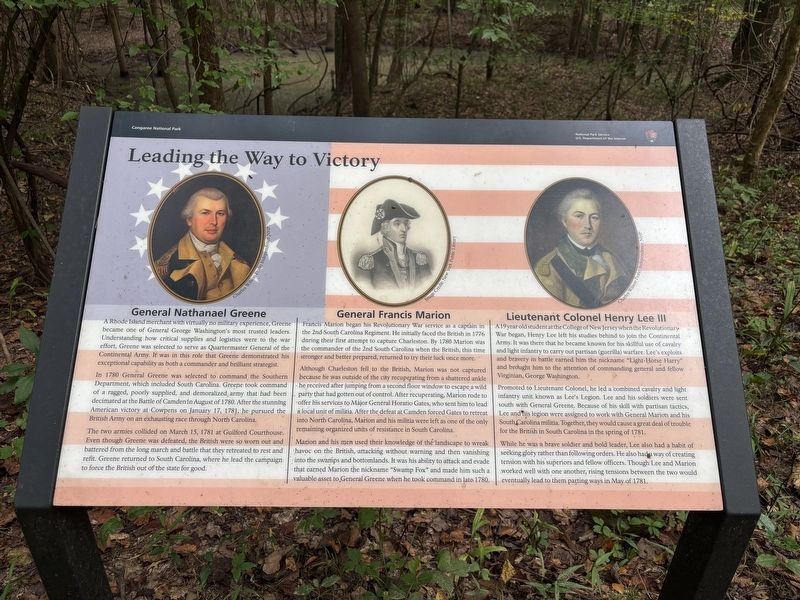
Leading the Way to Victory
| — | Congaree National Park | — |
Photographed by Benjamin Rubin, August 30, 2025
1. Leading the Way to Victory Marker
General Nathanael Greene
A Rhode Island merchant with virtually no military experience, Greene became one of General George Washington's most trusted leaders. Understanding how critical supplies and logistics were to the war effort, Greene was selected to serve as Quartermaster General of the Continental Army. It was in this role that Greene demonstrated his exceptional capability as both a commander and brilliant strategist.
In 1780 General Greene was selected to command the Southern Department, which included South Carolina. Greene took command of a ragged, poorly supplied, and demoralized army that had been decimated at the Battle of Camden in August of 1780. After the stunning American victory at Cowpens on January 17, 1781, he pursued the British Army on an exhausting race through North Carolina.
The two armies collided on March 15, 1781 at Guilford Courthouse. Even though Greene was defeated, the British were so worn out and battered from the long march and battle that they retreated to rest and refit. Greene returned to South Carolina, where he lead the campaign to force the British out of the state for
this page online
General Francis Marion
Francis Marion began his Revolutionary War service as a captain in the 2nd South Carolina Regiment. He initially faced the British in 1776 during their first attempt to capture Charleston. By 1780 Marion was the commander of the 2nd South Carolina when the British, this time stronger and better prepared, returned to try their luck once more.
Although Charleston fell to the British, Marion was not captured because he was outside of the city recuperating from a shattered ankle he received after jumping from a second floor window to escape a wild party that had gotten out of control. After recuperating, Marion rode to offer his services to Major Genéral Horatio Gates, who sent him to lead a local unit of militia. After the defeat at Camden forced Gates to retreat into North Carolina, Marion and his militia were left as one of the only remaining organized units of resistance in South Carolina.
Marion and his men used their knowledge of the landscape to wreak havoc on the British, attacking without warning and then vanishing into the swamps and bottomlands. It was his ability to attack and evade that
Photographed by Benjamin Rubin, August 30, 2025
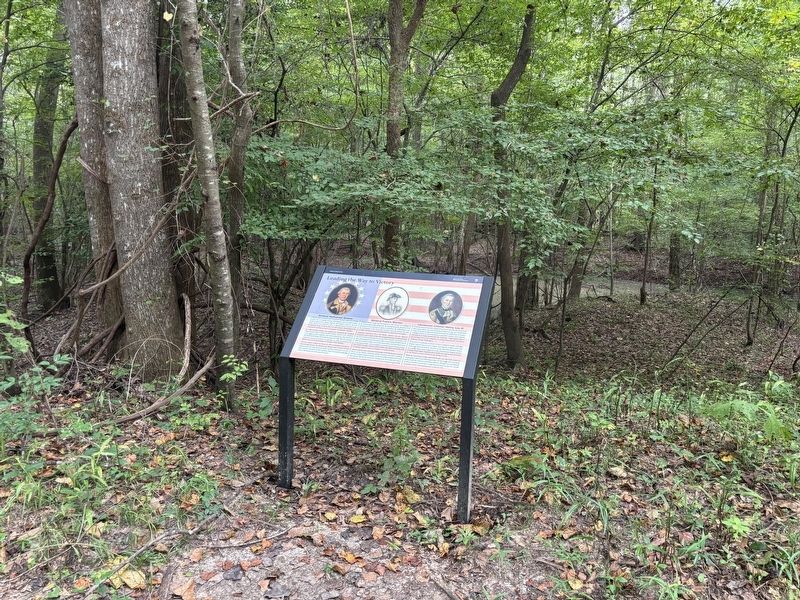
2. Leading the Way to Victory Marker
Lieutenant Colonel Henry Lee III
A 19 year old student at the College of New Jersey when the Revolutionary War began, Henry Lee left his studies behind to join the Continental Army. It was there that he became known for his skillful use of cavalry and light infantry to carry out partisan (guerrilla) warfare. Lee's exploits and bravery in battle earned him the nickname "Light-Horse Harry" and brought him to the attention of commanding general and fellow Virginian, George Washington.
Promoted to Lieutenant Colonel, he led a combined cavalry and light infantry unit known as Lee's Legion. Lee and his soldiers were sent south with General Greene. Because of his skill with partisan tactics, Lee and his legion were assigned to work with General Marion and his South Carolina militia. Together, they would cause a great deal of trouble for the British in South Carolina in the spring of 1781.
While he was a brave soldier and bold leader, Lee also had a habit of seeking glory rather than following orders. He also had a way of creating tension with his superiors and fellow officers. Though Lee and Marion worked well with one another, rising tensions between the two would eventually lead to them parting ways in May of 1781.
Erected by National Park Service, U.S. Department of the Interior.
Topics. This historical marker is listed in these topic lists: Parks & Recreational Areas • Patriots & Patriotism • War, US Revolutionary. A significant historical date for this entry is January 17, 1781.
Location. 33° 46.7′ N, 80° 38.881′ W. Marker is in Gadsden, South Carolina, in Richland County. It can be reached from U.S. 601 0.6 miles south of Bluff Road (South Carolina Route 48), on the right when traveling south. Located on the Bates Ferry Trail, 0.7 mile west of the Congaree National Park trailhead. Touch for map. Marker is in this post office area: Eastover SC 29044, United States of America. Touch for directions.

Regionally, this marker is in the Midlands, in the Greater Columbia Area, and in Congaree Country. It is also in the American South and specifically in the Deep South. Globally, it is in North America, the Western Hemisphere, the Western World, and the Anglosphere. Historically, it finds itself in what was once the territory of the Mississippian Culture, one of the original Thirteen Colonies, one of the Confederate States of America, and the Antebellum South.
Other nearby markers. At least 8 other markers are within walking distance of this marker: Rebecca Motte and the Revolution (approx. ¼ mile away); Challenging the Rebellion (approx. 0.3 miles away); "Obstinate and Strong" (approx. 0.4 miles away); The Key to the Carolinas (approx. half a mile away); McCord's Ferry: The Charleston to Camden Connection (approx. 0.7 miles away); Crossing the Congaree (approx. 0.7 miles away); What Happened to the Ferries? (approx. 0.7 miles away); Bates Ferry Trail (approx. 0.7 miles away). Touch for a list and map of all markers in Gadsden.
Also see . . . Congaree National Park. National Park Service (Submitted on September 1, 2025.)
Credits. This page was last revised on September 1, 2025. It was originally submitted on August 30, 2025, by Benjamin Rubin of Columbia, South Carolina. This page has been viewed 133 times since then and 60 times this year. Photos: 1, 2. submitted on August 30, 2025, by Benjamin Rubin of Columbia, South Carolina. • Bernard Fisher was the editor who published this page.
