Near Gadsden in Richland County, South Carolina — The American South (South Atlantic)
Challenging the Rebellion
| — | Congaree National Park | — |
Photographed by Benjamin Rubin, August 30, 2025
1. Challenging the Rebellion Marker
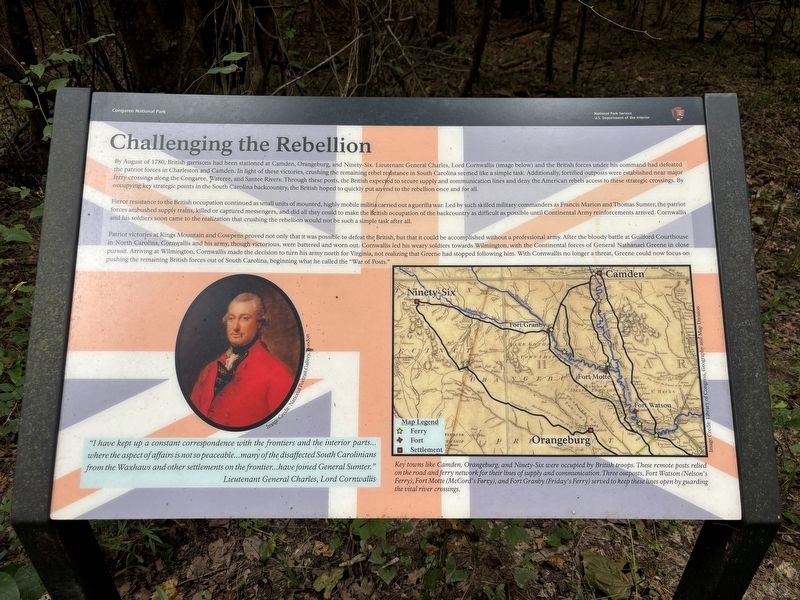
By August of 1780, British garrisons had been stationed at Camden, Orangeburg, and Ninety-Six. Lieutenant General Charles, Lord Cornwallis (image below) and the British forces under his command had defeated the patriot forces in Charleston and Camden. In light of these victories, crushing the remaining rebel resistance in South Carolina seemed like a simple task. Additionally, fortified outposts were established near major ferry crossings along the Congree, Wateree, and Santee Rivers. Through these posts, the British expected to secure supply and communication lines and deny the American rebels access to these strategic crossings. By occupying key strategic points in the South Carolina backcountry, the British hoped to quickly put an/end to the rebellion once and for all.
Fierce resistance to the British occupation continued as small units of mounted, highly mobile militia carried out a guerrilla war. Led by such skilled military commanders as Francis Marion and Thomas Sumter, the patriot forces ambushed supply trains, killed or captured messengers, and did all they could to make the British occupation of the backcountry
this page online
Patriot victories at Kings Mountain and Cowpens proved not only that it was possible to defeat the British, but that it could be accomplished without a professional army. After the bloody battle at Guilford Courthouse in North Carolina, Cornwallis and his army, though victorious, were battered and worn out. Cornwallis led his weary soldiers towards Wilmington, with the Continental forces of General Nathanael Greene in close pursuit. Arriving at Wilmington, Cornwallis made the decision to turn his army north for Virginia, not realizing that Greene had stopped following him. With Cornwallis no longer a threat, Greene could now focus on pushing the remaining British forces out of South Carolina, beginning what he called the "War of Posts."
"I have kept up a constant correspondence with the frontiers and the interior parts... where the aspect of affairs is not so peaceable... many of the disaffected South Carolinians from the Waxhaws and other settlements on the frontier... have joined General Sumter."(caption)- Lieutenant General Charles, Lord CornwallisPhotographed by Benjamin Rubin, August 30, 20252. Challenging the Rebellion Marker
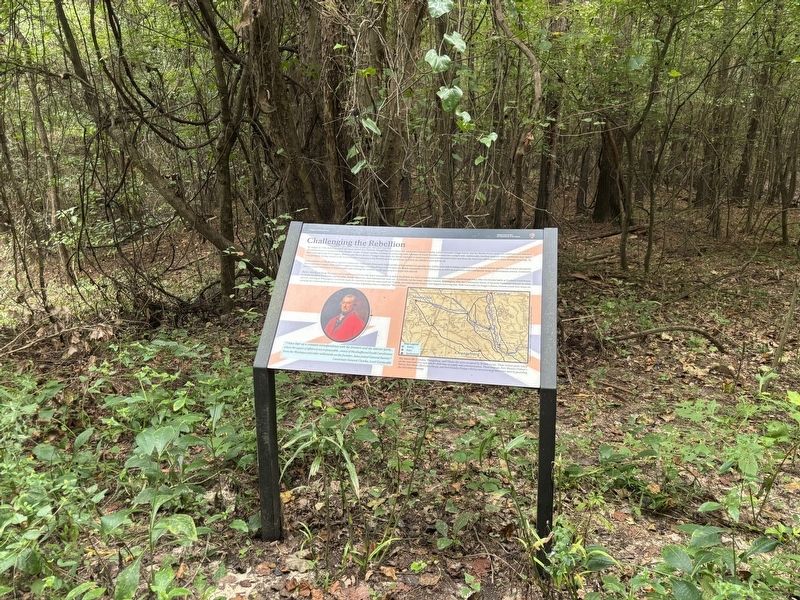
Key towns like Camden, Orangeburg, and Ninety-Six were occupied by British troops. These remote posts relied on the road and ferry network for their lines of supply and communication. Three outposts, Fort Watson (Nelson's Ferry), Fort Motte (McCord's Ferry), and Fort Granby (Friday's Ferry) served to keep these lines open by guarding the vital river crossings.
Erected by National Park Service, U.S. Department of the Interior.
Topics. This historical marker is listed in these topic lists: Parks & Recreational Areas • War, US Revolutionary. A significant historical month for this entry is August 1780.
Location. 33° 46.83′ N, 80° 38.606′ W. Marker is near Gadsden, South Carolina, in Richland County. It can be reached from U.S. 601 near Bluff Road (South Carolina Route 48), on the right when traveling south. Located on the Bates Ferry Trail, 0.4 mile west of the Congaree National Park trailhead. Touch for map. Marker is in this post office area: Eastover SC 29044, United States of America. Touch for directions.

Regionally, this marker is in the Midlands, in the Greater Columbia Area, and in Congaree Country. It is also in the American South and specifically in the Deep South. Globally, it is in North America, the Western Hemisphere, the Western World, and the Anglosphere. Historically, it finds itself in what was once the territory of the Mississippian Culture, one of the original Thirteen Colonies, one of the Confederate States of America, and the Antebellum South.
Other nearby markers. At least 8 other markers are within walking distance of this marker: The Key to the Carolinas (approx. 0.2 miles away); Leading the Way to Victory (approx. 0.3 miles away); McCord's Ferry: The Charleston to Camden Connection (approx. 0.4 miles away); Crossing the Congaree (approx. 0.4 miles away); What Happened to the Ferries? (approx. 0.4 miles away); Bates Ferry Trail (approx. 0.4 miles away); Rebecca Motte and the Revolution (approx. half a mile away); "Obstinate and Strong" (approx. 0.7 miles away). Touch for a list and map of all markers in Gadsden.
Also see . . . Congaree National Park. National Park Service (Submitted on September 1, 2025.)
Credits. This page was last revised on September 1, 2025. It was originally submitted on August 30, 2025, by Benjamin Rubin of Columbia, South Carolina. This page has been viewed 155 times since then and 60 times this year. Photos: 1, 2. submitted on August 30, 2025, by Benjamin Rubin of Columbia, South Carolina. • Bernard Fisher was the editor who published this page.
