Washington Heights in Manhattan in New York County, New York — The American Northeast (Mid-Atlantic)
Old Croton Aqueduct Trail

High Bridge, Manhattan
The Old Croton Aqueduct brought water across the Harlem River via the High Bridge, the most spectacular and technically advanced feature of New York City's first public water supply system. The original bridge, completed in 1848, was built with fifteen masonry arches, reminiscent of ancient Roman engineering. The bridge and promenade atop the bridge became a popular destination for trips to the countryside. In 1927, the arches over the main shipping channel were cut out and replaced with a single steel arch, allowing larger vessels to use the waterway.
As the city expanded into the high ground of upper Manhattan, the natural water pressure of the aqueduct's gravity-based system was not strong enough to carry water to these higher elevations. The water tower, located on the plaza above, and the reservoir, now the site of the Highbridge Pool, were built to overcome this limitation.The tower had a 47,000-gallon iron tank installed at the top so that water could be distributed under pressure to the newly settled areas in upper Manhattan.
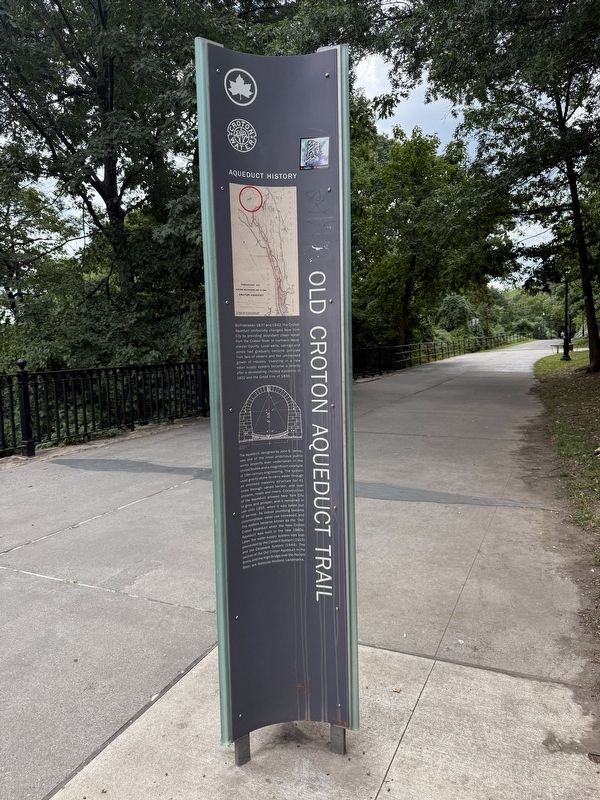
Aqueduct History
Between 1837 and 1842, the Croton Aqueduct
this page online
The aqueduct, designed by John B. Jervis, was one of the most ambitious public works projects ever undertaken in the United States and a magnificent example of 19th century engineering. The system used gravity alone to carry water through an enclosed masonry structure for 41 miles through varied terrain, and over streams, roads and rivers. Construction of the aqueduct allowed New York City to grow and prosper, and it remained in use until 1955, when it was taken out of service. As indoor plumbing became commonplace, water use increased, and this system became known as the 'Old' Croton Aqueduct when the New Croton Aqueduct was built in the late 1880s. Later, the water supply system was supplemented by the Catskill System (1915) and the Delaware System (1944). The section
Erected by NYC Parks.
Topics and series. This historical marker is listed in these topic lists: Bridges & Viaducts • Natural Features. In addition, it is included in the National Historic Landmarks, and the NYC Parks series lists. A significant historical year for this entry is 1848.
Location. 40° 50.534′ N, 73° 55.926′ W. Marker is in Manhattan, New York, in New York County. It is in Washington Heights. It can be reached from the intersection of Amsterdam Avenue and West 173rd Street, on the right when traveling north. Touch for map. Marker is in this post office area: New York NY 10033, United States of America. Touch for directions.

Regionally, this marker is in New York City. It is also in the American Northeast, in the Mid-Atlantic, and on the Eastern Seaboard. Globally, it is in the North Atlantic Region, North America, the Western Hemisphere, the Western World, and the Anglosphere. Historically, it finds itself in what was once New Netherland and also one of the original Thirteen Colonies.

Other nearby markers. At least 8 other markers are within walking distance of this marker: The High Bridge (about 500 feet away, measured in a direct line); Step Stairs (approx. 0.3 miles away); a different marker also named Old Croton Aqueduct Trail (approx. 0.3 miles away); Audubon Playground (approx. 0.3 miles away); "Listen With Me," 2021 (approx. 0.4 miles away); McNally Plaza World War I Memorial (approx. 0.4 miles away); Washington Heights-Inwood War Memorial (approx. 0.4 miles away); United Palace (approx. 0.4 miles away). Touch for a list and map of all markers in Manhattan.
Credits. This page was last revised on September 1, 2025. It was originally submitted on September 1, 2025, by Devry Becker Jones of Washington, District of Columbia. This page has been viewed 80 times since then and 20 times this year. Photos: 1, 2, 3, 4. submitted on September 1, 2025, by Devry Becker Jones of Washington, District of Columbia.
