Near Mooresville in Iredell County, North Carolina — The American South (South Atlantic)
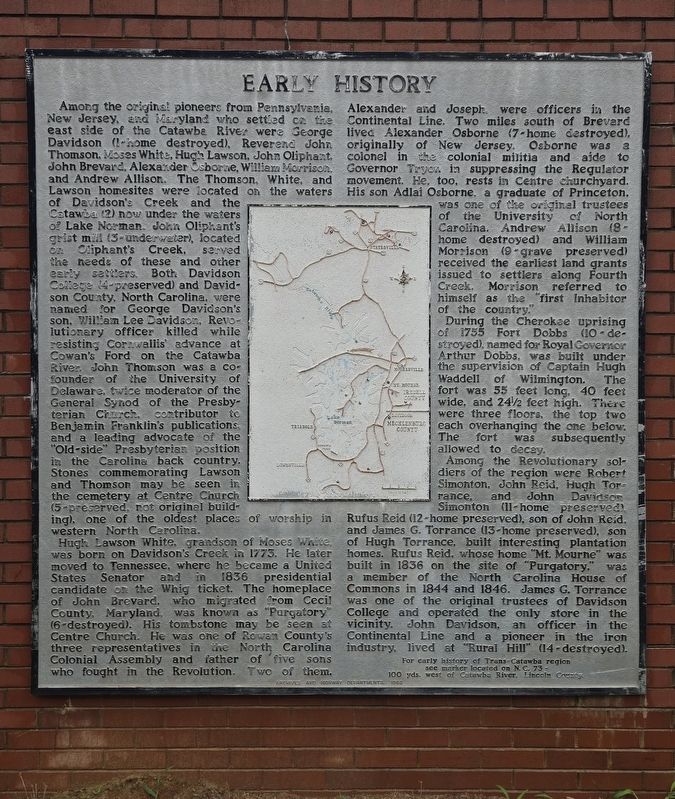
Early History
Photographed by Mark Parker, August 12, 2025
1. Early History Marker
this page online
Hugh Lawson White, grandson of Moses White, was born on Davidson's Creek in 1773. He later moved to Tennessee, where he became a United States Senator and in 1836 presidential candidate on the Whig ticket. The homeplace of John Brevard. who migrated from Cecil County, Maryland, was known as "Purgatory" (6-destroyed). His tombstone may be seen at Centre Church. He was one of Rowan County's three representatives in the North Carolina Colonial Assembly and father of five sons who fought in the Revolution. Two of them, Alexander and Joseph, were officers in the Continental Line. Two miles south of Brevard lived Alexander Osborne (7-home destroyed), originally of New Jersey. Osborne was a colonel in the colonial militia and aide to Governor Tryon in suppressing the Regulator movement. He, too, rests in Centre churchyard. His son Adlai Osborne, a graduate of Princeton, was one of the original trustees of the University of North Carolina. Andrew Allison (8-home destroyed) and William Morrison (9-grave preserved) received
Photographed by Mark Parker, August 12, 2025
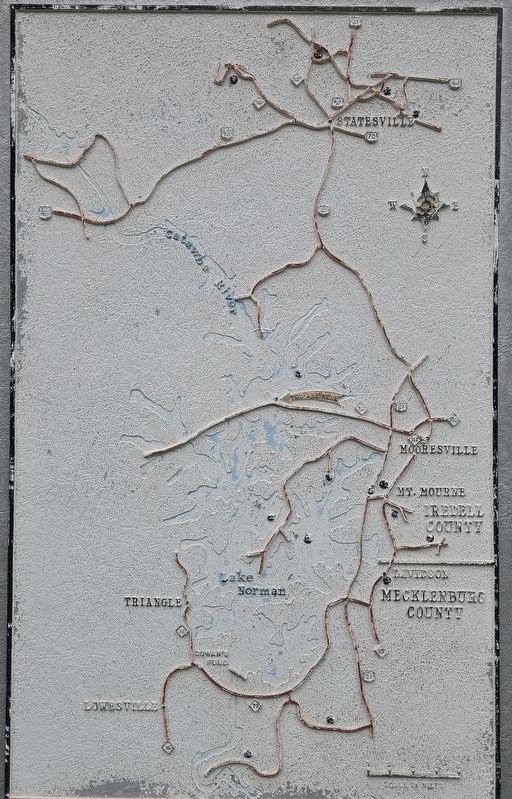
2. Closeup of the map from the Early History Marker
Most of the numbers referenced on the marker for the map are worn.
During the Cherokee uprising of 1755 Fort Dobbs (10-destroyed), named for Royal Governor Arthur Dobbs, was built under the supervision of Captain Hugh Waddell of Wilmington. The fort was 55 feet long. 40 feet wide, and 24½ feet high. There were three floors, the top two each overhanging the one below. The fort was subsequently allowed to decay.
Among the Revolutionary soldiers of the region were Robert Simonton. John Reid, Hugh Torrance, and John Davidson Simonton (11-home preserved), Rufus Reid (12-home preserved), son of John Reid, and James G. Torrance (13-home preserved), son of Hugh Torrance, built interesting plantation homes. Rufus Reid, whose home "Mt. Mourne" was built in 1836 on the site of "Purgatory," was a member of the North Carolina House of Commons in 1844 and 1846. James G. Torrance was one of the original trustees of Davidson College and operated the only store in the vicinity. John Davidson, an officer in the Continental Line and a pioneer in the iron industry, lived at "Rural Hill" (14-destroyed).
For early history of Trans-Catawba region see marker located on N.C. 73 - 100 yds. west of Catawba River, Lincoln County.
Erected 1963 by Archives and Highway Departments.
Topics. This historical marker is listed in these topic lists: Colonial Era • Education • Exploration • Forts and Castles • Settlements & Settlers • War, US Revolutionary. A significant historical year for this entry is 1773.
Location. 35° 36.371′ N, 80° 56.204′ W. Marker is near Mooresville, North Carolina, in Iredell County. It is at the intersection of River Highway (North Carolina Route 150) and Mariner Pointe Lane, on the right when traveling west on River Highway.
Photographed by Mark Parker, August 12, 2025
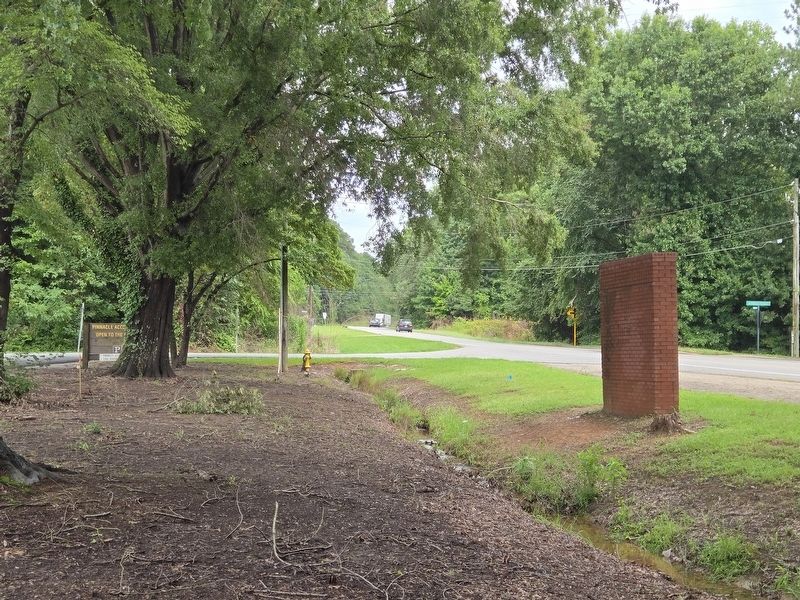
3. Early History Marker at the entrance to Pinnacle Access Area at Lake Norman
River Highway (NC Hwy 150) is in the background

Regionally, this marker is in the Piedmont and in Greater Charlotte. It is also in the American South and specifically in the Upper South. Globally, it is in North America, the Western Hemisphere, the Western World, and the Anglosphere. Historically, it finds itself in what was once the territory of the Mississippian Culture, one of the original Thirteen Colonies, one of the Confederate States of America, and the Antebellum South.
Other nearby markers. At least 8 other markers are within 8 miles of this marker, measured as the crow flies: Mayhewtown, N.C. (approx. 2.8 miles away); Long Island N.C. (approx. 5½ miles away); Baker Cemetery (approx. 6 miles away); The History of Centre Presbyterian Church / Centre Patriots (approx. 6 miles away); Centre Church (approx. 6½ miles away); Torrence's Tavern (approx. 6.8 miles away); Site of Torrence Tavern (approx. 6.8 miles away); John Franklin Moore (approx.
Photographed by Mark Parker, November 14, 2023
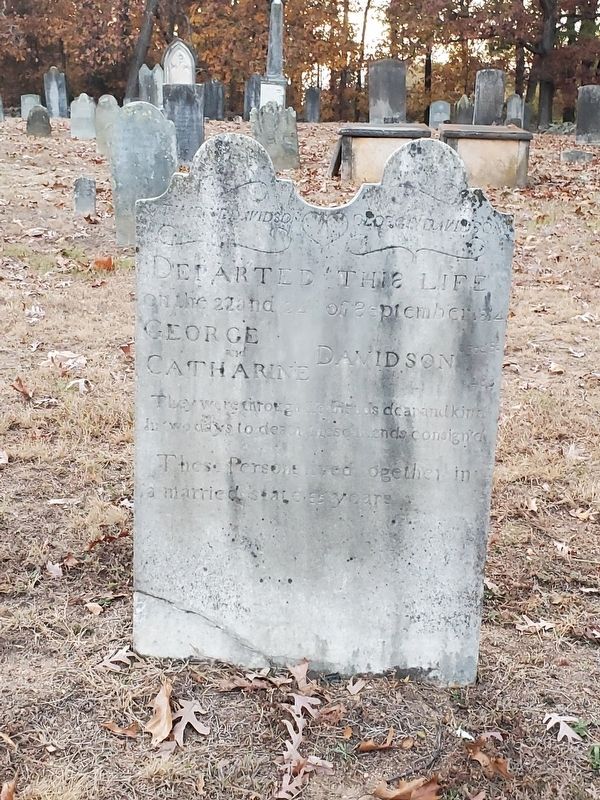
4. Gravesite of George and Catherine Davidson,early pioneers mentioned in Early History Marker
Burial site is at Centre Presbyterian Church in Mooresville
Related marker. Click here for another marker that is related to this marker.
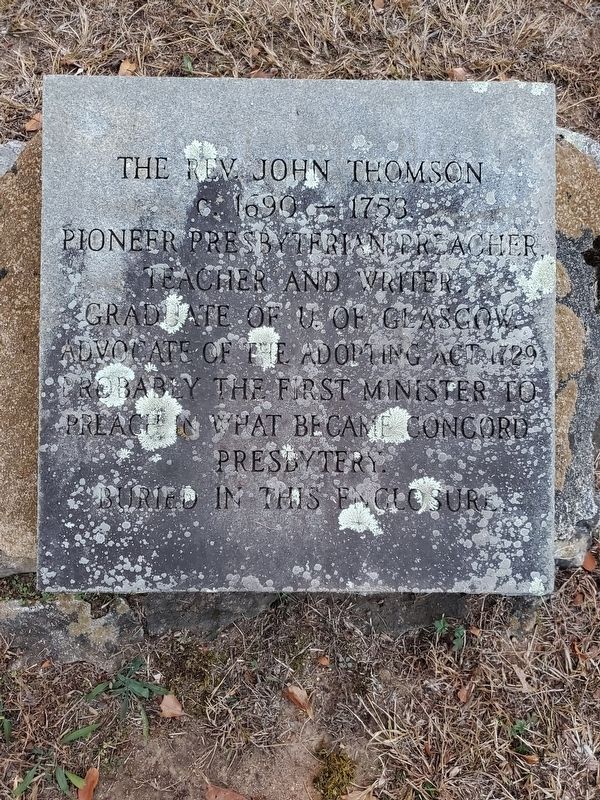
Photographed by Mark Parker, November 14, 2023
5. Gravesite of Rev John Thomson, one of the early pioneers mentioned in Early History Marker
Originally buried at Baker Cemetery, the plots were moved to Centre Presbyterian Church cemetery when Lake Norman was built. Likely the first minister to preach in the Concord Presbytery, as well at Hopewell Presbyterian Church near Charlotte.
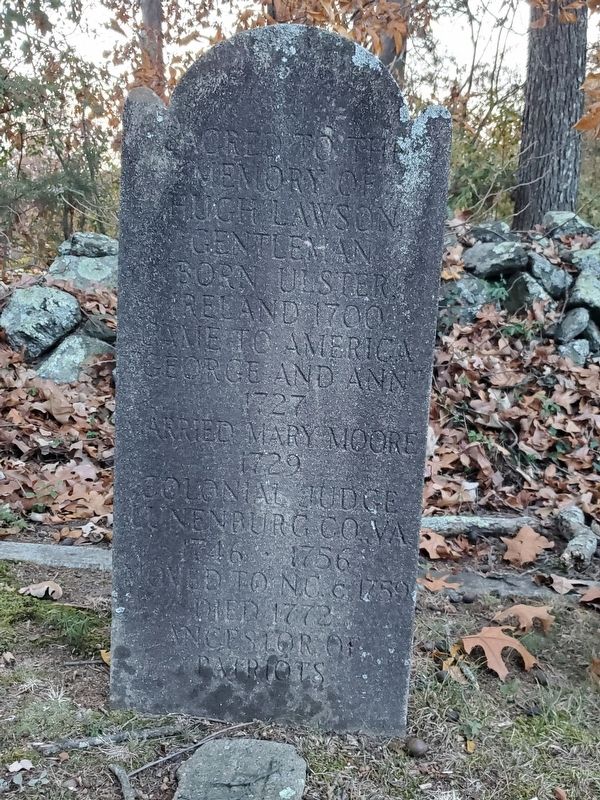
Photographed by Mark Parker, November 14, 2023
6. Gravesite of Hugh Lawson, one of the early pioneers mentioned in Early History Marker
Buried at Centre Presbyterian Church, Mooresville, NC
Credits. This page was last revised on September 1, 2025. It was originally submitted on September 1, 2025, by Mark Parker of Hickory, North Carolina. This page has been viewed 177 times since then and 86 times this year. Photos: 1, 2, 3, 4, 5, 6. submitted on September 1, 2025, by Mark Parker of Hickory, North Carolina. • Bernard Fisher was the editor who published this page.
