College Station in Brazos County, Texas — The American South (West South Central)
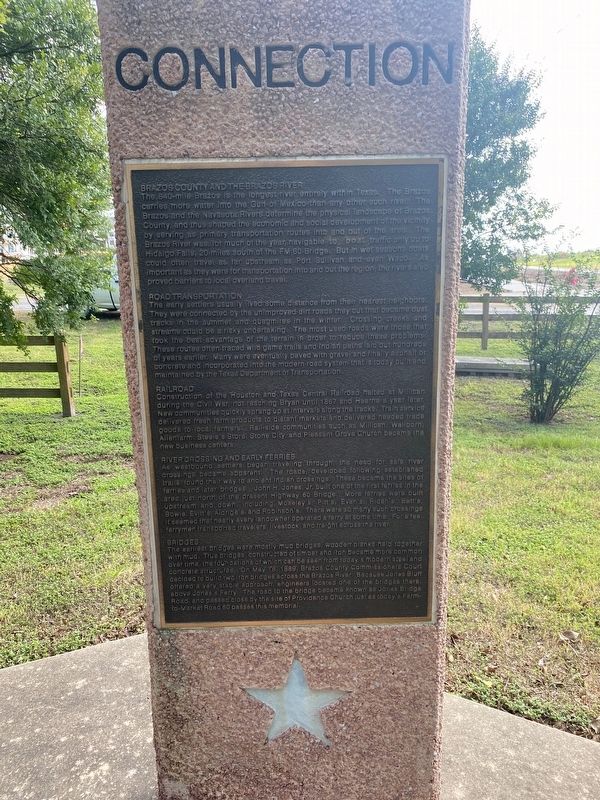
Connection
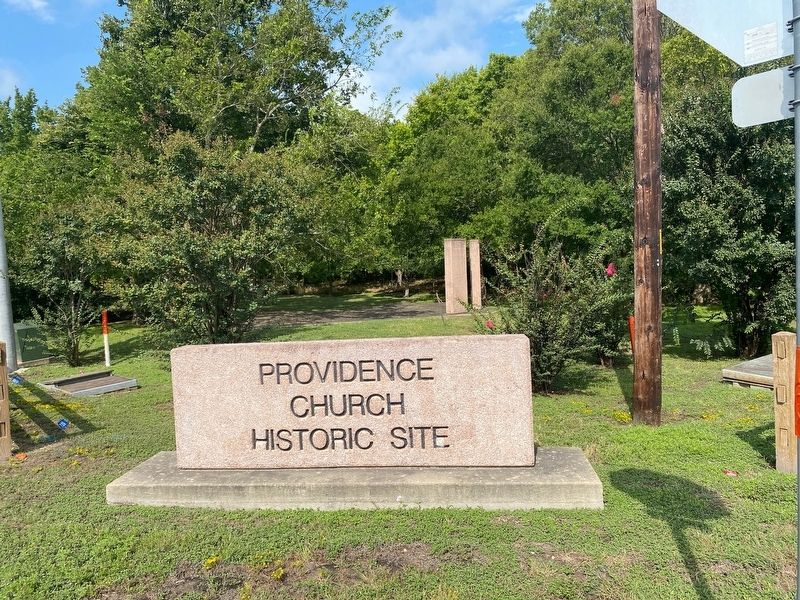
Providence Church Historic Site
Photographed by Morgan Petermann
1. Connection Marker
The 840-mile Brazos is the longest river entirely within Texas. The Brazos carries more water into the Gulf of Mexico than any other such river. The Brazos and the Navasota Rivers determine the physical landscape of Brazos County, and thus shaped the economic and social development of the vicinity by serving as primary transportation routes into and out of the area. The Brazos River was, for much of the year, navigable to boat traffic only up to Hidalgo Falls, 20 miles south of the FM 60 Bridge. But in wet seasons boats could often travel as far upstream as Port Sullivan and even Waco. As important as they were for transportation into and out of the region, the rivers also proved barriers to local overland travel.
Road Transportation
The early settler usually lived some distance from their nearest neighbors. They were connected by the unimproved dirt roads they cut that became dust tracks in the summer and quagmires in the winter. Crossing creeks and streams could be a risky undertaking. The most used roads were those that took the best advantage of the terrain in order to reduce
this page online
Railroad
Construction of the Houston and Texas Central Railroad halted at Millican during the Civil War, not reaching Bryan until 1867 and Hearne a year later. New communities quickly sprang up at intervals along the tracks. Train service delivered fresh farm products to distant markets and delivered needed trade goods to local farmers. Rail-side communities such as Millican, Wellborn, Allenfarm, Steele's Store, Stone City, and Pleasant Grove Church became the new business centers.
River Crossing and Early Ferries
As westbound settlers began traveling through, the need for safe river crossings became apparent. The roads, developed following established trails, found their way to ancient Indian crossings. These became the sites of ferries and later, bridges. John H. Jones, Jr. built one of the first ferries in the area just north
Photographed by Morgan Petermann
2. Providence Church Historic Site roadside park
Bridges
The earliest bridges were mostly mud bridges, wooden planks held together with mud. True bridges, constructed of timber and iron became more common over time, the foundations of which can be seen from today's modern steel and concrete structures. On May 18, 1889, Brazos County Commissioners Court decided to build two iron bridges across the Brazos River. Because Jones Bluff offered a very stable approach, engineers located one of the bridges there, above Jones's Ferry. The road to the bridge became known as Jones Bridge Road and passed close by the site of Providence Church just as today's Farm-to-Market Road 60 passes this memorial.
Erected 2008 by Brazos County Historical Commission.
Topics. This historical marker is listed in these topic lists: Bridges & Viaducts
Photographed by Morgan Petermann
3. Providence Church Historic Site roadside park
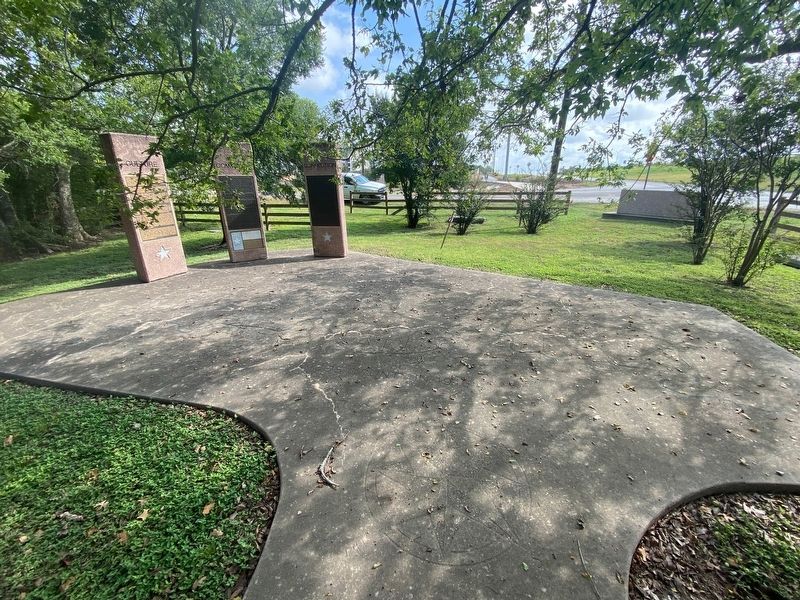
Not clearly visible in this picture, but visible in person, the roadside park features an early map of the communities of Brazos Valley.
Location. 30° 35.866′ N, 96° 22.303′ W. Marker is in College Station, Texas, in Brazos County. It is at the intersection of Turkey Creek Road and Raymond Stotzer Frontage, on the left when traveling north on Turkey Creek Road. Touch for map. Marker is at or near this postal address: 8878 Turkey Creek Rd, College Station TX 77845, United States of America. Touch for directions.

Regionally, this marker is in the Prairies & Lakes Region. It is also in the American South. Globally, it is in North America, a Gulf of Mexico state, the Western Hemisphere, the Western World, and the Anglosphere. Historically, it finds itself in what was once New Spain, the Republic of Texas, one of the Confederate States of America, and the Antebellum South.
Other nearby markers. At least 8 other markers are within 3 miles of this marker, measured as the crow flies: Community (here, next to this marker); Culture (here, next to this marker); College Station Railroad Depots (approx. 1.9 miles away); Main Drill Field, Texas A&M University (approx. 2.1 miles away); Aggies in World War I (approx. 2.1 miles away); Early Play-By-Play Radio Broadcast of a College Football Game (approx. 2.1 miles away); The Twelfth Man (approx. 2.1 miles away); Senator Matthew Gaines (approx. 2.1 miles away). Touch for a list and map of all markers in College Station.
Credits. This page was last revised on September 4, 2025. It was originally submitted on September 2, 2025, by Morgan Petermann of Hurst, Texas. This page has been viewed 142 times since then and 39 times this year. Photos: 1, 2, 3. submitted on September 2, 2025, by Morgan Petermann of Hurst, Texas. • James Hulse was the editor who published this page.
