Hell's Kitchen in Manhattan in New York County, New York — The American Northeast (Mid-Atlantic)
Clinton War Memorial
DeWitt Clinton Park
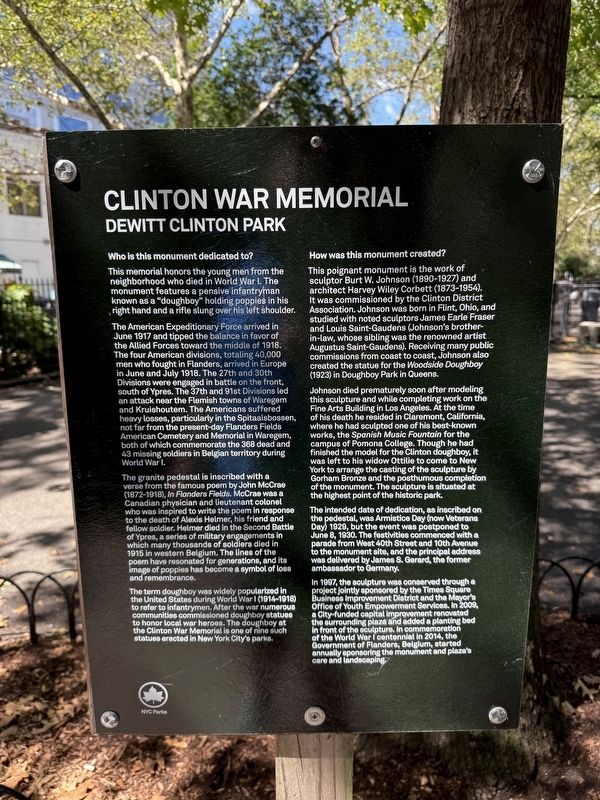
Who is this monument dedicated to?
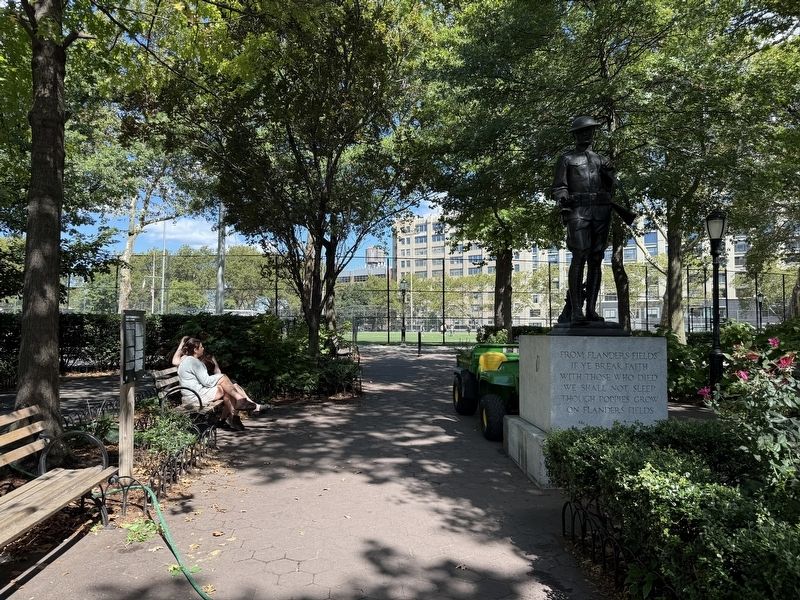
This memorial honors the young men from the neighborhood who died in World War I. The monument features a pensive infantryman known as a "doughboy" holding poppies in his right hand and a rifle slung over his left shoulder.
The American Expeditionary Force arrived in June 1917 and tipped the balance in favor of the Allied Forces toward the middle of 1918. the four American divisions, totaling 40,000 men who fought in Flanders, arrived in Europe in June and July 1918. The 27th and 30th Divisions were engaged in battle on the front, south of Ypres. The 37th and 91st Divisions led an attack near the Flemish towns of Waregem and Kruishoutem. The Americans suffered heavy losses, particularly in the Spitaalsbossen, not far from the present-day Flanders Fields American Cemetery and Memorial in Waregem, both of which commemorate the 368 dead and 43 missing soldiers in Belgian territory during World War I.
The granite pedestal is inscribed with a verse from the famous poem by John McCrae (1872-1918), In Flanders Fields. McCrae was a Canadian physician and lieutenant colonel who was inspired
this page online
The term doughboy was widely popularized in the United States during World War I (1914-1918) to refer to infantrymen. After the war numerous communities commissioned doughboy statues to honor local war heroes. The doughboy at the Clinton War Memorial is one of nine such statues erected in New York City's parks.
How was this monument created?
This poignant monument is the work of sculptor Burt W. Johnson (1890-1927) and architect Harvey Wiley Corbett (1873-1954). It was commissioned by the Clinton District Association. Johnson was born in Flint, Ohio, and studied with noted sculptors James Earle Fraser and Louis Saint-Gaudens (Johnson's brother-in-law, whose sibling was renowned artist Augustus Saint-Gaudens). Receiving many public commissions from coast to coast, Johnson
Photographed by Devry Becker Jones (CC0), August 30, 2025
2. Clinton War Memorial (right) and marker (left)
Johnson died prematurely soon after modeling this sculpture and while completing work on the Fine Arts Building in Los Angeles. At the time of his death he resided in Claremont, California, where he had sculpted one of his best-known works, the Spanish Music Fountain for the campus of Pomona College. Though he had finished the model for the Clinton doughboy, it was left to his widow Ottilie to come to New York to arrange the casting of the sculpture by Gorham Bronze and the posthumous completion of the monument. The sculpture is situated at the highest point of the historic park.
The intended date of dedication, as inscribed on the pedestal, was Armistice Day (now Veterans Day) 1929, but the event was postponed to June 8, 1930. The festivities commenced with a parade from West 40th Street and 10th Avenue to the monument site, and the principal address was delivered by James S. Gerard, the former ambassador to Germany.
In 1997, the sculpture was conserved through a project jointly sponsored by the Times Square Business Improvement District and the Mayor's Office of Youth Empowerment Services. In 2009, a City-funded capital improvement renovated the surrounding plaza and added a planting bed in front of the sculpture. In commemoration of the World War I centennial in 2014, the Government of Flanders, Belgium, started annually sponsoring the monument and plaza's care and landscaping.
Erected by NYC Parks. (Marker Number 301.)
Topics and series. This historical marker and memorial is listed in these topic lists: Arts, Letters, Music • Parks & Recreational Areas • War, World I. In addition, it is included in the NYC Parks series list. A significant historical month for this entry is June 1917.
Location. 40° 46.047′ N, 73° 59.632′ W. Marker is in Manhattan, New York, in New York County. It is in Hell's Kitchen. It is at the intersection of 11th Avenue and West 52nd Street, on the right when traveling south on 11th Avenue. Touch for map. Marker is at or near this postal address: 735 11th Ave, New York NY 10019, United States of America. Touch for directions.

Regionally, this marker and memorial is in New York City. It is also in the American Northeast, in the Mid-Atlantic, and on the Eastern Seaboard. Globally, it is in the North Atlantic Region, North America, the Western Hemisphere, the Western World, and the Anglosphere. Historically, it finds itself in what was once New Netherland and also one of the original Thirteen Colonies.
Other nearby markers. At least 8 other markers are within walking distance of this marker: A different marker also named Clinton War Memorial (here, next to this marker); DeWitt Clinton Park (a few steps from this marker); Joe Horvath (about 300 feet away, measured in a direct line); a different marker also named DeWitt Clinton Park (about 300 feet away); Juan Alonso Community Garden & Parks (about 400 feet away); Aquitania (approx. 0.3 miles away); Paris (approx. 0.3 miles away); RMS Queen Mary (approx. 0.3 miles away). Touch for a list and map of all markers in Manhattan.
Credits. This page was last revised on September 2, 2025. It was originally submitted on September 2, 2025, by Devry Becker Jones of Washington, District of Columbia. This page has been viewed 239 times since then and 166 times this year. Photos: 1, 2. submitted on September 2, 2025, by Devry Becker Jones of Washington, District of Columbia.
