Lincoln Square in Manhattan in New York County, New York — The American Northeast (Mid-Atlantic)
Riverside Park South
66.69 acres
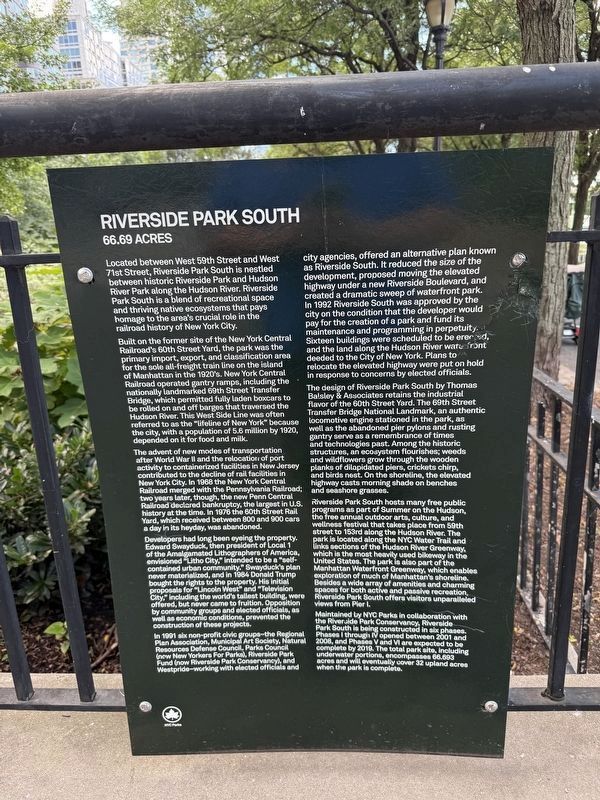
Located between West 59th Street and West 71st Street, Riverside Park South is nestled between historic Riverside Park and Hudson River Park along the Hudson River. Riverside Park South is a blend of recreational space and thriving native ecosystems that pays homage to the area's crucial railroad history of New York City.
Built on the former site of the New York Central Railroad's 60th Street Yard, the park was the primary import, export, and classification area for the sole all-freight train line on the island of Manhattan in the 1920's. New York Central Railroad operated gantry ramps, including the nationally landmarked 69th Street Transfer Bridge, which permitted fully laden boxcars to be rolled on and off barges that traversed the Hudson River. This West Side Line was often referred to as the "lifeline of New York" because the city, with a population of 5.6 million by 1920, depended on it for food and milk.
The advent of new modes of transportation after World War II and the relocation of port activity to containerized facilities in New Jersey contributed to the decline of rail facilities in New York City. In
this page online
Developers had long been eyeing the property. Edward Swayduck, then president of Local 1 of the Amalgamated Lithographers of America, envisioned "Litho City," intended to be a "self-contained urban community." Sayduck's plan never materialized, and in 1984 Donald Trump bought the rights to the property. His initial proposals for "Lincoln West" and "Television City," including the world's tallest building, were offered, but never came to fruition. Opposition by community groups and elected officials, as well as economic conditions, prevented the construction of these projects.
In 1991 six non-profit civic groups—the Regional Plan Association, Municipal Art Society, Natural Resources Defense Council, Parks Council (now New Yorkers For Parks), Riverside Park Fund (now Riverside Park Conservancy), and Westpride—working with elected officials
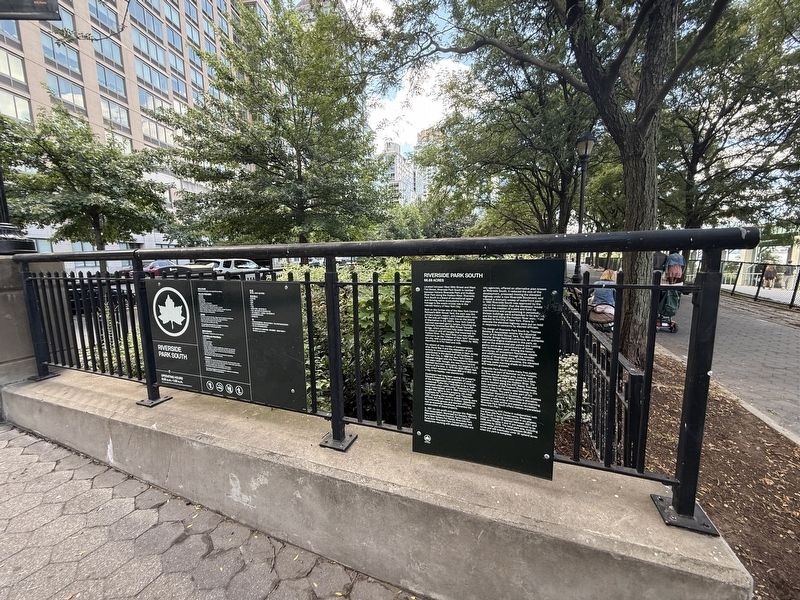
The design of Riverside Park South by Thomas Balsley & Associates retains the industrial flavor of the 60th Street Yard. The 69th Street Transfer Bridge National Landmark, an authentic locomotive engine stationed in the park, as well as the abandoned pier pylons and rusting gantry serve as a remembrance of times and technologies past. Among the historic structures, an ecosystem flourishes; weeds and wildflowers grow through the wooden planks of dilapidated piers, crickets chirp, and birds nest. On the shoreline, the elevated highway casts morning shade on benches and seashore grasses.
Riverside Park South hosts many free public programs as part of Summer on the Hudson, the free annual outdoor arts, culture, and wellness festival that takes place from 59th street to 153rd along the Hudson River. the park is located along the NYC Water Trail and links sections of the Hudson River Greenway, which is the most heavily used bikeway in the United States. The park is also part of the Manhattan Waterfront Greenway, which enables exploration of much of Manhattan's shoreline. Besides a wide array of amenities and charming spaces for both active and passive recreation, Riverside Park South offers visitors unparalleled views from Pier I.
Maintained by NYC Parks in collaboration with the Riverside Park Conservancy, Riverside Park South is being constructed in six phases. Phases I through IV opened between 2001 and 2008, and Phases V and VI are expected to be complete by 2019. The total park site, including underwater portions, encompasses 66.693 acres and will eventually cover 32 upland acres when the park is complete.
Erected by NYC Parks.
Topics and series. This historical marker is listed in these topic lists: Industry & Commerce • Parks & Recreational Areas • Railroads & Streetcars. In addition, it is included in the Former U.S. Presidents: #45 Donald J. Trump, the NYC Parks, and the Pennsylvania Railroad (PRR) series lists. A significant historical year for this entry is 1920.
Location. 40° 46.693′ N, 73° 59.332′ W. Marker is in Manhattan, New York, in New York County. It is in Lincoln Square. It is on West 68th Street west of Riverside Boulevard, on the left when traveling west. Touch for map. Marker is at or near this postal address: 63RD West Side Hwy, New York NY 10069, United States of America. Touch for directions.

Regionally, this marker is in New York City. It is also in the American Northeast, in the Mid-Atlantic, and on the Eastern Seaboard. Globally, it is in the North Atlantic Region, North America, the Western Hemisphere, the Western World, and the Anglosphere. Historically, it finds itself in what was once New Netherland and also one of the original Thirteen Colonies.
Other nearby markers. At least 8 other markers are within walking distance of this marker: New York Central Railroad (about 400 feet away, measured in a direct line); 240 West End Avenue (approx. 0.2 miles away); 246 West End Avenue (approx. ¼ mile away); Anna Eleanor Roosevelt (approx. ¼ mile away); Eleanor Roosevelt Monument (approx. ¼ mile away); a different marker also named Riverside Park South (approx. ¼ mile away); Matthew P. Sapolin Playground (approx. ¼ mile away); Samuel N. Bennerson II Playground (approx. 0.3 miles away). Touch for a list and map of all markers in Manhattan.
Other markers no longer nearby. Linda's Lawn (was about 500 feet away but has been permanently removed); Riverside Park (was approx. ¼ mile away but has been permanently removed); Septuagesimo Uno (was approx. ¼ mile away but has been replaced with another marker now near it); a different marker also named Septuagesimo Uno (was approx. ¼ mile away but has been permanently removed).
Credits. This page was last revised on September 2, 2025. It was originally submitted on September 2, 2025, by Devry Becker Jones of Washington, District of Columbia. This page has been viewed 69 times since then and 28 times this year. Photos: 1, 2. submitted on September 2, 2025, by Devry Becker Jones of Washington, District of Columbia.
