St. Augustine Beach in St. Johns County, Florida — The American South (South Atlantic)
21st Century
| — | St. Johns County Black Heritage Trail | — |
Photographed by Brandon D Cross, September 1, 2025
1. 21st Century Marker
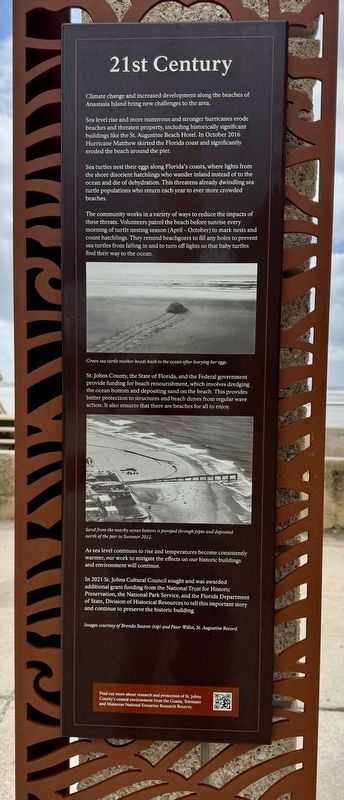
Sea level rise and more numerous and stronger hurricanes erode beaches and threaten property, including historically significant buildings like the St. Augustine Beach Hotel. In October 2016 Hurricane Matthew skirted the Florida coast and significantly eroded the beach around the pier.
Sea turtles nest their eggs along Florida's coasts, where lights from the shore disorient hatchlings who wander inland instead of to the ocean and die of dehydration. This threatens already dwindling sea turtle populations who return each year to ever more crowded beaches.
The community works in a variety of ways to reduce the impacts of these threats. Volunteers patrol the beach before sunrise every morning of turtle nesting season (April - October) to mark nests and count hatchlings. They remind beachgoers to fill any holes to prevent sea turtles from falling in and to turn off lights so that baby turtles find their way to the ocean.
St. Johns County, the State of Florida, and the Federal government provide funding for beach renourishment, which involves dredging the ocean bottom and depositing sand on the beach. This provides better protection to structures and beach dunes from regular wave action. It also ensures that there are beaches for all to enjoy.
As sea level continues to rise and temperatures become consistently warmer, our work to mitigate the effects on our historic buildings and environment will continue.
In 2021 St. Johns Cultural Council sought and was awarded additional grant funding from the National Trust for Historic Preservation, the National Park Service, and the Florida Department of State, Division of Historical Resources to tell this important story and continue to preserve
this page online
(captions)
Green sea turtle mother heads back to the ocean after burying her eggs.
Sand from the nearby ocean bottom is pumped through pipes and deposited north of the pier in Summer 2012.
Images courtesy of Brenda Swann (top) and Peter Willot, St. Augustine Record.
Find out more about research and protection of St. Johns County's coastal environment from the Guana, Tolomato and Matanzas National Estuarine Research Reserve.
Erected 2025 by St. Johns County Black Heritage Trail.
Topics. This historical marker is listed in these topic lists: Animals • Disasters • Environment. A significant historical month for this entry is October 2016.
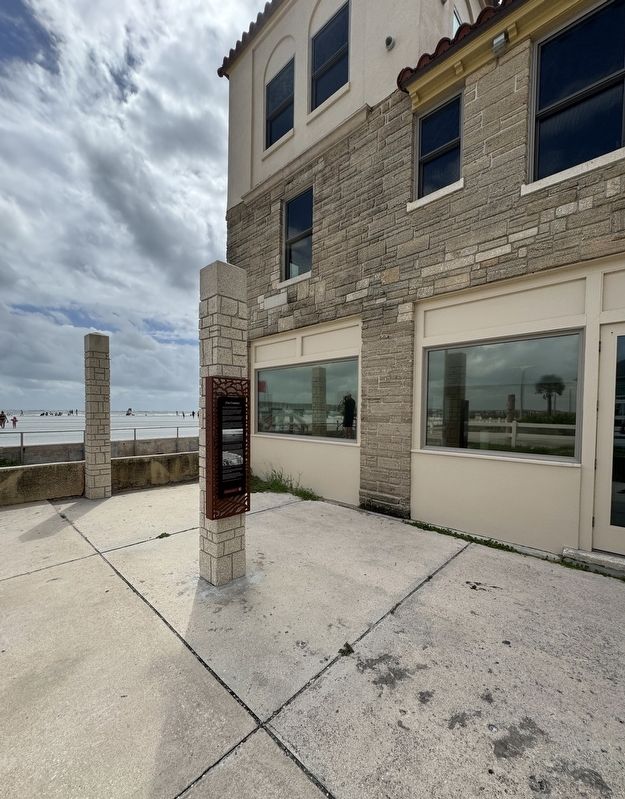
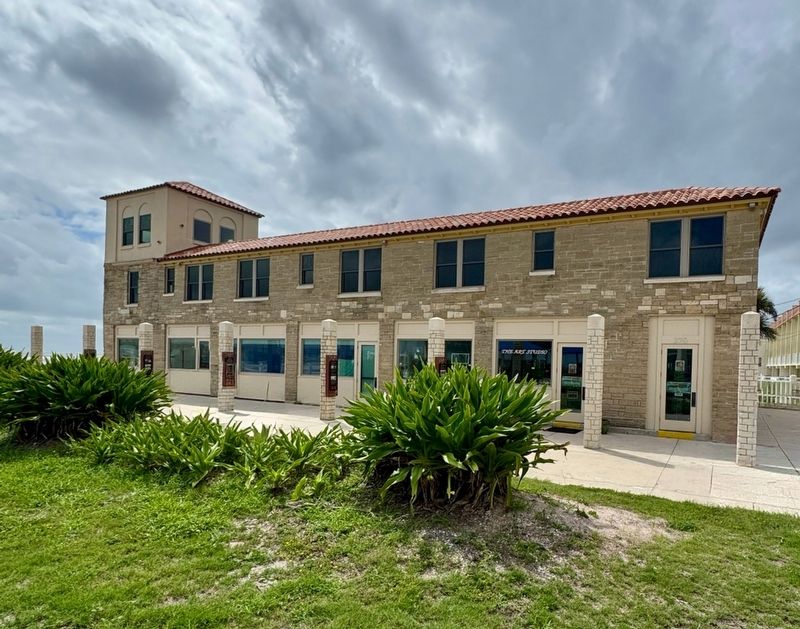
Location. 29° 51.397′ N, 81° 15.934′ W. Marker is in St. Augustine Beach, Florida, in St. Johns County. It can be reached from A1A Beach Boulevard 0.1 miles north of 16th Street, on the right when traveling north. Located in front of the St. Augustine Beach Hotel. Touch for map. Marker is at or near this postal address: 350 A1A Beach Boulevard, Saint Augustine FL 32080, United States of America. Touch for directions.

Regionally, this marker is in First Coast and
Photographed by Brandon D Cross, September 1, 2025
2. 21st Century Marker
Other nearby markers. At least 8 other markers are within one mile of this marker, measured as the crow flies: Time of Transition (here, next to this marker); Civil Rights (a few steps from this marker); Recreation and Fun (a few steps from this marker); Waves of Change (a few steps from this marker); St. Johns County Black Heritage Trail (within shouting distance of this marker); St. Augustine Beach Wade-Ins (within shouting distance of this marker); Veterans Memorial (approx. 0.8 miles away); Old Spanish Chimney and Well (approx. one mile away). Touch for a list and map of all markers in St. Augustine Beach.
Also see . . .
1. Waves of Change Exhibit. (Submitted on September 2, 2025, by Brandon D Cross of Flagler Beach, Florida.)
2. St. John’s County Black Heritage Trail.
Photographed by Brandon D Cross, September 1, 2025
3. St. Augustine Beach Hotel
Credits. This page was last revised on September 7, 2025. It was originally submitted on September 2, 2025, by Brandon D Cross of Flagler Beach, Florida. This page has been viewed 84 times since then and 24 times this year. Photos: 1, 2, 3. submitted on September 2, 2025, by Brandon D Cross of Flagler Beach, Florida. • Bernard Fisher was the editor who published this page.
