Upper West Side in Manhattan in New York County, New York — The American Northeast (Mid-Atlantic)
Hamilton Fountain
Riverside Park
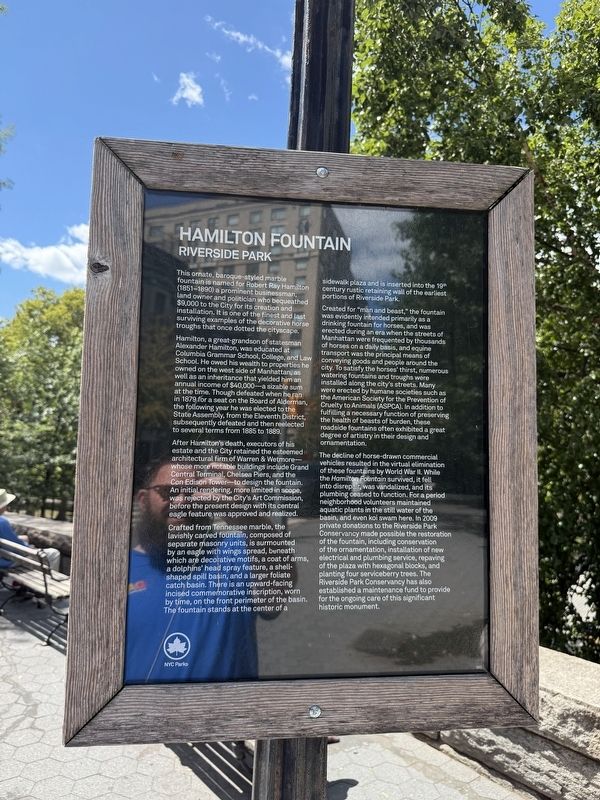
This ornate, baroque-styled marble fountain is named for Robert Ray Hamilton (1851-1890) a prominent businessman, land owner and politician who bequeathed $9,000 to the City for its creation and installation. It is one of the finest and last surviving examples of the decorative horse troughs that once dotted the cityscape.
Hamilton, a great-grandson of statesman Alexander Hamilton, was educated at Columbia Grammar School, College, and Law School. He owed his wealth to properties he owned on the west side of Manhattan, as well as an inheritance that yielded him an annual income of $40,000—a sizable sum at the time. Though defeated when he ran in 1879 for a seat on the Board of Alderman, the following year he was elected to the State Assembly, from the Eleventh District, subsequently defeated and then reelected to several terms from 1885 to 1889.
After Hamilton's death, executors of his estate and the City retained the esteemed architectural firm of Warren & Wetmore—whose more notable buildings include Grand Central Terminal, Chelsea Piers, and the Con Edison Tower—to design the fountain. An initial rendering, more
this page online
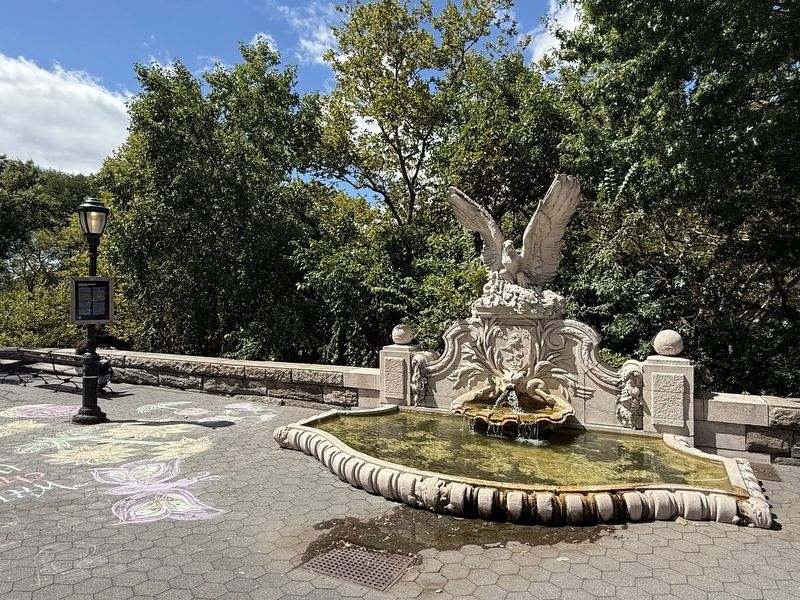
Crafted from Tennessee marble, the lavishly carved fountain, composed of separate masonry units, is surmounted by an eagle with wings spread, beneath which are decorative motifs, a coat of arms, a dolphins' head spray feature, a shell-shaped spill basin, and a larger foliate catch basin. There is an upward-facing incised commemorative inscription, worn by time, on the front perimeter of the basin. The fountain stands at the center of a sidewalk plaza and is inserted into the 19th century rustic retaining wall of the earliest portions of Riverside Park.
Created for "man and beast," the fountain was evidently intended primarily as a drinking fountain for horses, and was erected during an era when the streets of Manhattan were frequented by thousands of horses on a daily basis, and equine transport was the principal means of conveying goods and people around the city. To satisfy the horses' thirst, numerous watering fountains and troughs were installed along the city's streets. Many were
Photographed by Devry Becker Jones (CC0), August 30, 2025
2. Hamilton Fountain (right) and marker (left)
The decline of horse-drawn commercial vehicles in the virtual elimination of these fountains by World War II. While the Hamilton Fountain survived, it fell into disrepair, was vandalized, and its plumbing ceased to function. For a period neighborhood volunteers maintained aquatic plants in the still water of the basin, and even koi swam here. In 2009 private donations to the Riverside Park Conservancy made possible the restoration of the fountain, including conservation of the ornamentation, installation of new electrical and plumbing service, repaving of the plaza with hexagonal blocks, and planting four serviceberry trees. The Riverside Park Conservancy has also established a maintenance fund to provide for the ongoing care of this significant historic monument.
Erected by NYC Parks. (Marker Number 300.)
Topics and series. This historical marker is listed in these topic lists: Architecture • Arts, Letters, Music • Government & Politics • Parks & Recreational Areas. In addition, it is included in the NYC Parks series list. A significant historical year for this entry is 1879.
Location. 40° 46.992′ N, 73° 59.077′ W. Marker is in Manhattan, New York, in New York County. It is in the Upper West Side. It is at the intersection of Riverside Drive and West 76th Street, on the right when traveling south on Riverside Drive. Touch for map. Marker is at or near this postal address: 39 Riverside Dr, New York NY 10023, United States of America. Touch for directions.

Regionally, this marker is in New York City. It is also in the American Northeast, in the Mid-Atlantic, and on the Eastern Seaboard. Globally, it is in the North Atlantic Region, North America, the Western Hemisphere, the Western World, and the Anglosphere. Historically, it finds itself in what was once New Netherland and also one of the original Thirteen Colonies.
Other nearby markers. At least 8 other markers are within walking distance of this marker: George and Ira Gershwin (about 300 feet away, measured in a direct line); West End Collegiate Church and Collegiate School (about 800 feet away); a different marker also named West End Collegiate Church and Collegiate School (approx. 0.2 miles away); Eleanor Roosevelt Monument (approx. 0.2 miles away); Anna Eleanor Roosevelt (approx. 0.2 miles away); Riverside Park South (approx. 0.2 miles away); The Apthorp Apartments (approx. 0.2 miles away); Dorothy Parker (approx. ¼ mile away). Touch for a list and map of all markers in Manhattan.
Other markers no longer nearby. Hamilton Fountain (has been replaced with this marker); Riverside Park (was approx. 0.2 miles away but has been permanently removed).
Credits. This page was last revised on September 2, 2025. It was originally submitted on September 2, 2025, by Devry Becker Jones of Washington, District of Columbia. This page has been viewed 97 times since then and 28 times this year. Photos: 1, 2. submitted on September 2, 2025, by Devry Becker Jones of Washington, District of Columbia.
