Niagara-on-the-Lake in Niagara Region, Ontario — Central Canada (North America)
Count De Puisaye House
| — | Niagara on the Lake Bicentennial Building | — |
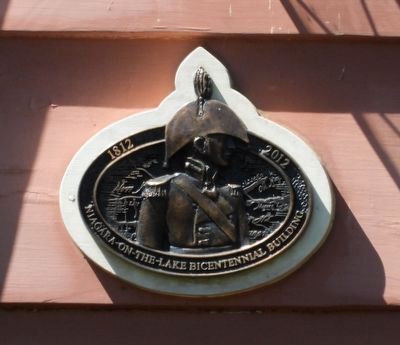
Photographed by Kevin Westell, August 31, 2025
1. Count De Puisaye House Bicentennial Plaque - Marker
Topics. This historical marker is listed in this topic list: War of 1812. A significant historical year for this entry is 1812.
Location. 43° 12.736′ N, 79° 3.725′ W. Marker is in Niagara-on-the-Lake, Ontario, in Niagara Region. It is on Niagara River Parkway. The marker is mounted on the east side of the house, 50 metres west of Service Road 66, and 30 metres north of Line 3 Rd. Touch for map. Marker is at or near this postal address: 15506 Niagara River Pkwy, Niagara-on-the-Lake ON L0S 1J0, Canada. Touch for directions.

Regionally, this marker is on the Golden Horseshoe and in Niagara Canada. It is also in Central Canada. Globally, it is in North America, on the Great Lakes, in the Western Hemisphere, in the Western World, and in the Anglosphere. Historically, it finds itself in what was once a British colony, the Viceroyalty of New France, the Haudenosaunee (Iroquois) Confederacy, and Rupert’s Land.
Other nearby markers. At least 8 other markers are within 3 kilometers
this page online
Another marker is no longer nearby. The Field House / La Maison Field (was approx. 1.2 kilometers away but has been confirmed missing).
More about this marker. The marker indicates that this building has been designated of cultural heritage significance under the Ontario Heritage Act. The reasons for its designation can be read at Also See link No. 1 below.
Regarding Count De Puisaye House. About Comte de Puisaye:
- French politician de Puisaye got on the wrongside during the French revolution, and escaped to England
 Photographed by Kevin Westell, August 31, 20252. Count De Puisaye HouseThe house is 50 metres back from the road. The heritage portion is right of the tree. The plaque is mounted just left of the front door.
 - his 1795 uprising in a French port failed
- in 1798, he started a farming community with other French refugees north of Toronto, which failed
- he lived around here for a couple of years, and acquired this house, which sat in a different nearby location
- he went back to England in 1802, where he died in 1827
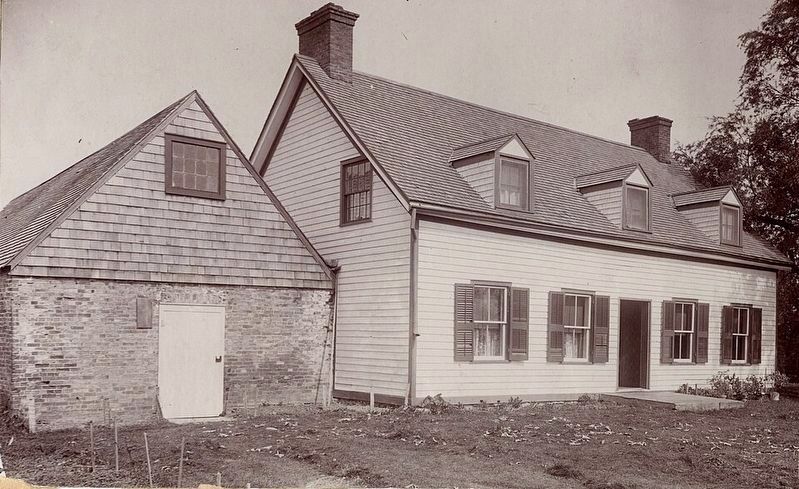
- The original section of the De Puisaye House dates circa 1794. It was constructed by Walter Butler Sheehan and purchased by the Count de Puisaye in 1798. Somewhere along the way, half of De Puisaye's house was destroyed. The surviving half of De Puisaye's house was moved to this location to save it from demolition; and incorporated as the wing of an existing house. So, half of this current house was also half of De Puisaye's house.
Also see . . . Statement of Cultural Value or Interest (Page 13). Excerpt:
The cultural heritage value of the De Puisaye House lies in the age of the structure, its surviving architectural details, and its association with Walter Butler Sheehan and(Submitted on December 8, 2025.)Joseph Genevieve, Count de Puisaye. The present day surviving structure dates back to circa 1794 and is early Georgian in style.Toronto Reference Library via Wikimedia Commons (Public Domain)3. Count De Puisaye House, pictured 1890
Credits. This page was last revised on December 8, 2025. It was originally submitted on September 2, 2025, by Kevin Westell of St. Catharines, Ontario. This page has been viewed 47 times since then and 23 times this year. Photos: 1, 2, 3. submitted on September 2, 2025, by Kevin Westell of St. Catharines, Ontario. • J. J. Prats was the editor who published this page.
