Siena in Provincia di Siena, Tuscany, Italy — Southern and Western Europe (Mediterranean)
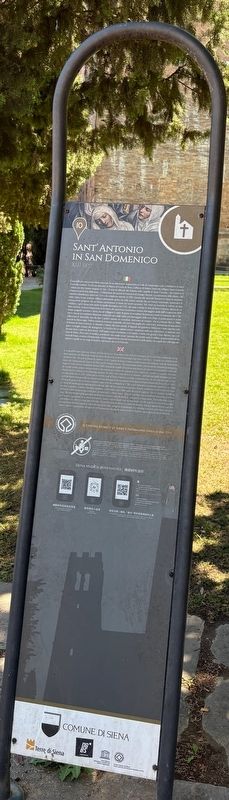
Sant'Antonio in San Domenico
XIII Sec
⎯⎯⎯
13th Century
Photographed by Sean P. Flynn, July 31, 2025
1. Sant'Antonio in San Domenico Marker
É una delle più importanti chiese senesi per le sue dimensioni, la posizione sul colle di Camporegio e per la collezione di opere d'arte che contiene. Tra di esse spiccano: la Maesta di Guido da Siena, l'affresco di Andrea Vanni che raffigura Santa Caterina unico suo vero ritratto eseguito in vita, il ciclo di affreschi del Sodoma nella cappella di Santa Caterina che conserva il reliquario con la testa della santa-, l'Adorazione dei pastori di Francesco di Giorgio Martini. La costruzione della chiesa e del convento domenicano iniziò nel 1226 e fu completata intorno al 1265. Intorno alla metà del Trecento la chiesa fu ampliata. come indica la sua struttura stilistica pienamente gotica sia nella navata centrale che nel braccio trasversale, nonostante le innumerevoli peripezie che ne
this page online
Photographed by Sean P. Flynn, July 31, 2025
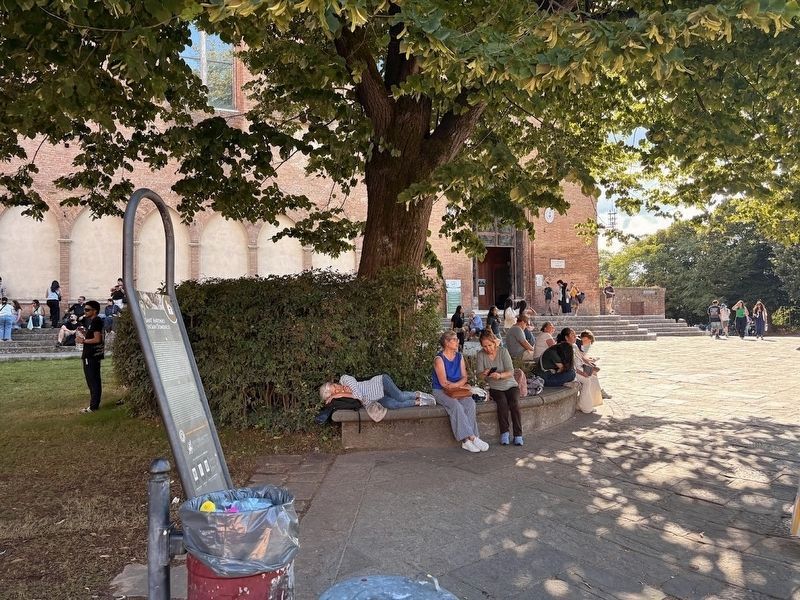
2. Sant'Antonio in San Domenico Marker
It is one of the most important Sienese churches for its size its position on the hill of Camporegio, for it collection of artworks among them stand out: The maestà by Guida da Siena, the fresco by Andrea Vanni depicting Santa Caterina — the only true portrait made during her life—, the cycle of frescoes by Sodoma in the Cappella di Santa Caterina which contains the reliquary with the head of the Samt, the Aderazione dei Pastori by Francesco di Giorgio Marrini. The construction of the Church and the Domenican monastery began in 1226 and was completed around 1265. Around the middle of the fourteenth century the church was expanded as indicated by its fully Gothic stylistic structure both in the central nave and in the transversal arm, despite the countless vicissitudes that have characterized its history in the following centuries. In 1443 a fire reduced it in its structure, and also was badly damaged from the one that broke out in 1531, which put at risk the head of Santa Caterina, saved by a converted friar. In the mid-sixteenth century both the church and especially the convent were also damaged by the occupation of the Spanish troops stationed in Siena, but to inflict the coup de grace to the Dominican complex came with the earthquake of 1798, which reduced it to disastrous conditions, resulting in one of the buildings more damaged than the city. After the first appraisals it was even thought to demolish it, but at the end it was decided to operate a complex restoration operation, which lasted until 1806, when the church reopened. On this occasion the soaring bell tower, which had a twenty-meter spire, surmounted by a bronze statue of Santa Caterina, was lowered and reduced to its current state. The deterioration of the grandiose building was overcome only thanks to the long post-war restorations. The baailica has a severe and massive appearance in its brick architecture, with a smooth facade and no decorations. In the large fourteenth-century crypt, with three naves, there is a large painted Cross the work of Sano di Pietro, Just below the basilica, taking a slightly hidden road that dencends below the hill, popularly called the coast of the Serpe, you get to Fontebranda. Very striking is the view of the back side of the church, which is enjoyed from the opposite hill compared to the one on which stands the basilica, especially from via di Diacceto.
Topics.
Photographed by Sean P. Flynn, July 31, 2025
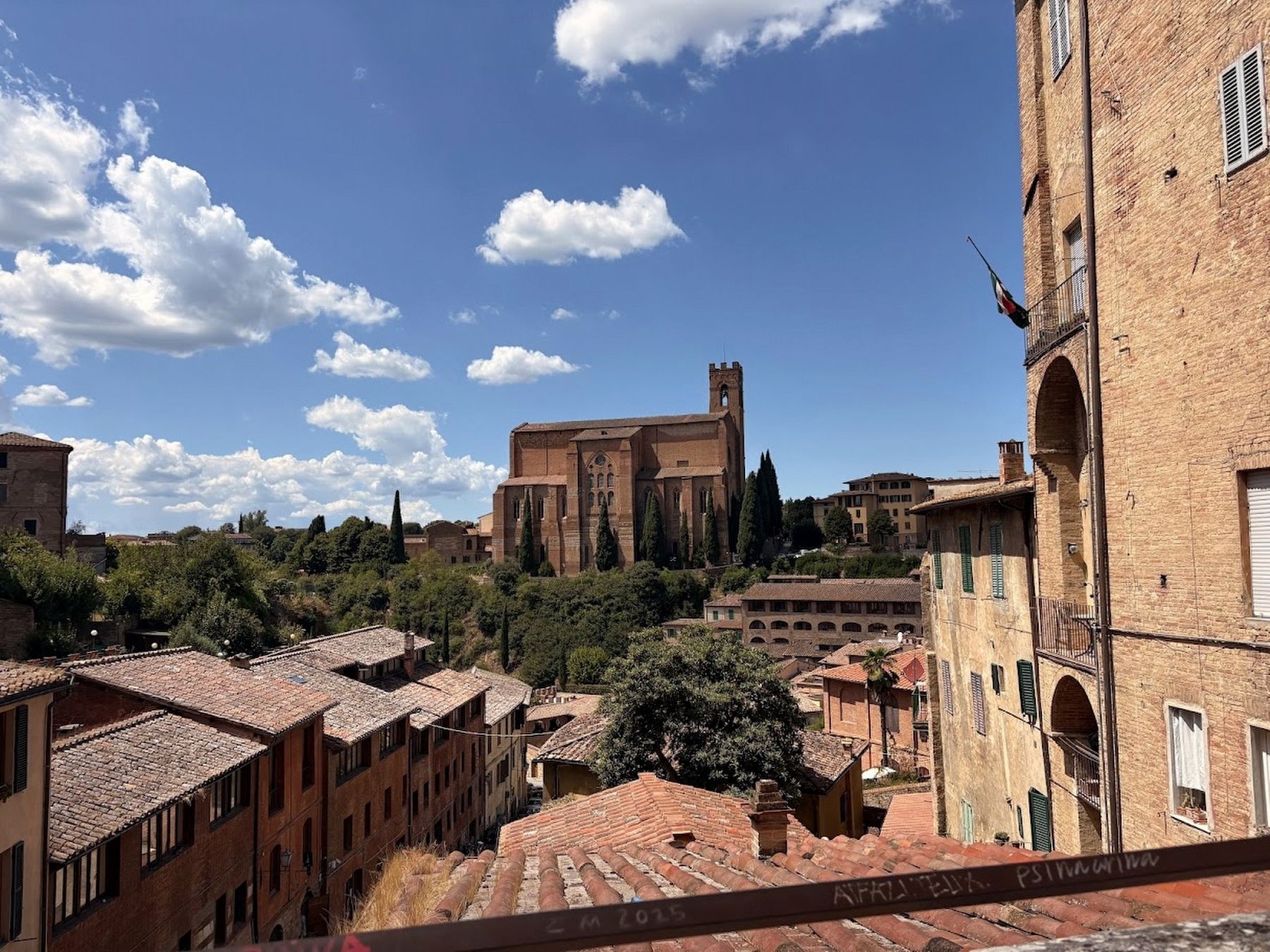
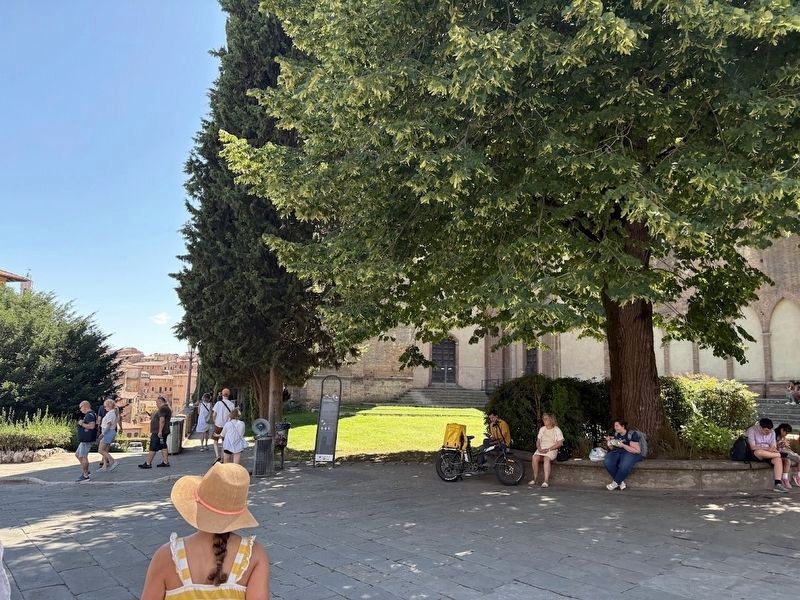
3. Basilica of San Domenico
Location. 43° 19.213′ N, 11° 19.606′ E. Marker is in Siena, Toscana (Tuscany), in Provincia di Siena. It is on Piazza San Domenico, on the right when traveling south. Touch for map. Marker is at or near this postal address: Piazza San Domenico 1, Siena, Toscana 53100, Italy. Touch for directions.

Regionally, it is in Europe, the European Union, the Schengen Area, a coastal Mediterranean country, and the Western World. Historically, it finds itself in what was once the Roman Empire and specifically also the Holy Roman Empire.
Other nearby markers. At least 8 other markers are within 21 kilometers
Photographed by Sean P. Flynn, July 31, 2025
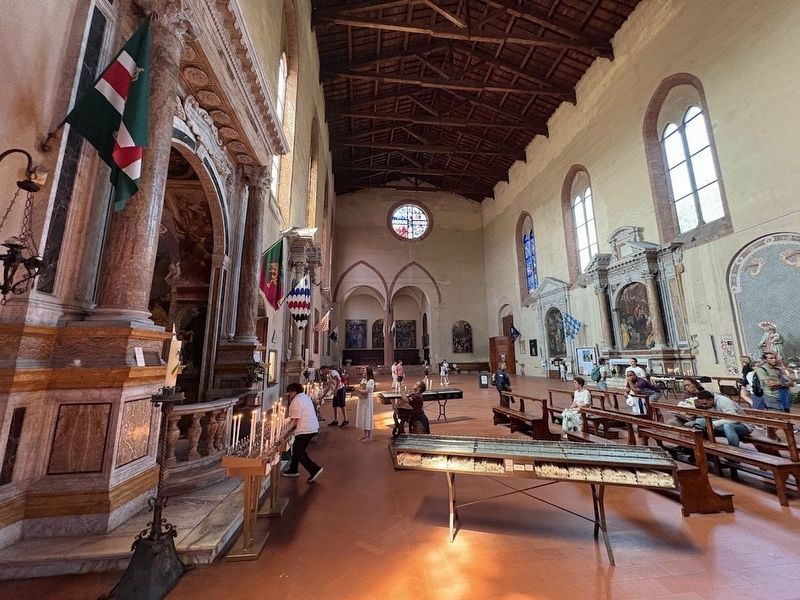
4. Inside the Basilica of San Domenico
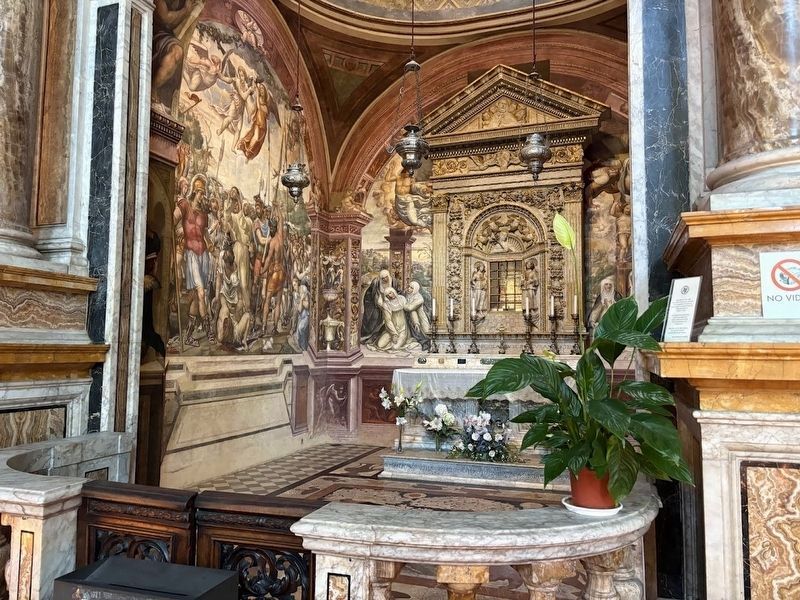
The altar featuring the head of St. Catherine is on the left side of this photo.
Regarding Sant'Antonio in San Domenico. St. Catherine, patroness of Europe and Italy, was born and raised in Siena and attended church here at San Domenico. She died in
Photographed by Sean P. Flynn, July 31, 2025
5. Sant'Antonio in San Domenico Marker
Also see . . . The Relics of St. Catherine. From the Municipality of Siena's tourism website
Excerpt: "So, the mummified head of St Catherine was displayed in the centre of the chapel, behind a grid. It’s surrounded by the striking frescoes by Sodoma on the Ecstasy of the Saint and The Fainting Caused by the Stigmata. The beauty of the painting reflects the greatness of the mind of the young Sienese girl."(Submitted on March 5, 2026, by Sean P. Flynn of Oak Park, Illinois.)
Photographed by Sean P. Flynn, July 31, 2025
6. Altar with Catherine's head at the Basilica of San Domenico
Photographed by Sean P. Flynn, July 31, 2025
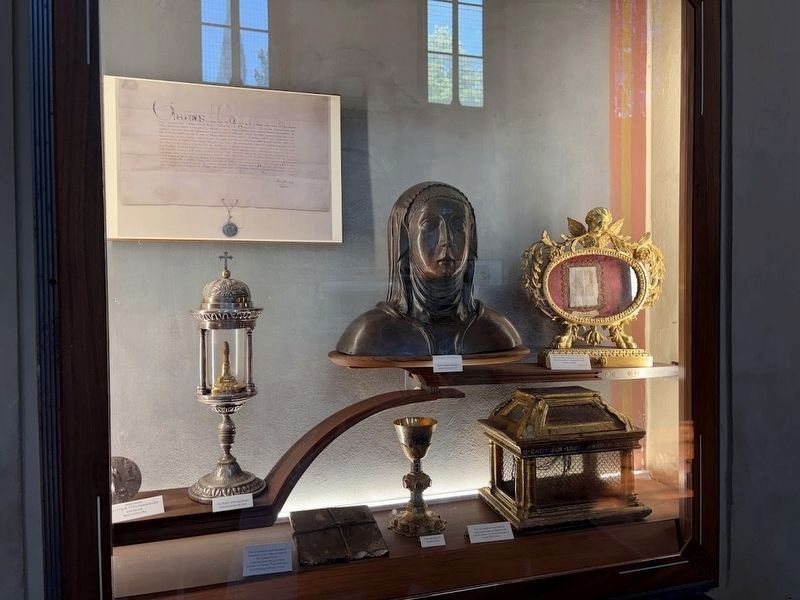
7. Relics of St. Catherine of Siena at San Domenico
Relics on display here include one of her fingers.
Photographed by Sean P. Flynn, July 31, 2025
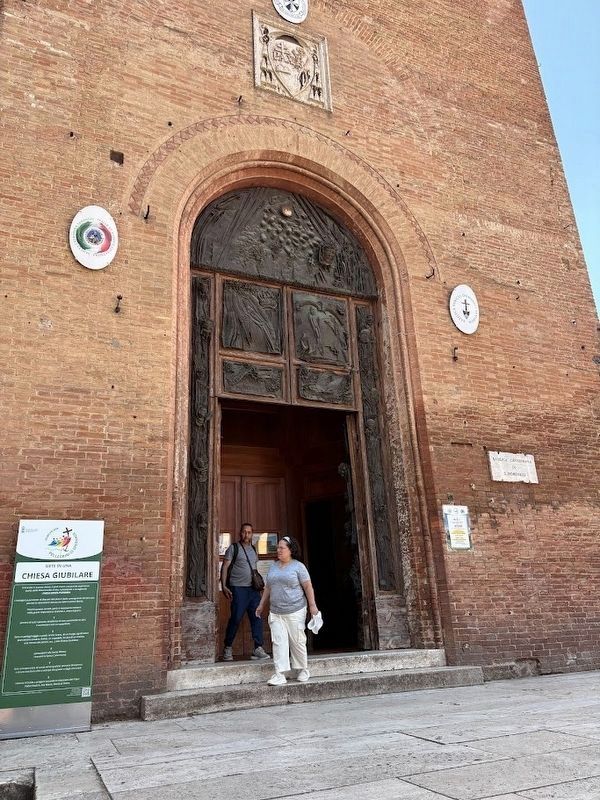
8. The doors of San Domenico
Credits. This page was last revised on March 5, 2026. It was originally submitted on September 2, 2025, by Sean P. Flynn of Oak Park, Illinois. This page has been viewed 92 times since then and 32 times this year. Photos: 1. submitted on September 2, 2025, by Sean P. Flynn of Oak Park, Illinois. 2, 3, 4, 5. submitted on September 3, 2025, by Sean P. Flynn of Oak Park, Illinois. 6, 7. submitted on September 4, 2025, by Sean P. Flynn of Oak Park, Illinois. 8. submitted on September 3, 2025, by Sean P. Flynn of Oak Park, Illinois.
