Goleta in Santa Barbara County, California — The American West (Pacific Coastal)
Sea Otter Hunting
Soft Gold
Photographed by Craig Baker
1. Sea Otter Hunting Marker
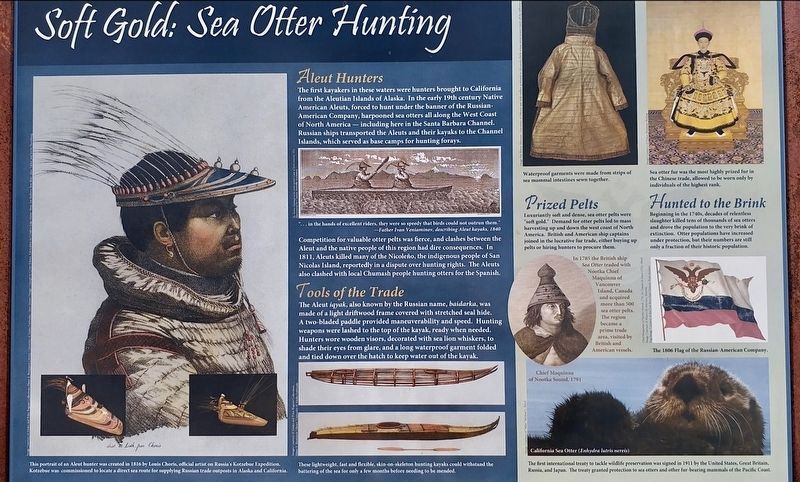
Aleut Hunters
The first kayakers in these waters were hunters brought to California from the Aleutian Islands of Alaska. In the early 19th century Native American Aleuts, forced to hunt under the banner of the Russian-American Company, harpooned sea otters all along the West Coast of North America - including here in the Santa Barbara Channel. Russian ships transported the Aleuts and their kayaks to the Channel Islands, which served as base camps for hunting forays.
Competition for valuable otter pelts was fierce, and clashes between the Aleut and the native people of this region had dire consequences. In 1811, Aleuts killed many of the Nicoleño, the indigenous people of San Nicolas Island, reportedly in a dispute over hunting rights. The Aleuts also clashed with local Chumash people hunting otters for the Spanish.
Tools of the Trade
The Aleut igyak, also known by the Russian name, baidarka, was made of a light driftwood frame covered with stretched seal hide. A two-bladed paddle provided maneuverability and speed. Hunting weapons were lashed to the top of the kayak, ready when
this page online
Prized Pelts
Luxuriously soft and dense, sea otter pelts were “soft gold.” Demand for otter pelts led to mass harvesting up and down the west coast of North America. British and and American ship captains joined the lucrative fur trade, either buying pelts or hiring hunters to procure them. In 1785 the British ship Sea Otter traded with Nootka Chief Maquinna of Vancouver Island, Canada and acquired more than 500 sea otter pelts. The region became a prime trade area, visited by British and American vessels.
Hunted to the Brink
Beginning in the 1740s, decades of relentless slaughter killed tens of thousands of sea otters and drove the population to the very brink of extinction. Otter populations have increased under protection, but their numbers are still only a fraction of their historic population.
Topics. This historical marker is listed in these topic lists: Animals • Indigenous Peoples and Communities
Photographed by Craig Baker
2. Sea Otter Hunting Marker
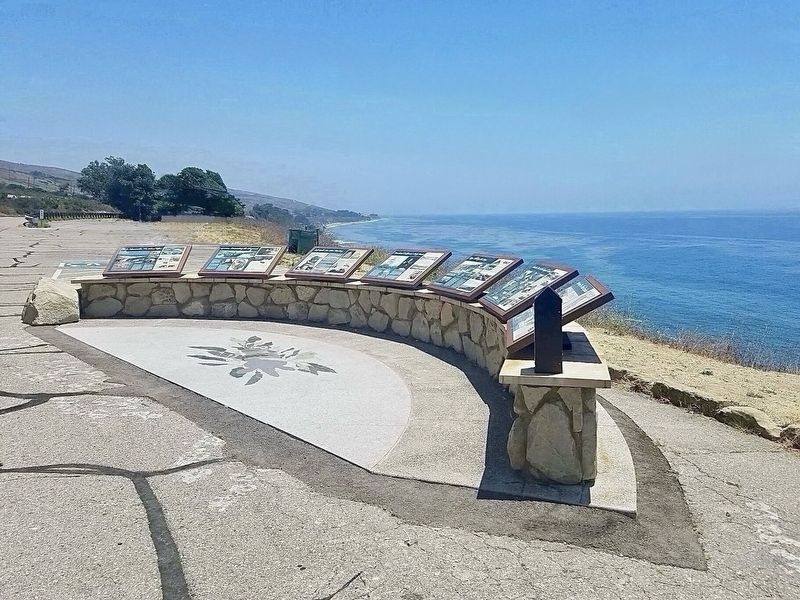
Location. 34° 28.437′ N, 120° 8.21′ W. Marker is in Goleta, California, in Santa Barbara County. It can be reached from U.S. 101, on the right when traveling east. Located at Arroyo Hondo Vista Point, only accessible from the eastbound lanes. Touch for map. Marker is in this post office area: Goleta CA 93117, United States of America. Touch for directions.

Regionally, this marker is on the Central Coast, specifically on the Coast Ranges, and specifically in the Transverse Ranges. It is also on the American Pacific Coast. Globally, it is in North America, on the Ring of Fire, on the Pacific Rim, in the Western Hemisphere, in the Western World, and in the Anglosphere. Historically, it finds itself in what was once New Spain and also Mexico’s Alta California.
Other nearby markers. At least 8 other markers are within 6 miles of this marker, measured as the crow flies: Gaviota: Pass to the Seagull’s Coast (here, next to this marker); Bouchard: California’s Only Pirate (here, next to this marker); Mini-Mammoths (here, next to this marker); Tomol (a few steps from this marker); Rigs: Drilling the Deep (a few steps from this marker); Bicycling (a few steps from this marker); Arroyo Hondo Fish Passage & Upstream Habitat Restoration (approx. 0.2 miles away); Gaviota Timeline: 7) Highways and Byways (approx. 5.3 miles away). Touch for a list and map of all markers in Goleta.
Related marker. Click here for another marker that is related to this marker. - Juana Maria, the last of the indigenous people of San Nicolas Island.
Credits. This page was last revised on September 3, 2025. It was originally submitted on September 3, 2025, by Craig Baker of Sylmar, California. This page has been viewed 139 times since then and 63 times this year. Photos: 1, 2. submitted on September 3, 2025, by Craig Baker of Sylmar, California.
