Goleta in Santa Barbara County, California — The American West (Pacific Coastal)
Mini-Mammoths
The Island Effect
Photographed by Craig Baker, August 1, 2025
1. Mini-Mammoths Marker
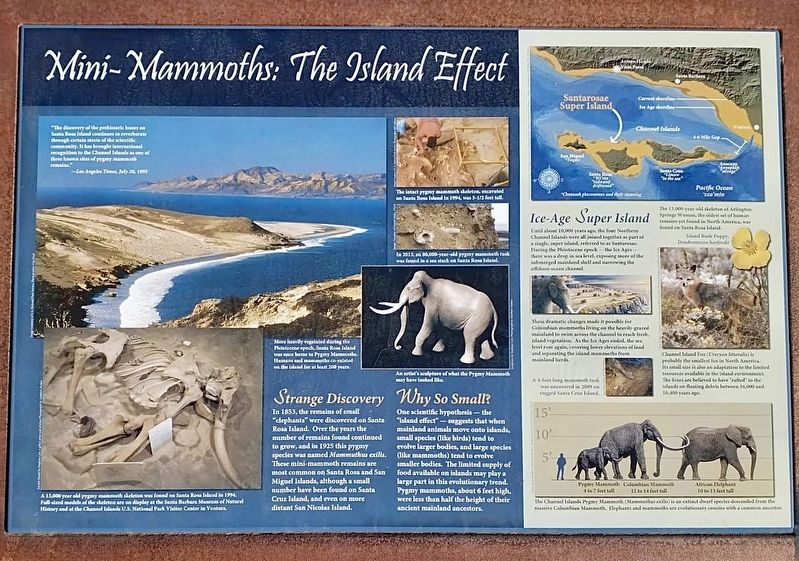
Strange Discovery
In 1853, the remains of small "elephants" were discovered on Santa Rosa Island. Over the years the number of remains found continued to grow, and in 1925 this pygmy species was named Mammuthus exilis. These mini-mammoth remains are most common on Santa Rosa and San Miguel Islands, although a small number have been found on Santa Cruz Island, and even on more distant San Nicolas Island.
Why So Small?
One scientific hypothesis - the "island effect" — suggests that when mainland animals move onto islands, small species (like birds) tend to evolve larger bodies, and large species (like mammoths) tend to evolve smaller bodies. The limited supply of food available on islands may play a large part in this evolutionary trend. Pygmy mammoths, about 6 feet high, were less than half the height of their ancient mainland ancestors.
Ice-Age Super Island
Until about 10,000 years ago, the four Northern Channel Islands were all joined together as part of a single, super island, referred to as Santarosac. During the Pleistocene epoch - the Ice Ages - there was a drop in sea level, exposing
this page online
These dramatic changes made it possible for Columbian mammoths living on the heavily-grazed mainland to swim across the channel to reach fresh island vegetation. As the Ice Ages ended, the sea level rose again, covering lower elevations of land and separating the island mammoths from mainland herds.
photo captions:
· A 13,000 year old pygmy mammoth skeleton was found on Santa Rosa Island in 1994. Full-sized models of the skeleton are on display at the Santa Barbara Museum of Natural History and at the Channel Islands U.S. National Park Visitor Center in Ventura.
· The intact pygmy mammoth skeleton, excavated on Santa Rosa Island in 1994, was 5½ feet tall.
· More heavily vegetated during the Pleistocene epoch, Santa Rosa Island was once home to Pygmy Mammoths. Humans and mammoths co-existed on the island for at least 200 years.
· The 13,000-year-old skeleton of Arlington Springs Woman, the oldest set of human remains yet found in North America, was found on Santa Rosa Island.
· Channel Island Fox (Urocvon littoralis)
Photographed by Craig Baker
2. Mini-Mammoths Marker
Topics. This historical marker is listed in these topic lists: Animals • Anthropology & Archaeology. A significant historical year for this entry is 1853.
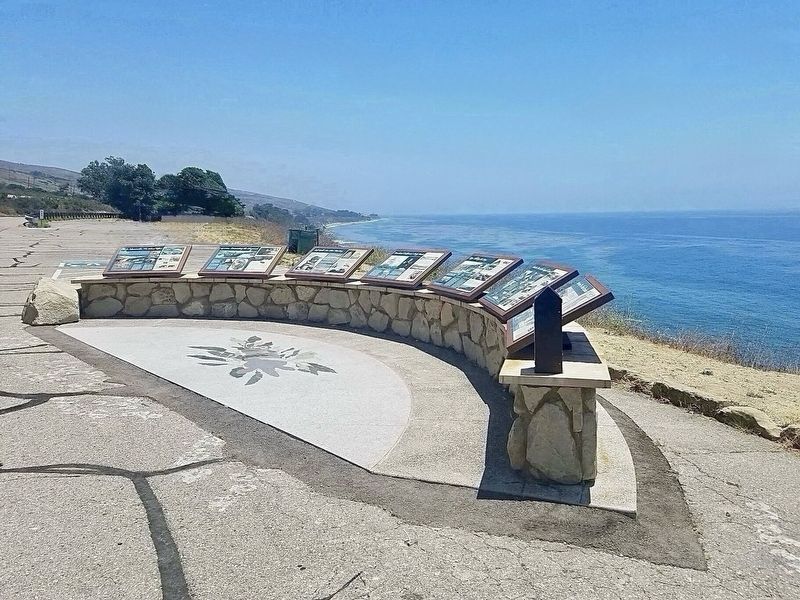
Location. 34° 28.439′ N, 120° 8.215′ W. Marker is in Goleta, California, in Santa Barbara County. It is on El Camino Real, on the right when traveling east. Located at Arroyo Hondo Vista Point, only accessible from the eastbound lanes. Touch for map. Marker is in this post office area: Goleta CA 93117, United States of America. Touch for directions.

Regionally, this marker is on the Central Coast, specifically on the Coast Ranges, and specifically in the Transverse Ranges. It is also on the American Pacific Coast. Globally, it is in North America, on the Ring of Fire, on the Pacific Rim, in the Western Hemisphere, in the Western World, and in the Anglosphere. Historically, it finds itself in what was once New Spain and also Mexico’s Alta California.
Other nearby markers. At least 8 other markers are within 6 miles of this marker, measured as the crow flies: Rigs: Drilling the Deep (here, next to this marker); Bicycling (here, next to this marker); Bouchard: California’s Only Pirate (here, next to this marker); Sea Otter Hunting (here, next to this marker); Gaviota: Pass to the Seagull’s Coast (a few steps from this marker); Tomol (a few steps from this marker); Arroyo Hondo Fish Passage & Upstream Habitat Restoration (approx. 0.2 miles away); Gaviota Timeline: 7) Highways and Byways (approx. 5.3 miles away). Touch for a list and map of all markers in Goleta.
Credits. This page was last revised on September 3, 2025. It was originally submitted on September 3, 2025, by Craig Baker of Sylmar, California. This page has been viewed 122 times since then and 40 times this year. Photos: 1, 2. submitted on September 3, 2025, by Craig Baker of Sylmar, California.
