Hoboken in Hudson County, New Jersey — The American Northeast (Mid-Atlantic)
Architectural Design of the Hoboken Ferry Terminal
By Devry Becker Jones (CC0), August 30, 2025
1. Architectural Design of the Hoboken Ferry Terminal Marker
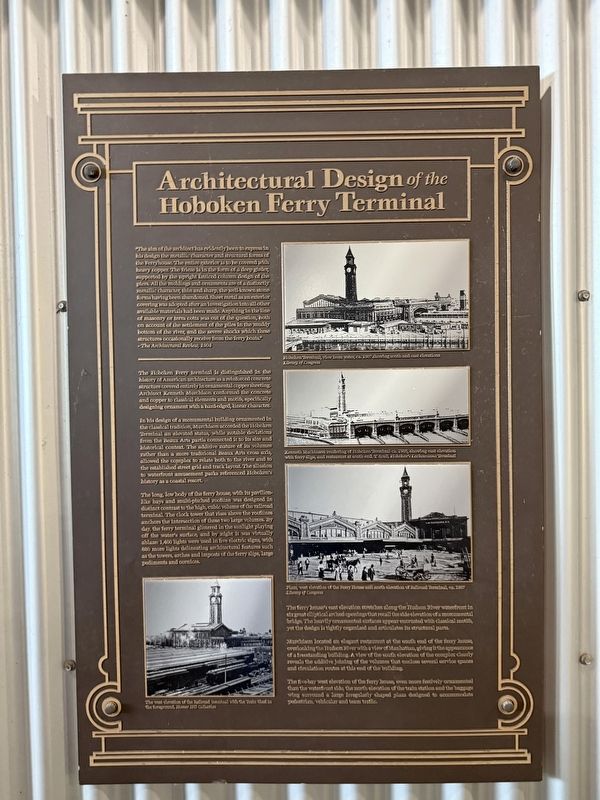
"The aim of the architect has evidently been to express in his design the metallic character and structural forms of the Ferryhouse. The entire exterior is to be covered with heavy copper. The frieze is in form of a deep girder, supported by the upright latticed column design of the piers. all the moldings and ornaments are of a distinctly metallic character, thin and sharp, the well-known stone forms having been abandoned. Sheet metal as an exterior covering was adopted after an investigation into all other available materials had been made. Anything in the line of masonry or terra cotta was out of the question, both on account of the settlement of the piles in the muddy bottom of the river and the severe shocks which these structures occasionally receive from the ferry boats."
– The Architectural Review, 1904
The Hoboken Ferry terminal is distinguished in the history of American architecture as a reinforced concrete structure covered entirely in ornamental coppersheeting. Architect Kenneth Murchison conformed the concrete and copper to classical elements and motifs, specifically designing ornament with a hard-edged,
this page online
In his design of a monumental building ornamented in the classical tradition, Murchison accorded the Hoboken Terminal an elevated status, while notable deviations from the Beaux Arts partis connected it to its site and historical context. The additive nature of its volumes rather than a more traditional Beaux Arts cross axis, allowed the complex to relate both to the river and to the established street grid and track layout. The allusion to waterfront amusement parks referenced Hoboken's history as a coastal resort.
The long, low body of the ferry house, with its pavilion-like bays and multi-pitched roofline was designed in distinct contrast to the high, cubic volume of the railroad terminal. The clock tower that rises above the rooflines anchors the intersection of these two large volumes. By day, the ferry terminal glittered in the sunlight playing off the water's surface, and by night it was virtually ablaze: 1,400 lights were used in five electric signs, with 880 more lights delineating architectural features such as the towers, arches and imposts of the ferry slips, large pediments and cornices.
The ferry
Photographed by Devry Becker Jones (CC0), August 30, 2025
2. Hoboken Ferry Terminal markers
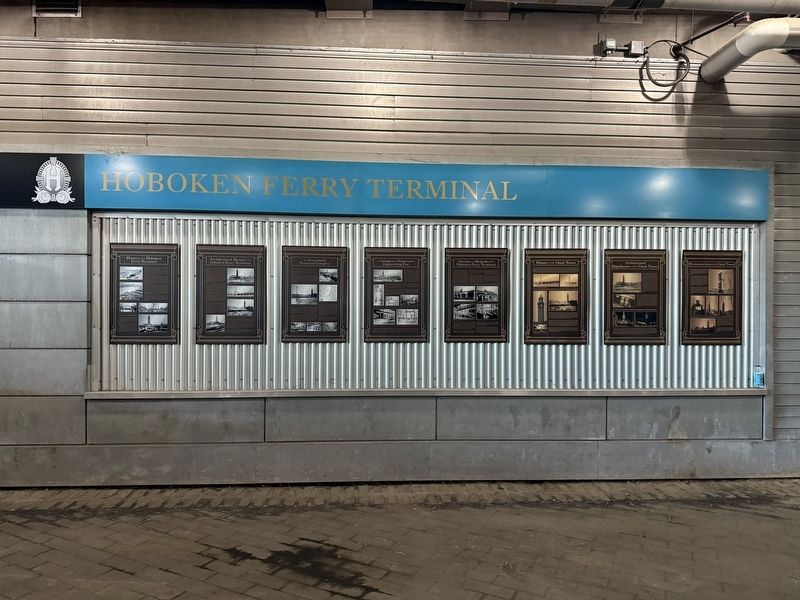
This set of markers can be found between the rail station and the ferry docks. It is partially open-air with entrances to the rail station, and gates that open to ferries as they arrive and depart.
Murchison located an elegant restaurant at the south end of the ferry house, overlooking the Hudson River with a view of Manhattan, giving it the appearance of a freestanding building. A view of the south elevation of the complex clearly reveals the additive joining of the volumes that enclose several service spaces and circulation routes at this end of the building.
The five-bay west elevation of the ferry house, even more festively ornamented than the waterfront side, the north elevation of the train station and the baggage wing surround a large irregularly shaped plaza designed to accommodate pedestrian, vehicular and team traffic.
Topics. This historical marker is listed in these topic lists: Architecture • Industry & Commerce • Railroads & Streetcars • Waterways & Vessels. A significant historical year for this entry is 1904.
Location. 40° 44.107′ N, 74° 1.649′ W. Marker is in Hoboken, New Jersey, in Hudson County. It is on Hudson Place (County Road 736) east of River Street, on the right when traveling east. he marker is on the grounds of the Hoboken Transit Terminal between the rail station and the ferry docks. The area is partially open-air. Touch for map. Marker is at or near this postal address: 1 Hudson Pl, Hoboken NJ 07030, United States of America. Touch for directions.

Regionally, this marker is in North Jersey, in Greater Newark, and in the New York City Metropolitan Area. It is also in the American Northeast, in the Mid-Atlantic, and on the Eastern Seaboard. Globally, it is in the North Atlantic Region, North America, the Western Hemisphere, the Western World, and the Anglosphere. Historically, it finds itself in what was once New Netherland and also one of the original Thirteen Colonies.
Other nearby markers. At least 8 other markers are within walking distance of this marker: The Intermodal Terminal Complex (here, next to this marker); A Complex and Innovative Engineering Feat (here, next to this marker); Decline and Rebirth of the Hoboken Ferry Terminal (here, next to this marker); History of the Clock Tower (here, next to this marker); Architectural Significance of the Clock Tower (here, next to this marker); History of the Hoboken Ferry Terminal (here, next to this marker); Reconstruction of the Clock Tower (within shouting distance of this marker); We Remember (about 500 feet away, measured in a direct line). Touch for a list and map of all markers in Hoboken.
Credits. This page was last revised on September 3, 2025. It was originally submitted on September 3, 2025, by Devry Becker Jones of Washington, District of Columbia. This page has been viewed 116 times since then and 31 times this year. Photos: 1, 2. submitted on September 3, 2025, by Devry Becker Jones of Washington, District of Columbia.
