Hoboken in Hudson County, New Jersey — The American Northeast (Mid-Atlantic)
A Complex and Innovative Engineering Feat
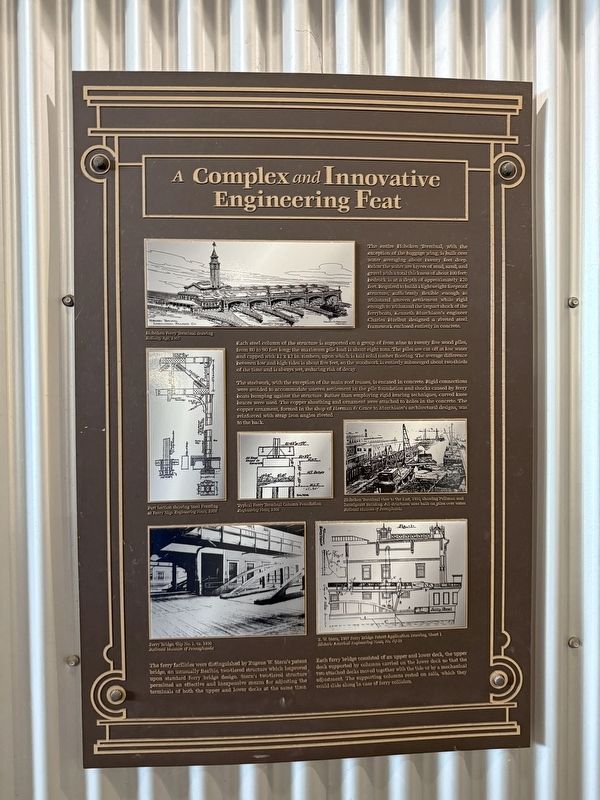
The entire Hoboken Terminal, with the exception of the baggage wing, is built over water averaging about twenty feet deep. Below the water are layers of mud, sand, and gravel with a total thickness of about 100 feet; bedrock is at a depth of approximately 120 feet. Required to build a lightweight fireproof structure, sufficiently flexible enough to withstand uneven settlement while rigid enough to withstand the impact shock of the ferryboats, Kenneth Murchison's engineer Charles Hurlbut designed a riveted steel framework enclosed entirely in concrete.
Each steel column of the structure is supported on a group of from nine to twenty five wood piles, from 80 to 90 feet long; the maximum pile load is about eight tons. The piles are cut off at low water and capped with 12 x 12 in. timbers, which is laid solid timber flooring. The average difference between low and high tides is about five feet, so the woodwork is entirely submerged about two-thirds of the time and is always wet, reducing risk of decay.
The steelwork, with the exception of the main roof trusses, is encased in concrete. Rigid connections were avoided
this page online
The ferry facilities were distinguished by Eugene W. Stern's patent bridge, an unusually flexible, two-tiered structure which improved upon standard ferry bridge design. Stern's two-tiered structure permitted an effective and inexpensive means for adjusting the terminals of both the upper and lower decks at the same time.
Each ferry bridge consisted of an upper and lower deck, the upper deck supported by columns carried on the lower deck so that the two attached decks moved together with the tide or by a mechanical adjustment. The supporting columns rested on rails, which they could slide along in case of ferry collision.
Topics. This historical marker is listed in these topic lists: Architecture •
Photographed by Devry Becker Jones (CC0), August 30, 2025
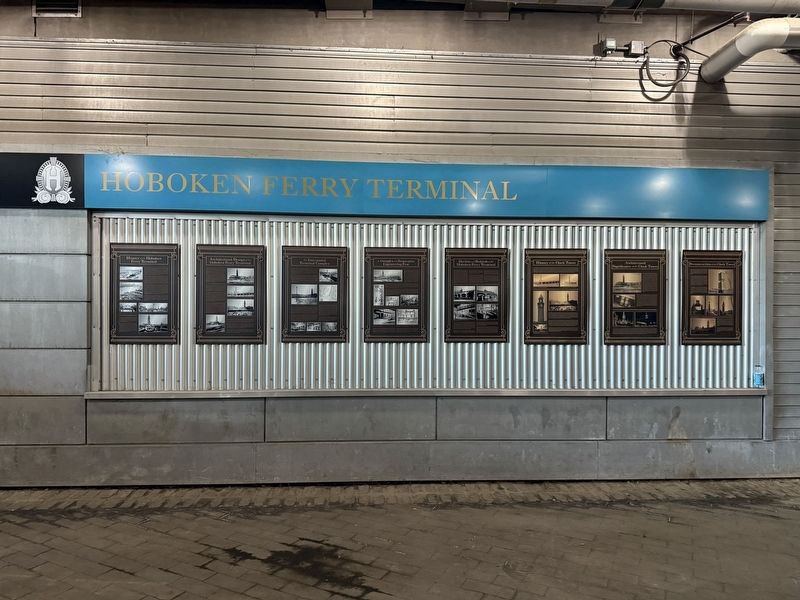
2. Hoboken Ferry Terminal markers
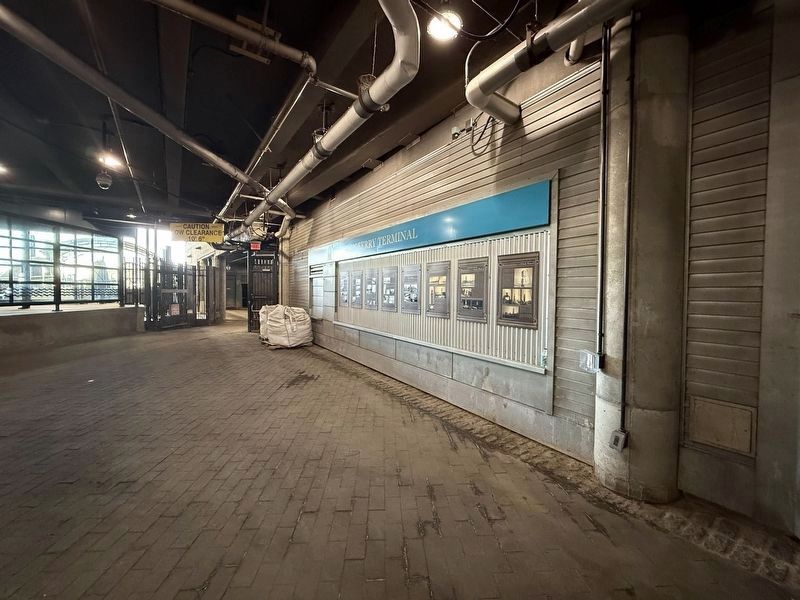
This set of markers can be found between the rail station and the ferry docks. It is partially open-air with entrances to the rail station, and gates that open to ferries as they arrive and depart.
Location. 40° 44.107′ N, 74° 1.649′ W. Marker is in Hoboken, New Jersey, in Hudson County. It can be reached from Hudson Place (County Road 736) east of River Street, on the right when traveling east. Touch for map. Marker is at or near this postal address: 1 Hudson Pl, Hoboken NJ 07030, United States of America. Touch for directions.

Regionally, this marker is in North Jersey, in Greater Newark, and in the New York City Metropolitan Area. It is also in the American Northeast, in the Mid-Atlantic, and on the Eastern Seaboard. Globally, it is in the North Atlantic Region, North America, the Western Hemisphere, the Western World, and the Anglosphere. Historically, it finds itself in what was once New Netherland and also one of the original Thirteen Colonies.
Other nearby markers. At least 8 other markers are within walking distance of this marker: Architectural Design of the Hoboken Ferry Terminal (here, next to this marker); The Intermodal Terminal Complex (here, next to this marker); Decline and Rebirth of the Hoboken Ferry Terminal
Credits. This page was last revised on September 3, 2025. It was originally submitted on September 3, 2025, by Devry Becker Jones of Washington, District of Columbia. This page has been viewed 93 times since then and 30 times this year. Photos: 1, 2, 3. submitted on September 3, 2025, by Devry Becker Jones of Washington, District of Columbia.
