Hoboken in Hudson County, New Jersey — The American Northeast (Mid-Atlantic)
Decline and Rebirth of the Hoboken Ferry Terminal
By Devry Becker Jones (CC0), August 30, 2025
1. Decline and Rebirth of the Hoboken Ferry Terminal Marker
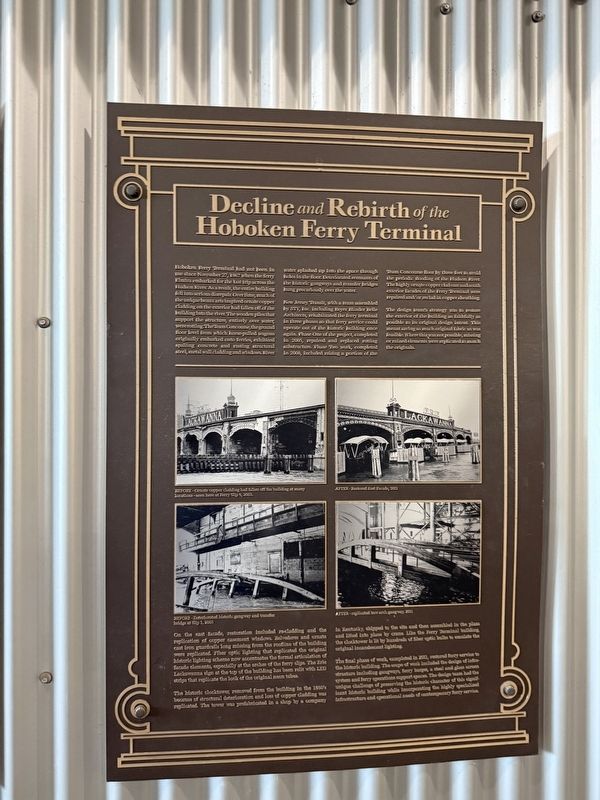
Hoboken Ferry Terminal had not been in use since November 27, 1967 when the ferry Elmira embarked for the last trip across the Hudson River. As a result, the entire building fell into serious disrepair. Over time, much of the unique beaux arts inspired ornate copper cladding on the exterior had fallen off the building into the river. The wooden piles that support the structure, entirely over water, were rotting. The Team Concourse, the ground floor level from which horse-pulled wagons originally embarked onto ferries, exhibited spalling concrete and rusting structural steel, metal wall cladding and windows. River water splashed up into the space through holes in the floor. Deteriorated remnants of the historic gangways and transfer bridges hung precariously over the water.
New Jersey Transit, with a team assembled by STV, Inc. including Beyer Blinder Belle Architects, rehabilitated the ferry terminal in three phases so that ferry service could operate out of the historic building once again. Phase One of the project, completed in 2005, repaired and replaced rotting substructure. Phase Two work, completed in 2008, included
this page online
The design team's strategy was to restore the exterior of the building as faithfully as possible to its original design intent. This meant saving as much original fabric as was feasible. Where this was not possible, missing or ruined elements were replicated to match the originals.
On the east facade, restoration included re-cladding and the replication of copper casement windows. Belvederes and ornate cast iron guardrails long missing from the roofline of the building were replicated. Fiber optic lighting that replicated the original historic lighting scheme now accentuates the formal articulation of facade elements, especially at the arches of the ferry slips. The Erie Lackawanna sign at the top of the building has been relit with LED strips that replicate the look of the original neon tubes.
The historic clocktower, removed from the building in the 1950's because of structural deterioration

Photographed by Devry Becker Jones (CC0), August 30, 2025
2. Hoboken Ferry Terminal markers
This set of markers can be found between the rail station and the ferry docks. It is partially open-air with entrances to the rail station, and gates that open to ferries as they arrive and depart.
The final phase of the work, completed in 2011, restored ferry service to the historic building. The scope of work included the design of infrastructure including gangways, ferry barges, and steel and glass screen system and ferry operations support spaces. The design team had the unique challenge of preserving the historic character of this significant historic building while incorporating the highly specialized infrastructure and operational needs of contemporary ferry services.
Topics. This historical marker is listed in these topic lists: Architecture • Communications • Industry & Commerce • Waterways & Vessels. A significant historical date for this entry is November 27, 1967.
Location. 40° 44.107′ N, 74° 1.651′ W. Marker is in Hoboken, New Jersey, in Hudson County. It can be reached from Hudson Place (County Road 736) east of River Street, on the right when traveling west. The marker is on the grounds of the Hoboken Transit Terminal between the rail station and the ferry docks. The area is partially open-air. Touch for map. Marker is at or near this postal address: 1 Hudson Pl, Hoboken NJ 07030, United States of America. Touch for directions.

Regionally, this marker is in North Jersey, in Greater Newark, and in the New York City Metropolitan Area. It is also in the American Northeast, in the Mid-Atlantic, and on the Eastern Seaboard. Globally, it is in the North Atlantic Region, North America, the Western Hemisphere, the Western World, and the Anglosphere. Historically, it finds itself in what was once New Netherland and also one of the original Thirteen Colonies.
Other nearby markers. At least 8 other markers are within walking distance of this marker: History of the Clock Tower (here, next to this marker); Architectural Significance of the Clock Tower (here, next to this marker); Architectural Design of the Hoboken Ferry Terminal (here, next to this marker); The Intermodal Terminal Complex (here, next to this marker); A Complex and Innovative Engineering Feat (here, next to this marker); History of the Hoboken Ferry Terminal (here, next to this marker); Reconstruction of the Clock Tower (within shouting distance of this marker); We Remember (about 500 feet away, measured in a direct line). Touch for a list and map of all markers in Hoboken.
Credits. This page was last revised on September 3, 2025. It was originally submitted on September 3, 2025, by Devry Becker Jones of Washington, District of Columbia. This page has been viewed 146 times since then and 36 times this year. Photos: 1, 2. submitted on September 3, 2025, by Devry Becker Jones of Washington, District of Columbia.
