Hoboken in Hudson County, New Jersey — The American Northeast (Mid-Atlantic)
History of the Clock Tower
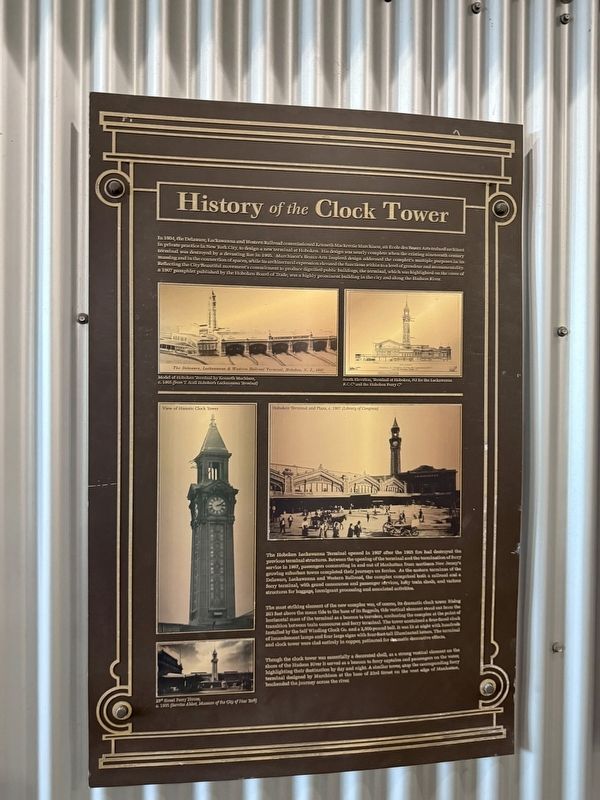
In 1904, the Delaware, Lackawanna and Western Railroad commissioned Kenneth Mackenzie Murchison, an Ecole des Beaux Arts trained architect in private practice in New York City, to design a new terminal at Hoboken. His design was nearly complete when the existing nineteenth century terminal was destroyed by a devasting fire in 1905. Murchison's Beaux-Arts inspired design addressed the complex's multiple purposes in its massing and in the connection of spaces, while its architectural expression elevated the function within to a level of grandeur and monumentality. Reflecting the City Beautiful movement's commitment to produce dignified public buildings, the terminal, which was highlighted on the cover of a 1907 pamphlet published by the Hoboken Board of Trade, was a highly prominent building in the city and along the Hudson River.
The Hoboken Lackawanna Terminal opened in 1907 after the 1905 fire had destroyed its previous terminal structures. Between the opening of the terminal and the termination of ferry service in 1967, passengers commuting in and out of Manhattan from northern New Jersey's growing suburban towns
this page online
The most striking element of the new complex was, of course, the dramatic clock tower. Rising 203 feet above the mean tide to the base of its flagpole, this vertical elements stood out from the horizontal mass of the terminal as a beacon to travelers, anchoring the complex at the point of transition between train concourse and ferry terminal. The tower contained a four-faced clock installed by the Self Winding Clock Co. and a 2,500-pound bell. It was lit at night with hundreds of incandescent lamps and four large signs with four-foot-tall illuminated letters. The terminal and clock tower were clad entirely in copper, patinated for dramatic decorative effects.
Though the clock tower was essentially a decorated shell, as a strong vertical element on the shore of the Hudson River it served as a beacon to ferry captains

Photographed by Devry Becker Jones (CC0), August 30, 2025
2. Hoboken Ferry Terminal markers
This set of markers can be found between the rail station and the ferry docks. It is partially open-air with entrances to the rail station, and gates that open to ferries as they arrive and depart.
Topics. This historical marker is listed in these topic lists: Architecture • Industry & Commerce • Railroads & Streetcars • Women. A significant historical year for this entry is 1904.
Location. 40° 44.107′ N, 74° 1.651′ W. Marker is in Hoboken, New Jersey, in Hudson County. It can be reached from Hudson Place (County Road 736) east of River Street, on the right when traveling east. The marker is on the grounds of the Hoboken Transit Terminal between the rail station and the ferry docks. The area is partially open-air. Touch for map. Marker is at or near this postal address: 1 Hudson Pl, Hoboken NJ 07030, United States of America. Touch for directions.

Regionally, this marker is in North Jersey, in Greater Newark, and in the New York City Metropolitan Area. It is also in the American Northeast, in the Mid-Atlantic, and on the Eastern Seaboard. Globally, it is in the North Atlantic Region, North America, the Western Hemisphere, the Western World, and the Anglosphere. Historically, it finds itself in what was once New Netherland and also one of the original Thirteen Colonies.
Other nearby markers. At least 8 other markers are within walking distance of this marker: Decline and Rebirth of the Hoboken Ferry Terminal (here, next to this marker); Architectural Significance of the Clock Tower (here, next to this marker); Architectural Design of the Hoboken Ferry Terminal (here, next to this marker); The Intermodal Terminal Complex (here, next to this marker); A Complex and Innovative Engineering Feat (here, next to this marker); History of the Hoboken Ferry Terminal (here, next to this marker); Reconstruction of the Clock Tower (within shouting distance of this marker); We Remember (about 500 feet away, measured in a direct line). Touch for a list and map of all markers in Hoboken.
Credits. This page was last revised on September 3, 2025. It was originally submitted on September 3, 2025, by Devry Becker Jones of Washington, District of Columbia. This page has been viewed 178 times since then and 52 times this year. Photos: 1, 2. submitted on September 3, 2025, by Devry Becker Jones of Washington, District of Columbia.
