Hoboken in Hudson County, New Jersey — The American Northeast (Mid-Atlantic)
Architectural Significance of the Clock Tower
By Devry Becker Jones (CC0), August 30, 2025
1. Architectural Significance of the Clock Tower Marker
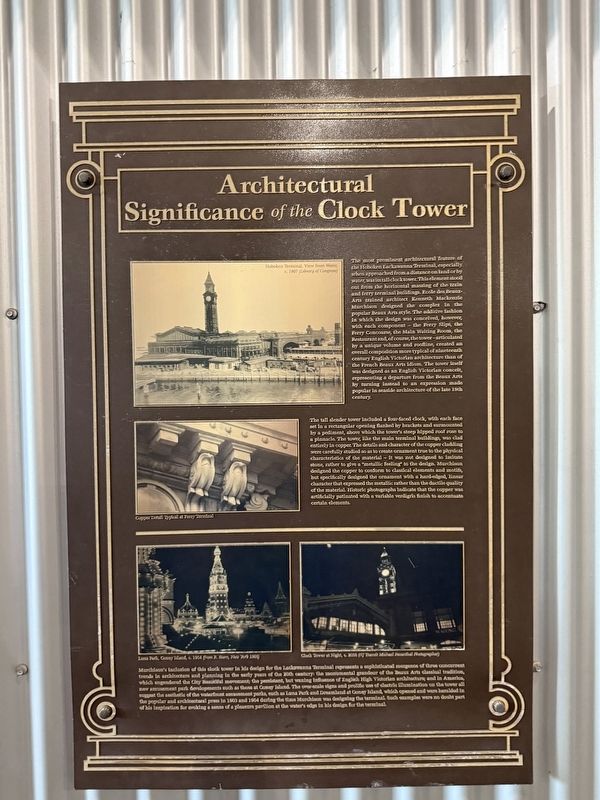
The most prominent architectural feature of the Hoboken Lackawanna Terminal, especially when approached from a distance on land or by water, was its tall clock tower. This element stood out from the horizontal massing of the train and ferry terminal buildings. Ecole des Beaux-Arts trained architect Kenneth Mackenzie Murchison designed the complex in the popular Beaux Arts style. The additive fashion in which the design was conceived, however, with each component — the Ferry Slips, the Ferry Concourse, the Main Waiting Room, the Restaurant, and of course, the tower — articulated by a unique volume and roofline, created an overall composition more typical of nineteenth century English Victorian architecture than of the French Beaux Arts idiom. The tower itself was designed as an English Victorian conceit, representing a departure from the Beaux Arts by turning instead to an expression made popular in seaside architecture of the late 19th century.
The tall slender tower included a four-faced clock, with each face set in a rectangular opening flanked by brackets and surmounted by a pediment, above which the tower's steep
this page online
Murchison's inclusion of this clock tower in his design for the Lackawanna Terminal represents a sophisticated mergence of three trends in architecture and planning in the early years of the 20th century: the monumental grandeur of the Beaux Arts classical tradition, which engendered the City Beautiful movement; the persistent, but waning influence of English High Victorian architecture, and in America, new amusement park developments

Photographed by Devry Becker Jones (CC0), August 30, 2025
2. Hoboken Ferry Terminal markers
This set of markers can be found between the rail station and the ferry docks. It is partially open-air with entrances to the rail station, and gates that open to ferries as they arrive and depart.
Topics. This historical marker is listed in these topic lists: Architecture • Parks & Recreational Areas • Railroads & Streetcars. A significant historical year for this entry is 1903.
Location. 40° 44.107′ N, 74° 1.651′ W. Marker is in Hoboken, New Jersey, in Hudson County. It can be reached from Hudson Place (County Road 736) east of River Street, on the right when traveling east. The marker is on the grounds of the Hoboken Transit Terminal between the rail station and the ferry docks. The area is partially open-air. Touch for map. Marker is at or near this postal address: 1 Hudson Pl, Hoboken NJ 07030, United States of America. Touch for directions.

Regionally, this marker is in North Jersey, in Greater Newark, and in the New York City Metropolitan Area. It is also in the American Northeast, in the Mid-Atlantic, and on the Eastern Seaboard. Globally, it is in the North Atlantic Region, North America, the Western Hemisphere, the Western World, and the Anglosphere. Historically, it finds itself in what was once New Netherland and also one of the original Thirteen Colonies.
Other nearby markers. At least 8 other markers are within walking distance of this marker: Decline and Rebirth of the Hoboken Ferry Terminal (here, next to this marker); History of the Clock Tower (here, next to this marker); Architectural Design of the Hoboken Ferry Terminal (here, next to this marker); The Intermodal Terminal Complex (here, next to this marker); A Complex and Innovative Engineering Feat (here, next to this marker); History of the Hoboken Ferry Terminal (here, next to this marker); Reconstruction of the Clock Tower (within shouting distance of this marker); We Remember (about 500 feet away, measured in a direct line). Touch for a list and map of all markers in Hoboken.
Credits. This page was last revised on September 3, 2025. It was originally submitted on September 3, 2025, by Devry Becker Jones of Washington, District of Columbia. This page has been viewed 106 times since then and 32 times this year. Photos: 1, 2. submitted on September 3, 2025, by Devry Becker Jones of Washington, District of Columbia.
