Treptow-Köpenick in Berlin in Treptow-Köpenick, Germany — Northeast German Plain (The European Plain)
Anna Seghers
Photographed by Andrew Ruppenstein, September 3, 2025
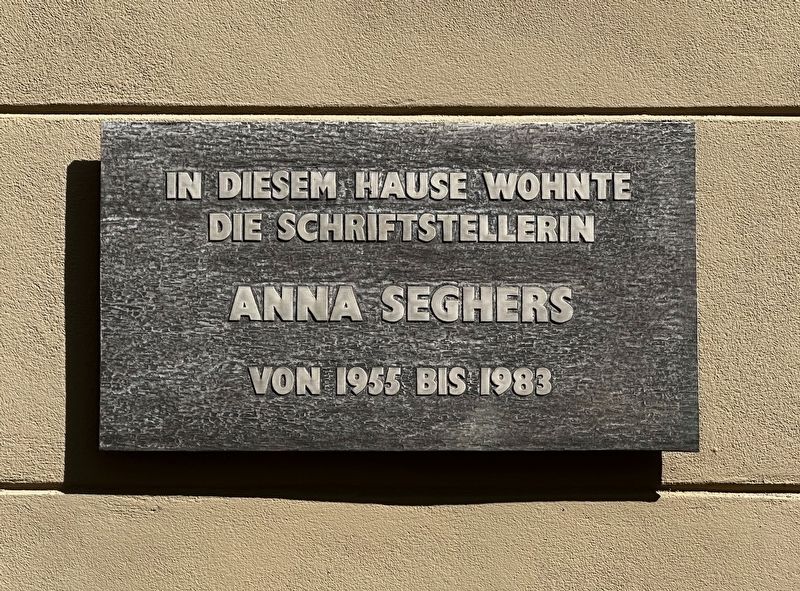
1. Anna Seghers Marker

die Schriftstellerin
Anna Seghers
von 1955 bis 1983
Topics. This historical marker is listed in these topic lists: Arts, Letters, Music • Women. A significant historical date for this entry is June 1, 1983.
Location. 52° 26.296′ N, 13° 32.438′ E. Marker is in Berlin, in Treptow-Köpenick. It is in Treptow-Köpenick. It is at the intersection of Anna-Seghers-Straße and Silberbergerstraße, on the right when traveling north on Anna-Seghers-Straße. Touch for map. Marker is at or near this postal address: Anna-Seghers-Straße 81, Berlin 12489, Germany. Touch for directions.

Regionally, it is in Europe, the European Union, Atlantic Europe, Central Europe, the Schengen Area, Western Europe, and the Western World. Historically, it finds itself in what was once the Holy Roman Empire, the former East Germany, and at the Berlin Wall.
Other nearby markers. At least 8 other markers are within 13 kilometers of this marker, measured as the crow flies: Rudolf Wagner Régeny (approx. 0.3 kilometers away); NS Zwangsarbeit in Adlerhof / Nazi Forced Labour in Adlerhof
this page online
Also see . . . Anna Seghers (Wikipedia). Excerpts:
Anna Seghers (born Anna Reiling, 19 November 1900 – 1 June 1983), is the pseudonym of German writer Anna Reiling, who was notable for exploring and depicting the moral experience of the Second World War...(Submitted on September 4, 2025.)
While still in Paris, in 1939, she had written The Seventh Cross. The novel is set in 1936 and describes the escape of seven prisoners from a concentration camp. It was published in English in the United States in 1942 and quickly adapted for an American movie of the same name. The Seventh Cross was one of the veryfew depictions of Nazi concentration camps, in either literature or the cinema, during World War II. In 1947 Seghers was awarded the Georg Büchner-Prize for this novel.Photographed by Andrew Ruppenstein, September 3, 20252. Anna Seghers Marker - wide view
Seghers's best-known short story, the title of her collection in The Outing of the Dead Girls (1946), was written in Mexico. It was partially autobiographical, drawn from her reminiscence and reimagining of a pre-World War I class excursion on the Rhine river. She explores the actions of the protagonist's classmates in light of their decisions and ultimate fates during both world wars. In describing them, the German countryside, and her hometown Mainz, which was soon destroyed in the second war, Seghers expresses lost innocence and ponders the senseless injustices of war. She shows there is no escape from such loss, whether or not one sympathized with the Nazi Party…

Additional keywords. Gedenktafel
Credits. This page was last revised on September 4, 2025. It was originally submitted on September 4, 2025, by Andrew Ruppenstein of Lamorinda, California. This page has been viewed 66 times since then and 12 times this year. Photos: 1, 2. submitted on September 4, 2025, by Andrew Ruppenstein of Lamorinda, California.
