Near St. Catharines in Niagara Region, Ontario — Central Canada (North America)
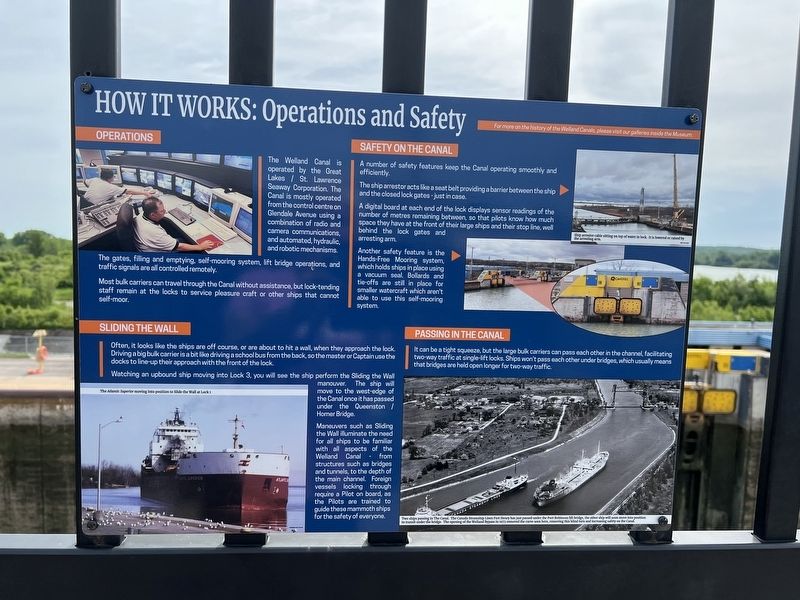
How it Works: Operations and Safety
Photographed by Sandra Hughes Tidwell
1. How it Works:Operations and Safety Marker
For more on the history of the Welland Canals, please visit our galleries inside the Museum.
Operations
The Welland Canal is operated by the Great Lakes / St. Lawrence Seaway Corporation. The Canal is mostly operated from the control centre on Glendale Avenue using a combination of radio and camera communications, and automated, hydraulic, and robotic mechanisms. The gates, filling and emptying, self-mooring system, lift bridge operations, and traffic signals are all controlled remotely.
Most bulk carriers can travel through the Canal with assistance, but lock-tending staff remain at the locks to service pleasure craft or other ships that cannot self-moor.
Sliding the Wall
Often, it looks like the ships are off course, or about to hit a wall, when they approach the lock. Driving a big bulk carrier is a bit like driving a school bus from the back., so the master or Captain use the docks to line-up their approach with the front of the lock.
Watching an unbound ship moving into Lock 3, you will see the ship perform the Sliding the Wall manouver. The ship will move to the west-edge of the Canal once
this page online
Maneuvers such as Sliding the Wall illuminate the need for all ships to be familiar with all aspects of the Welland Canal - from structures such as bridges and tunnels, to the depth of the main channel. Foreign vessels locking through require a Pilot on board, as the Pilots are trained to guide these mammoth ships for the safety of everyone.
Safety on the Canal
A number of safety features enable the Canal operating smoothly and efficiently.
The ship arrestor acts like a seat belt providing a barrier between the ship and the closed lock gates - just in case.
A digital board at each end of the lock displays sensor readings of the number of metres remaining between, so that pilots know how much space they have at the front of their large ships and their stop line, well behind the lock gates and arresting arm.
Another safety feature is the Hands-Free Mooring system which holds ships in place using a vacuum seal. Bollards and tie-offs are still in place for smaller watercraft that aren't able to use this self-mooring system.
Passing in the Canal
It can be a tight squeeze,

Photographed by Sandra Hughes Tidwell
2. How it Works:Operations and Safety Marker
Erected by St. Catharines Museum and Welland Canals Centre.
Topics and series. This historical marker is listed in this topic list: Waterways & Vessels. In addition, it is included in the The Welland Canals series list.
Location. 43° 9.356′ N, 79° 11.634′ W. Marker is near St. Catharines, Ontario, in Niagara Region. It can be reached from Welland Canals Pkwy, on the right when traveling north. The marker is at the St. Catharines Museum and Welland Canals Centre, on the elevated viewing platform that overlooks Lock 3. Touch for map. Marker is at or near this postal address: 1932 Welland Canals Pkwy, St Catharines ON L2R 7K6, Canada. Touch for directions.

Regionally, this marker is on the Golden Horseshoe and in Niagara Canada. It is also in Central Canada. Globally, it is in North America, on the Great Lakes, in the Western Hemisphere, in the Western World, and in the Anglosphere. Historically, it finds itself in what was once a British colony, the Viceroyalty of New France, the Haudenosaunee (Iroquois) Confederacy, and Rupert’s Land.
Other nearby markers. At least 8 other markers are within walking distance of this marker: The St. Lawrence Seaway (here, next to this marker); How It Works: Locking Through (here, next to this marker); Welland Ship Canal (a few steps from this marker); William Hamilton Merritt 1793 - 1862 (a few steps from this marker); Global Irish Famine Way (within shouting distance of this marker); The Fourth Welland Canal (within shouting distance of this marker); Bollard (within shouting distance of this marker); Early Welland Canals (within shouting distance of this marker). Touch for a list and map of all markers in St. Catharines.
Regarding How it Works: Operations and Safety. The Welland canal actually supports five (5) mooring approaches.
1. HFM (hands-free mooring) for most vessels, which are all big cargo ships with flat sides.
2. If HFM is busted, they can moor with ropes, the old-fashioned way. This requires dock-side line handlers.
3. If HFM is busted, they can also moor with metal cables, a different old-fashioned way (that require different dock-side fittings than ropes). This requires dock-side line handlers.
4. Pleasure craft (down to 6 metres - 20' length) with motors may transit the canal ($200 CA end-to-end); they travel in a convoy, one convoy each day, and "moor" by holding onto ropes tossed by line-handlers.
5. Ships (solo tugs, tall sailing ships, military) that cannot use HFM, and don't want to pay for the line-handler costs, can transit without mooring at all: while the lock is filling or draining, they need to run their engines ultra-really-slow upstream (which may be forward or astern), to keep themselves positioned in the lock, away from the lock-gates.
Credits. This page was last revised on September 5, 2025. It was originally submitted on July 8, 2024, by Sandra Hughes Tidwell of Killen, Alabama, USA. This page has been viewed 242 times since then and 73 times this year. Last updated on September 4, 2025, by Kevin Westell of St. Catharines, Ontario. Photos: 1, 2. submitted on July 8, 2024, by Sandra Hughes Tidwell of Killen, Alabama, USA. • Devry Becker Jones was the editor who published this page.
