Siena in Provincia di Siena, Tuscany, Italy — Southern and Western Europe (Mediterranean)
Il Cristallo Colligiano
⎯⎯⎯
Colligian Crystal
Beads for Beading

Photographed by Sean P. Flynn, July 31, 2025
1. Il Cristallo Colligiano / Colligian Crystal Marker
Colle Val d'Elsa concentrates 15% of crystal world production and 95% of crystal national production.
Cenni Storici - Gli Inizi
La tradizione vetraria di Colle Val d'Elsa vanta origini antiche tanto che già nel medioevo (XIV secolo) venivano prodotti vasi e bicchieri di vetro. Giá negli Statuti del 1300 venivano regolamentate le "ga-belle da imporre ai fabbricanti di vasellame e oggetti in vetro. La produzione di vetro, che in Toscana interessa va anche Gambassi Terme e Montaione, con il passare del tempo raggiunse livelli di importanza e di eccellenza tali da rendere necessaria un' ordinanza granducale con cui, il 20 aprile 1577 veniva bandito dallo Stato fiorentino il "vetro forestiero".
A Brief History
The glassware tradition of Colle Val D'Elsa has its origins in history to such an extent that in the Medieval Age (XIV Century) vases and glasses were produced that were made of glass. Already in the statutes of the thirte en hundreds, duties were often imposed on
this page online
Le Riosorse Locali
A Colle potevano essere sfruttate le risorse del territorio circostante per la produzione la legna per alimentare fomi di coltura e ricavame ceneri (che venivano usate al posto della potassa), la sabbia silicea, presente nelle cave della vicina Montevasoni, Fabbondanza di acqua, la presenza di terra refrattaria ricca di carbonato di magne sio: la presenza di un'arteria importante come la Via Francigena rendeva facile il trasporto delle materie prime e dei prodotti finiti.
Local Resources
The resources in Colle and from the surrounding area could be exploited for production. The wood was used to stoke the furnace and the ashes were extracted, which were a substitute for potassium. The silica sand was also present in quarries close to Montevasoni. Moreover the abundant supply of water
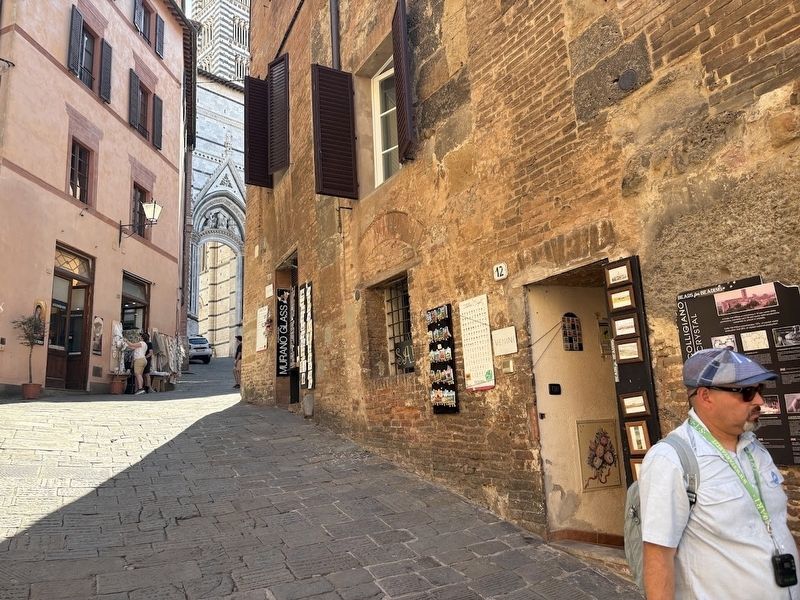
Photographed by Sean P. Flynn, July 31, 2025
2. Il Cristallo Colligiano / Colligian Crystal Marker
A sliver of the Siena Cathedral (Duomo di Siena) can be seen in the background, up the street.
La Produzione su Vasta Scala
Nella città di Colle Val d'Elsa la produzione del vetro ha un impulso verso la fine dell'ottocento con l'apertura delle formaci. Nel corso del '900 la produzione subisce un forte impulso fino ad arrivare agli anni 70 quando comincia a diversificarsi la produzione tra le varie aziende. Alcune punteranno sull'automazione della produzione.
The Production on the Large Scale
In the town of Colle Val D'Elsa, the production of glaas dates back to the end of the eighteenth hundreds when the furnaces were opened. In the ninteen hundreds, the production of glass experienced an incredible boost until the ninteen seventies when the production among the various glassmakers began to diversify.
Il Lavoro Manuale
Nonostante la crisi economica e la forte contrazione del mercato, tante piccole fornaci hanno conservato le antiche tradizioni artigianali e manuali (vetro fusione manuale, soffiatura a bocca e molatura). Altre ancora hanno valorizzato la loro produzione attraverso la collaborazione di firme famose del design nazionale e internazionale come Joe Colombo, Ettore Sottsass, David Palterer, Roger Tallon, Blanca, Kita, Enzo Mari.
Manual Work
There are those that aim for the automation of glass production, while there are others who attempt to conserve the artisan traditions and manual side of glass production (fused glass, blown glass and cut glass). Although, others seek the partnership of famous international and national labels such as Joe Colombo, Ettore Sottsass, David Palterer, Roger Tallon, Blanca, Kita, and Enzo Mari.
Il Cristallo da Degustazione
L'incontro tra la famosa vocazione vinicola del territorio senese e la tradizione vetraia di Colle Val d'Elsa ha dato vita ad una virtuosa collaborazione per una sempre maggiore specializzazione del settore della degustazione di vini e distillati pregiati.
Tasting Glass
Crystal glasses are used for wine tasting and for prestigious spirits, because of the purity and clearness of this material.
Le Materie Prime per la Produzione del Cristallo Per produrre cristallo occorrono diverse materie prime:
• silice, anidride borica e anidride fosforica sono sostanze vetrificanti;
• composti di sodio e potassio sono sostanze fondenti, ed hanno la caratteristica di abbassare la temperatura di fusione delle sostanze vetrificanti che altrimenti necessi-terebbero di temperature addiritura superiori a 1700";
• sodio e potassio.
Solo una saggia collaborazione tra chimici specializzati e Maestri Vetrai fa si che il cristallo abbia tutte quelle caratteristiche che lo rendono un prodotto unico.
The Raw Materials for Crystal Production
The raw materials that are used in the production of crystal. A number of raw materials are needed to produce crystal namely:
Silica, boric oxide and phosphorous pentoxide, which are vitrifying substances.
Composed of sodium and potassium, these are substances which can melt others and have the capacity to lower the fusion temperature of the vetrifying substance, which would otherwise need a temperature of over 1,700 degrees centigrade.
Topics. This historical marker is listed in these topic lists: Arts, Letters, Music • Industry & Commerce • Science & Medicine. A significant historical date for this entry is April 20, 1577.
Location. 43° 19.074′ N, 11° 19.797′ E. Marker is in Siena, Toscana (Tuscany), in Provincia di Siena. It is on Via del Monna Agnese south of Via delle Campane. The marker is next to the entrance of a store called Beads for Beading. Touch for map. Marker is at or near this postal address: Via del Monna Agnese 12/14/16, Siena, Toscana 53100, Italy. Touch for directions.

Regionally, it is in Europe, the European Union, the Schengen Area, a coastal Mediterranean country, and the Western World. Historically, it finds itself in what was once the Roman Empire and specifically also the Holy Roman Empire.
Other nearby markers. At least 8 other markers are within 21 kilometers of this marker, measured as the crow flies: Cesare Brandi (within shouting distance of this marker); 1868-69 Renovation of the Siena Cathedral Façade (about 90 meters away, measured in a direct line); Santuario Casa di Santa Caterina da Siena (approx. 0.2 kilometers away); Ferdinand III (approx. 0.3 kilometers away); Peter Leopold, Archduke of Austria (approx. 0.3 kilometers away); Sant'Antonio in San Domenico (approx. 0.4 kilometers away); Santa Caterina Benincasa (approx. 0.6 kilometers away); Resti del Ponte di Spugna / Remains of the Spugna Bridge (approx. 19.8 kilometers away). Touch for a list and map of all markers in Siena.
Also see . . . Beads for Beading official site. (Submitted on September 4, 2025, by Sean P. Flynn of Oak Park, Illinois.)
Credits. This page was last revised on September 4, 2025. It was originally submitted on September 4, 2025, by Sean P. Flynn of Oak Park, Illinois. This page has been viewed 84 times since then and 12 times this year. Photos: 1, 2. submitted on September 4, 2025, by Sean P. Flynn of Oak Park, Illinois.
