St. Catharines in Niagara Region, Ontario — Central Canada (North America)
How It Works: Locking Through
Photographed by Sandra Hughes Tidwell
1. How It Works: Locking it Through Marker
For more on the history of the Welland Canals, please visit our galleries inside the Museum.
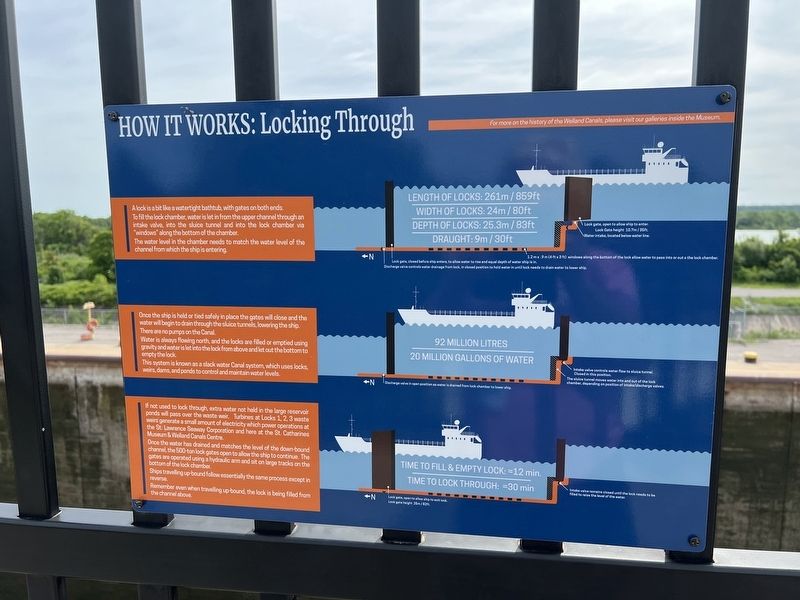
A lock is a bit like a watertight bathtub with gates on both ends. To fill the lock chamber, water is let in from the upper channel through an intake valve, into the sluice tunnel and into the lock chamber via "windows" along the bottom of the chamber. The water level in the chamber needs to match the water level of the channel from which the ship is entering.
Photo Length of Locks: 261m / 859ft
Width of Locks:24m / 80ft
Depth of Locks: 25.3m / 83ft
Draught: 9m / 30 ft
.Lock gate, closed before ship enters, to allow water to rise and equal depth of water ship is in.
.Discharge valve controls water drainage from lock, in closed position to hold water in until lock needs to drain water to lower ship
. Lock gate, open to allow ship to enter. Lock Gate Height 10.7m / 35ft
.Water intake, located below water line.
. 1.2 x .9m (4 ft x 3ft) windows along the bottom of the lock allow water to pass into or out o the lock chamber.
Once the ship is held or tied safely in place the gates will close and the water will begin
this page online
Photo: 92 million litres
20 million gallons of water
. Discharge valve in open position as water is drained from lock chamber to lower ship.
. The intake valve controls water flow to sluice tunnel. Closed in this position.
. The sluice tunnel moves water into and out of the lock chamber, depending on the position of intake/discharge valves.
If not used to lock through, extra water not held in the large reservoir ponds will pass over the waste weir. Turbines at Lock 1,2,3 waste weirs generate a small amount of electricity which powers operations at the St. Lawrence Seaway Corporation and here at the St. Catharines Museum & Welland Canals Centre.
Once the water has drained and matches the level of the down-bound channel, the 500-ton lock gates
Photographed by Sandra Hughes Tidwell
2. How It Works: Locking it Through Marker
Photo: Time to fill & empty lock: 12min.
Time to lock through: 30 min
. Lock gate, open to allow ship to exit lock.
. Lock gate height 25m / 82ft.
. intake valve remains closed until the lock needs to be filled to raise the level of the water.
Erected by St. Catharines Museum and Welland Canals Centre.
Topics and series. This historical marker is listed in this topic list: Waterways & Vessels. In addition, it is included in the The Welland Canals series list.
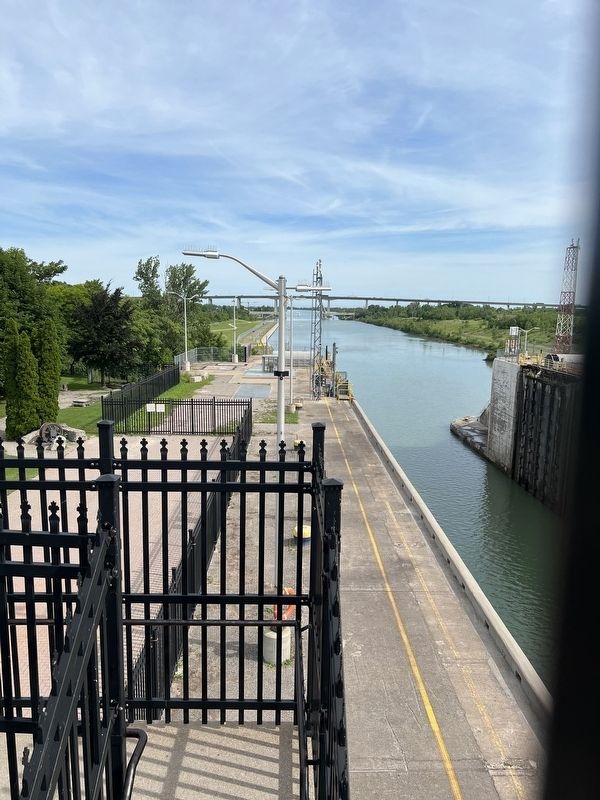
Location. 43° 9.353′ N, 79° 11.634′ W. Marker is in St. Catharines, Ontario, in Niagara Region. It is on Welland Canals Parkway, on the right when traveling north. The marker is at the St. Catharines Museum and Welland Canals Centre, on the outdoor observation platform, overlooking Lock 3. Touch for map. Marker
Photographed by Sandra Hughes Tidwell
3. How It Works: Locking Through Marker

Regionally, this marker is on the Golden Horseshoe and in Niagara Canada. It is also in Central Canada. Globally, it is in North America, on the Great Lakes, in the Western Hemisphere, in the Western World, and in the Anglosphere. Historically, it finds itself in what was once a British colony, the Viceroyalty of New France, the Haudenosaunee (Iroquois) Confederacy, and Rupert’s Land.
Other nearby markers. At least 8 other markers are within walking distance of this marker: The St. Lawrence Seaway (here, next to this marker); How it Works: Operations and Safety (here, next to this marker); Welland Ship Canal (a few steps from this marker); William Hamilton Merritt 1793 - 1862 (a few steps from this marker); Global Irish Famine Way (a few steps from this marker); The Fourth Welland Canal (within shouting distance of this marker); Early Welland Canals (within shouting distance of this marker); Bollard (within shouting distance of this marker). Touch for a list and map of all markers in St. Catharines.
Credits. This page was last revised on September 5, 2025. It was originally submitted on July 8, 2024, by Sandra Hughes Tidwell of Killen, Alabama, USA. This page has been viewed 127 times since then and 16 times this year. Last updated on September 5, 2025, by Kevin Westell of St. Catharines, Ontario. Photos: 1, 2, 3. submitted on July 8, 2024, by Sandra Hughes Tidwell of Killen, Alabama, USA. • Devry Becker Jones was the editor who published this page.
