Chelsea in Manhattan in New York County, New York — The American Northeast (Mid-Atlantic)
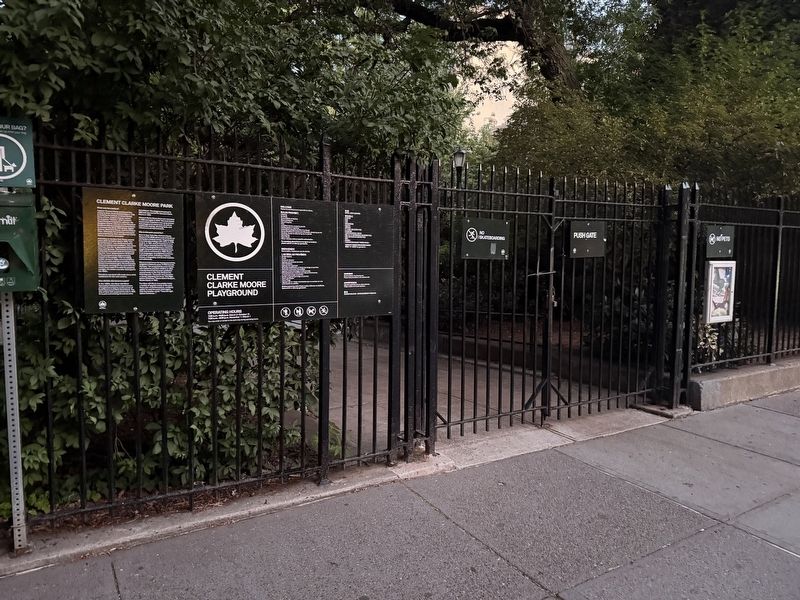
Clement Clarke Moore Park
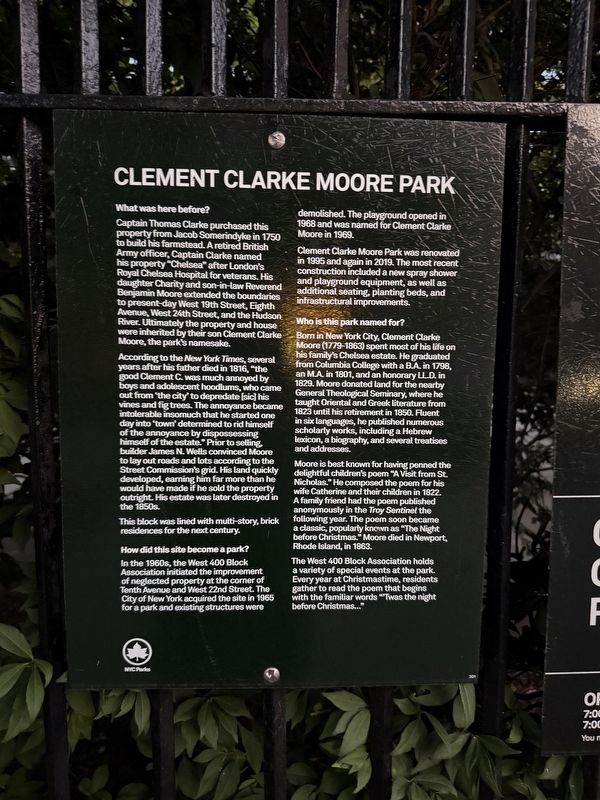
What was here before?
Captain Thomas Clarke purchased this property from Jacob Somerindyke in 1750 to build his farmstead. A retired British Army officer, Captain Clarke renamed his property "Chelsea" after London's Royal Chelsea Hospital for veterans. His daughter Charity and son-in-law Reverend Benjamin Moore extended the boundaries to present-day West 19th Street, Eighth Avenue, West 24th Street, and the Hudson River. Ultimately the property and house were inherited by their son Clement Clarke Moore, the park's namesake.
According to the New York Times, several years after his father died in 1816, "the good Clement C. was much annoyed by boys and adolescent hoodlums, who came out from 'the city' to depredate [sic] his vines and fig trees. The annoyance became intolerable insomuch that he started one day into 'town' determined to rid himself of the annoyance by dispossessing himself of the estate." Prior to selling, builder James N. Wells convinced Moore to lay out roads and lots according to the Street Commission's grid. His land quickly developed, earning him far more than he would have made if he sold the property
this page online
This block was lined with multi-story, brick residences for the next century.
How did this site become a park?
In the 1960s, the West 400 Block Association initiated the improvement of neglected property at the corner of Tenth Avenue and West 22nd Street. The City of New York acquired the site in 1965 for a park and existing structures were demolished. The playground opened in 1968 and was named for Clement Clarke Moore in 1969.
Clement Clarke Moore Park was renovated in 1995 and again in 2019. The most recent construction included a new spray shower and playground equipment, as well as additional seating, planting beds, and infrastructural improvements.
Who is this park named for?
Born in New York City, Clement Clarke Moore (1779-1863) spent most of his life on his family's Chelsea estate. He graduated from Columbia College with a B.A. in 1798, an M.A. in 1801, and an honorary LL.D. in 1829. Moore donated land for the nearby General Theological Seminary, where he taught Oriental and Greek literature from 1823 until his retirement in 1850. Fluent in six languages,
Moore is best known for having penned the delightful children's poem "A Visit from St. Nicholas." He composed the poem for his wife Catherine and their children in 1822. A family friend had the poem published anonymously in the Troy Sentinel the following year. The poem soon became a classic, popularly known as "The Night before Christmas." Moore died in Newport, Rhode Island, in 1863.
The West 400 Block Association holds a variety of special events at the park. Every year at Christmastime, residents gather to read the poem that begins with the familiar words "'Twas the night before Christmas…"
Erected by NYC Parks. (Marker Number 301.)
Topics and series. This historical marker is listed in these topic lists: Arts, Letters, Music • Education • Parks & Recreational Areas • Settlements & Settlers. In addition, it is included in the NYC Parks series list. A significant historical year for this entry is 1750.
Location. 40° 44.806′ N, 74° 0.281′ W. Marker is in Manhattan, New York, in New York County. It is in Chelsea. It is on 10th Avenue south of West 22nd Street, on the right when traveling north. Touch for map. Marker is at or near this postal address: 190 10th Ave, New York NY 10011, United States of America. Touch for directions.

Regionally, this marker is in New York City. It is also in the American Northeast, in the Mid-Atlantic, and on the Eastern Seaboard. Globally, it is in the North Atlantic Region, North America, the Western Hemisphere, the Western World, and the Anglosphere. Historically, it finds itself in what was once New Netherland and also one of the original Thirteen Colonies.
Other nearby markers. At least 8 other markers are within walking distance of this marker: Chelsea Historic District and District Extension (about 600 feet away, measured in a direct line); Clement Clarke Moore (about 600 feet away); James N. Wells Mansion - 1835 (about 700 feet away); Adam Cohen (about 700 feet away); Cushman Row (about 800 feet away); Chelsea Historic District (approx. 0.2 miles away); John Richard Ress, Jr. (approx. ¼ mile away); Church of Saint Eleftherios (approx. ¼ mile away). Touch for a list and map of all markers in Manhattan.
Other markers no longer nearby. Clement Clarke Moore Park (has been replaced with this marker); a different marker also named Clement Clarke Moore Park (has been replaced with this marker).
Credits. This page was last revised on September 5, 2025. It was originally submitted on September 5, 2025, by Devry Becker Jones of Washington, District of Columbia. This page has been viewed 111 times since then and 27 times this year. Photos: 1, 2. submitted on September 5, 2025, by Devry Becker Jones of Washington, District of Columbia.
