Niagara Falls in Niagara Region, Ontario — Central Canada (North America)
Indigenous History along the Niagara River
L’Histoire Autochtone le Long de la Rivière Niagara
| — | Niagara Parks | — |

Photographed by Sandra Hughes Tidwell, June 25, 2024
1. Indigenous History Marker

Indigenous History along the Niagara River
Archaeological evidence shows that Indigenous peoples have lived within the Niagara region for some 13,000 years. The first people who Europeans encountered here were the Neutral Nation. They were the region's most prominent Indigenous group until the middle of the seventeenth century, during which time conflict with the Haudenosaunee led to their demise as a distinct people. During the eighteenth and early nineteenth centuries, important strategic alliances between several Indigenous nations, the Crown, and other defenders of Upper Canada prior to and during the War of 1812 helped to keep the land we know as Canada free from American rule. Friendship between local Indigenous peoples and settler populations endures today as we work toward truth and reconciliation between our nations.
L’Histoire Autochtone le Long de la Rivière Niagara
Des preuves archéologiques montrent que les peuples autochtones ont vécu dans la région du Niagara pendant quelque 13 000 ans. Les premières personnes que les Européens ont rencontrées ici étaient la nation Neutre. Ils étaient le
this page online
Erected by Niagara Parks.
Topics. This historical marker is listed in these topic lists: Indigenous Peoples and Communities • Settlements & Settlers • War of 1812. A significant historical year for this entry is 9999 BCE.
Location. 43° 4.704′ N, 79° 4.734′ W. Marker is in Niagara Falls, Ontario, in Niagara Region. It can be reached from Niagara River Parkway, on the right when traveling north. This marker is 60 metres east of the road, along the
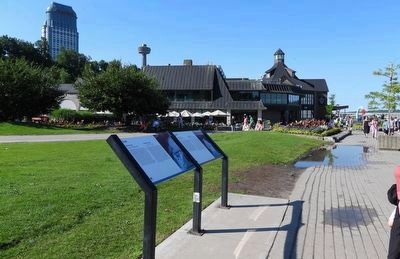
Photographed by Kevin Westell, July 18, 2025
2. Indigenous History along the Niagara River - Marker in context
Photo faces north. This marker (and its twin) are 20 metres south of a patio which is part of the Table Rock complex; and adjacent to the walking path that runs all along the west shore near the falls (out-of-screen right).

Regionally, this marker is on the Golden Horseshoe and in Niagara Canada. It is also in Central Canada. Globally, it is in North America, on the Great Lakes, in the Western Hemisphere, in the Western World, and in the Anglosphere. Historically, it finds itself in what was once a British colony, the Viceroyalty of New France, the Haudenosaunee (Iroquois) Confederacy, and Rupert’s Land.
Other nearby markers. At least 8 other markers are within walking distance of this marker: Indigenous Culture / Approaches to Water (here, next to this marker); The Niagara Parks Commission / Commission Des Parcs Du Niagara (a few steps from this marker); José María Heredia (within shouting distance of this marker); Niagara Falls Park and River Railway Powerhouse (within shouting distance of this marker); Geological Formation of Niagara Falls and the Niagara River (within shouting distance of this marker); The History of Tourism around Niagara Falls
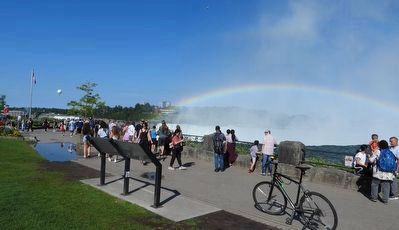
Photographed by Kevin Westell, July 18, 2025
3. Indigenous History along the Niagara River - Marker in context
Photo faces north-east and east. This marker (and its twin) are at the brim of the Horseshoe Falls. Goat Island in Niagara Falls, New York is the far shore. The American Falls are visible (distant left, under balloon).
Regarding Indigenous History along the Niagara River. Regarding the Neutral nation's demise: a contributing factor was French and English introducing guns to certain Indigenous peoples; which upset the balance of power with other peoples (armed with stone-age weapons such as bow-and-arrow and axe).
Credits. This page was last revised on September 9, 2025. It was originally submitted on July 11, 2024, by Sandra Hughes Tidwell of Killen, Alabama, USA. This page has been viewed 361 times since then and 37 times this year. Last updated on September 6, 2025, by Kevin Westell of St. Catharines, Ontario. Photos: 1. submitted on July 11, 2024, by Sandra Hughes Tidwell of Killen, Alabama, USA. 2, 3. submitted on July 19, 2025, by Kevin Westell of St. Catharines, Ontario. • Devry Becker Jones was the editor who published this page.
