Berliner Innenstadt in Tempelhof-Schöneberg, Germany — Northeast German Plain (The European Plain)
Kurt Hiller
Erzählen/Erinnern/Gedenken
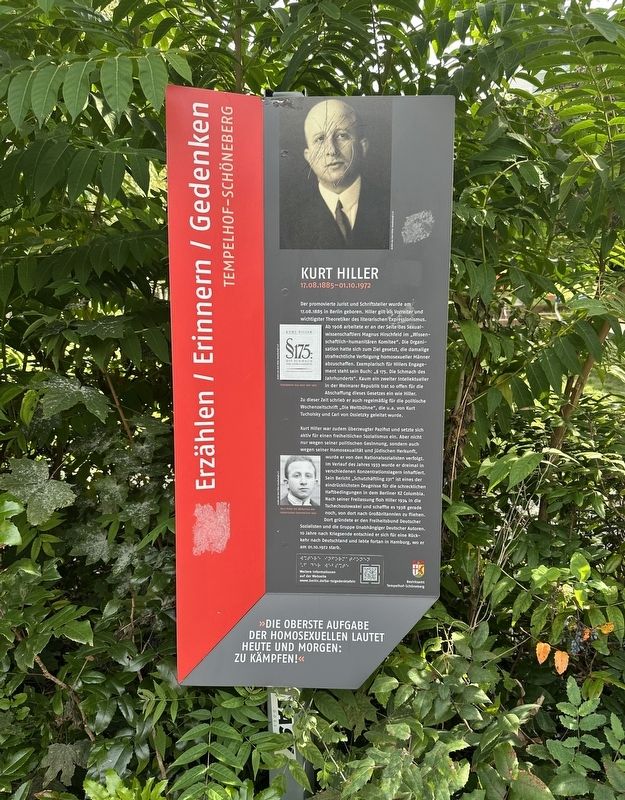
Photographed by Andrew Ruppenstein, September 4, 2025
1. Kurt Hiller Marker

17.08.1885-01.10.1972
Der promovierte Jurist und Schriftsteller wurde am 17.08.1885 in Berlin geboren. Hiller gilt als Vorreiter und wichtigster Theoretiker des literarischen Expressionismus. Ab 1908 arbeitete er an der Seite des Sexualwissenschaftlers Magnus Hirschfeld im „Wissenschaftlich-humanitären Komitee". Die Organisation hatte sich zum Ziel gesetzt, die damalige strafrechtliche Verfolgung homosexueller Männer abzuschaffen. Exemplarisch für Hillers Engagement steht sein Buch: „§ 175. Die Schmach des Jahrhunderts“. Kaum ein zweiter Intellektueller in der Weimarer Republik trat so offen für die Abschaffung dieses Gesetzes ein wie Hiller. Zu dieser Zeit schrieb er auch regelmäßig für die politische Wochenzeitschrift „Die Weltbühne“, die u.a. von Kurt Tucholsky und Carl von Ossietzky geleitet wurde.
Kurt Hiller war zudem überzeugter Pazifist und setzte sich aktiv für einen freiheitlichen Sozialismus ein. Aber nicht nur wegen seiner politischen Gesinnung, sondern auch wegen seiner Homosexualität und jüdischen Herkunft, wurde er von den Nationalsozialisten verfolgt. Im Verlauf des Jahres
this page online
»Die oberste Aufgabe der Homosexuellen lautet heute und morgen: zu kämpfen!«
(English translation)
Kurt Hiller
August 17, 1885 – October 1, 1972
The lawyer and writer, who held a doctorate in law, was born in Berlin on August 17, 1885. Hiller is considered a pioneer and the most important theorist of literary expressionism. From 1908 onwards, he worked alongside the sexologist Magnus Hirschfeld in the "Scientific-Humanitarian Committee." The organization's goal was to abolish the then-existing criminal laws that persecuted homosexual
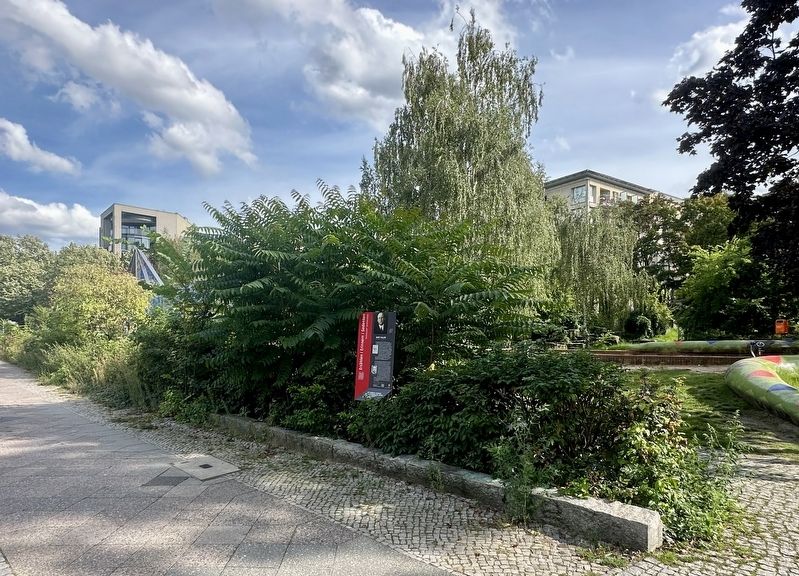
Photographed by Andrew Ruppenstein, September 4, 2025
2. Kurt Hiller Marker - wide view
Kurt Hiller was also a committed pacifist and an active advocate of libertarian socialism. He was persecuted by the Nazis not only because of his political beliefs, but also because of his homosexuality and Jewish heritage. During 1933, he was imprisoned three times in various concentration camps. His account, "Prisoner 231," is one of the most poignant testimonies to the horrific conditions in the Columbia concentration camp in Berlin. After his release, Hiller fled to Czechoslovakia in 1934 and barely managed to escape to Great Britain in 1938. There, he founded the Freedom League of German Socialists and the Group of Independent German Authors. Ten years after the end of the war, he decided to return to Germany and lived in Hamburg until his death on October 1, 1972.
"The most important task for homosexuals today and tomorrow is: to fight!"
Erected 2021 by Bezirksamt Tempelhof-Schöneberg.
Topics. This historical marker is listed in these topic lists: Arts, Letters, Music • Civil Rights. A significant historical date for this entry is October 1, 1972.
Location. 52° 29.416′ N, 13° 21.468′ E. Marker is in Berlin, in Tempelhof-Schöneberg. It is in Berliner Innenstadt. It is on Grunewaldstraße, on the right when traveling east. The marker is in front of the play area in Kurt Hiller Park. Touch for map. Marker is at or near this postal address: Grunewaldstraße 18, Berlin 10823, Germany. Touch for directions.

Regionally, it is in Europe, the European Union, Atlantic Europe, Central Europe, the Schengen Area, Western Europe, and the Western World. Historically, it finds itself in what was once the Holy Roman Empire, the former West Germany, and at the Berlin Wall.
Other nearby markers. At least 8 other markers are within walking distance of this marker: David Bowie (about 150 meters away, measured in a direct line); Die erste neue Straße / The First New Street (approx. 0.6 kilometers away); Hildegard Knef (approx. 0.8 kilometers away); Hauptgeschäftsstraße der Insel / Main Commercial Street of the Island (approx. 0.9 kilometers away); Christopher Isherwood (approx. one kilometer away); Hilde Radusch (approx. one kilometer away); Die »Rote Insel« (approx. one kilometer away); Else Lasker-Schüler (approx. one kilometer away). Touch for a list and map of all markers in Berlin.
Also see . . .
1. Kurt Hiller (Wikipedia). (Submitted on September 7, 2025.)
2. Gedenktafel zur Ehrung von Kurt Hiller eingeweiht (Bezirksamt Tempelhof-Schöneberg, in German). Press release regarding the dedication of the marker. Excerpt (in translation):
On November 16, 2021, District Mayor Angelika Schöttler and the Deputy Mayor for Culture, Matthias Steuckardt, jointly inaugurated the commemorative plaque in Kurt Hiller Park on Grunewaldstraße in Schöneberg. The plaque is intended to highlight the life and work of the writer and publicist for whom the park is named.(Submitted on September 7, 2025.)
Hiller is considered a pioneer and the most important theorist of literary expressionism. He also campaigned to abolish the criminal prosecution of homosexual men at that time. Kurt Hiller was a committed pacifist and an active advocate of libertarian socialism. He was persecuted by the Nazis not only because of his political beliefs, but also because of his homosexuality and Jewish heritage. After being imprisoned in a concentration camp and escaping from Germany, he returned after the war and lived in Hamburg.
Deputy Mayor for Culture, Matthias Steuckardt, explained:
“As a groundbreaking publicist and a champion of the rights of sexual minorities, Kurt Hiller made a significant contribution to his home district. With the unveiling of this memorial plaque, his recognition in the park named after him is now complete.”
Additional keywords. Gedenktafel, LGBT, LGBTQ
Credits. This page was last revised on September 7, 2025. It was originally submitted on September 7, 2025, by Andrew Ruppenstein of Lamorinda, California. This page has been viewed 86 times since then and 18 times this year. Photos: 1, 2. submitted on September 7, 2025, by Andrew Ruppenstein of Lamorinda, California.
