Guelph in Wellington County, Ontario — Central Canada (North America)
Macdonald Hall
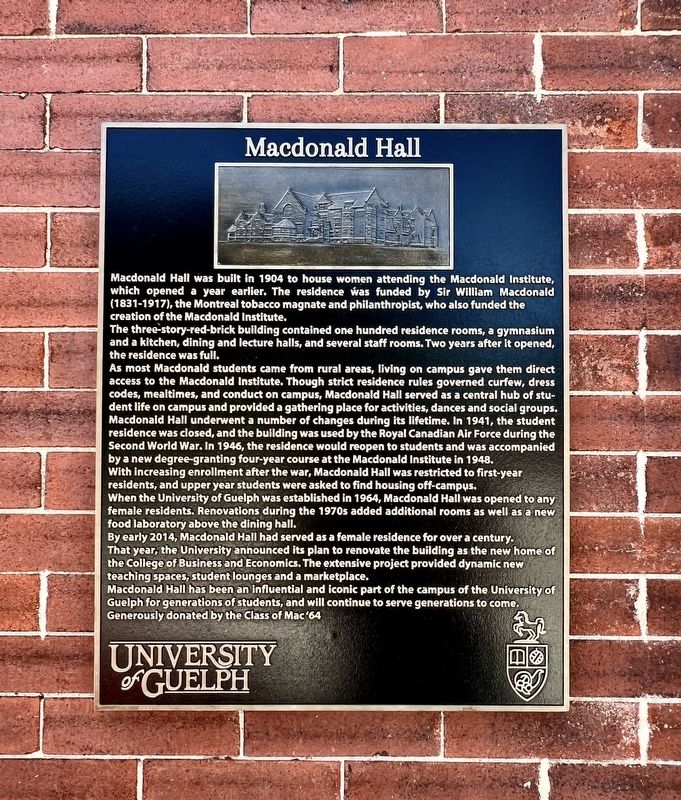
Photographed by Tim Boyd, September 1, 2025
1. Macdonald Hall Marker
Macdonald Hall was built in 1904 to house women attending the Macdonald Institute, which opened a year earlier. The residence was funded by Sir William Macdonald (1831-1917), the Montreal tobacco magnate and philanthropist, who also funded the creation of the Macdonald Institute.
The three-story-red-brick building contained one hundred residence rooms, a gymnasium and a kitchen, dining and lecture halls, and several staff rooms. Two years after it opened, the residence was full.
As most Macdonald students came from rural areas, living on campus gave them direct access to the Macdonald Institute. Though strict residence rules governed curfew, dress codes, mealtimes, and conduct on campus, Macdonald Hall served as a central hub of student life on campus and provided a gathering place for activities, dances and social groups. Macdonald Hall underwent a number of changes during its lifetime. In 1941, the student residence was closed, and the building was used by the Royal Canadian Air Force during the Second World War. In 1946, the residence would reopen to students and was accompanied by a new degree-granting four-year
this page online
With increasing enrollment after the war, Macdonald Hall was restricted to first-year residents, and upper year students were asked to find housing off-campus.
When the University of Guelph was established in 1964, Macdonald Hall was opened to any female residents. Renovations during the 1970s added additional rooms as well as a new food laboratory above the dining hall. By early 2014, Macdonald Hall had served as a female residence for over a century. That year, the University announced its plan to renovate the building as the new home of the College of Business and Economics. The extensive project provided dynamic new teaching spaces, student lounges and a marketplace.
Macdonald Hall has been an influential and iconic part of the campus of the University of Guelph for generations of students, and will continue to serve generations to come.
Generously donated by the Class of Mac'64
Erected by University of Guelph.
Topics. This historical marker is listed in these topic lists: Architecture • Education • Women. A significant historical year for this entry is 1904.
Location. 43° 32.046′ N,
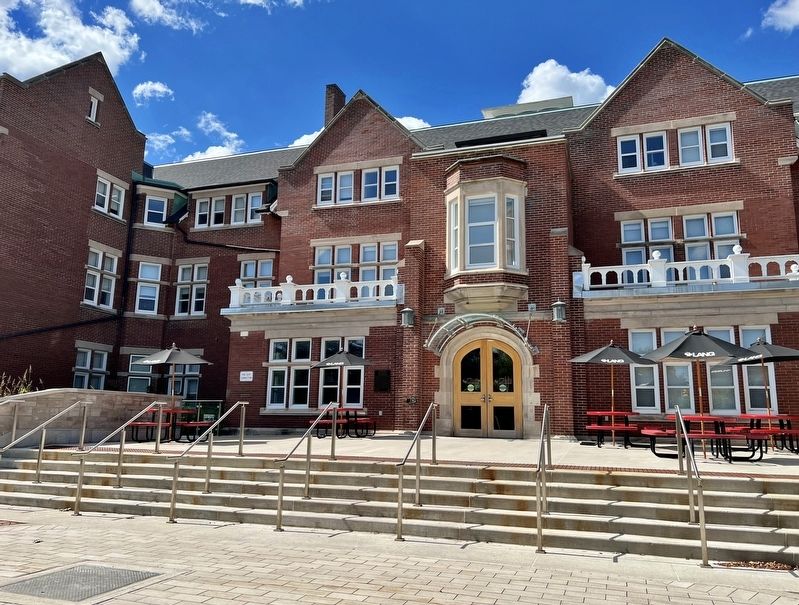
Photographed by Tim Boyd, September 1, 2025
2. Macdonald Hall Marker
To the left of the doorway

Regionally, this marker is in the Huron-Perth-Waterloo-Wellington Area and in Southwestern Ontario. It is also in Central Canada. Globally, it is in North America, the Western Hemisphere, the Western World, and the Anglosphere. Historically, it finds itself in what was once a British colony, the Viceroyalty of New France, the Haudenosaunee (Iroquois) Confederacy, and Rupert’s Land.
Other nearby markers. At least 8 other markers are within walking distance of this marker: The Gordon S. Lang School of Business and Economics (a few steps from this marker); The President’s House (within shouting distance of this marker); Macdonald Institute (about 90 meters away, measured in a direct line); James Mills 1840-1924 (about 90 meters away); George Creelman 1869-1929 (about 120 meters away);

Photographed by Tim Boyd, September 1, 2025
3. Macdonald Hall (Gordon S Lang School of Business), 2025
Credits. This page was last revised on September 7, 2025. It was originally submitted on September 7, 2025, by Tim Boyd of Hamilton, Ontario. This page has been viewed 73 times since then and 16 times this year. Photos: 1, 2, 3. submitted on September 7, 2025, by Tim Boyd of Hamilton, Ontario. • Andrew Ruppenstein was the editor who published this page.
