Perryville in Boyle County, Kentucky — The American South (East South Central)
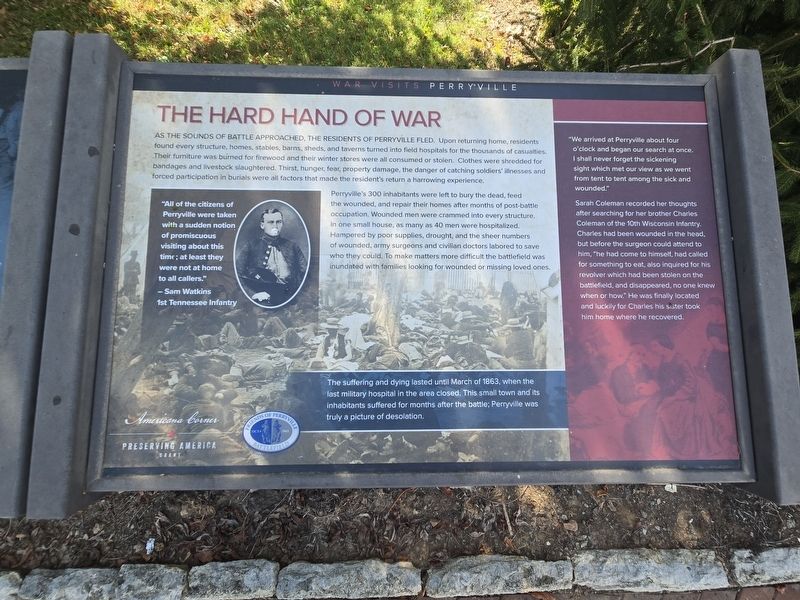
The Hard Hand Of War
| — | War Visits Perryville | — |
Photographed by Mark Parker, August 18, 2025
1. The Hard Hand of War Marker
As the sounds of battle approached, the residents of Perryville fled. Upon returning home, residents found every structure, homes, stables, barns, sheds, and taverns turned into field hospitals for the thousands of casualties. Their furniture was burned for firewood and their winter stores were all consumed or stolen. Clothes were shredded for bandages and livestock slaughtered. Thirst, hunger, fear, property damage, the danger of catching soldiers' illnesses and forced participation in burials were all factors that made the resident's return a harrowing experience.
Perryville's 300 inhabitants were left to bury the dead, feed the wounded, and repair their homes after months of post-battle occupation. Wounded men were crammed into every structure. In one small house, as many as 40 men were hospitalized. Hampered by poor supplies, drought, and the sheer numbers of wounded, army surgeons and civilian doctors labored to save who they could. To make matters more difficult the battlefield was inundated with families looking for wounded or missing loved ones.
"All of the citizens of Perryville were taken with a sudden(sidebar)notion of promiscuous visiting about this time; at least they were not at home to all callers."
Click or scan to see
this page online
-Sam Watkins 1st Tennessee Infantry
"We arrived at Perryville about four o'clock and began our search at once. I shall never forget the sickening sight which met our view as we went from tent to tent among the sick and wounded"
Sarah Coleman recorded her thoughts after searching for her brother Charles Coleman of the 10th Wisconsin Infantry. Charles had been wounded in the head,vbut before the surgeon could attend to him, "he had come to himself, had called for something to eat, also inquired for his revolver which had been stolen on the battlefield, and disappeared, no one knew when or how." He was finally located and luckily for Charles his sister took him home where he recovered.
(footer)
The suffering and dying lasted until March of 1863, when the last military hospital in the area closed. This small town and its inhabitants suffered for months after the battle; Perryville was truly a picture of desolation.
Erected by Americana Corner, Friends of Perryville Battlefield.
Topics. This historical marker
Photographed by Mark Parker, August 18, 2025
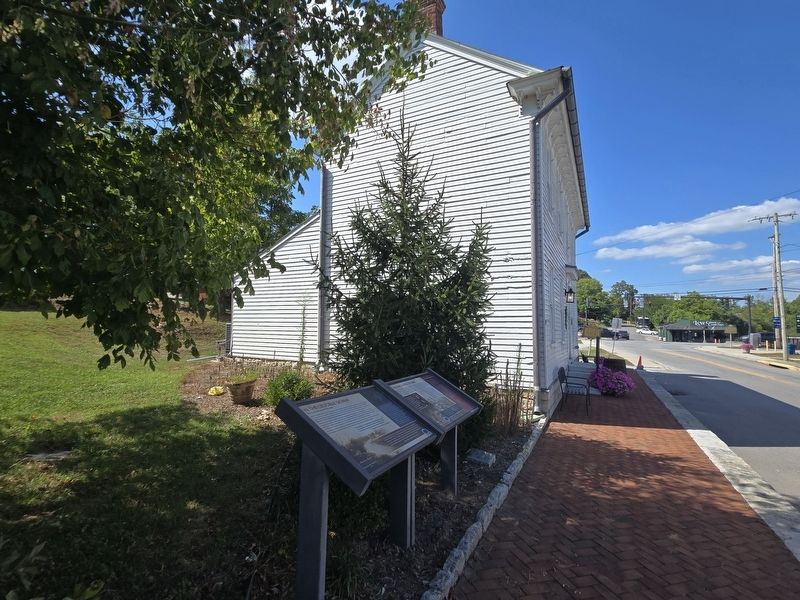
2. The Hard Hand of War Marker on the right of the two markers looking north on S. Buell St.
Location. 37° 38.985′ N, 84° 57.115′ W. Marker is in Perryville, Kentucky, in Boyle County. It is on South Buell Street (U.S. 68) south of West Second Street (U.S. 150), on the right when traveling south. Touch for map. Marker is at or near this postal address: 207 S Buell St, Perryville KY 40468, United States of America. Touch for directions.

Regionally, this marker is in Kentucky’s Bluegrass Region. It is also in the American South and specifically in the Upper South. Globally, it is in North America, the Western Hemisphere, the Western World, and the Anglosphere. Historically, it finds itself in what was once the territory of the Mississippian Culture and also the Antebellum South.
Other nearby markers. At least 8 other markers are within walking distance of this marker: In The Crucible Of War (here, next to this marker); Bragg's Invasion of Kentucky (a few steps from this marker); The Battle of Perryville (a few steps from this marker); Merchants' Row / Street Fighting (within shouting distance of this marker); Elizabeth Madox Roberts (within shouting distance of this marker); Cecil Carpenter (within shouting distance of this marker); W.H. Rogers (within shouting distance of this marker); Alyssa Wray (within shouting distance of this marker). Touch for a list and map of all markers in Perryville.
Credits. This page was last revised on September 8, 2025. It was originally submitted on September 7, 2025, by Mark Parker of Hickory, North Carolina. This page has been viewed 90 times since then and 28 times this year. Photos: 1, 2. submitted on September 7, 2025, by Mark Parker of Hickory, North Carolina. • Bernard Fisher was the editor who published this page.
