
Wilmot in Baden in Waterloo Region, Ontario — Central Canada (North America)
The First Amish Settlement

Photographed by Tim Boyd, June 11, 2024
1. The First Amish Settlement Marker
Erected by Ontario Heritage Foundation, Ministry of Culture and Recreation.
Topics and series. This historical marker is listed in these topic lists: Immigration • Religion & Religious Structures • Settlements & Settlers. In addition, it is included in the Canada, Ontario Heritage Trust series list. A significant historical year for this entry is 1822.
Location. 43° 23.976′ N, 80° 41.747′ W. Marker is in
this page online

Regionally, this marker is in the Huron-Perth-Waterloo-Wellington Area and in Southwestern Ontario. It is also in Central Canada. Globally, it is in North America, the Western Hemisphere, the Western World, and the Anglosphere. Historically, it finds itself in what was once a British colony, the Viceroyalty of New France, the Haudenosaunee (Iroquois) Confederacy, and Rupert’s Land.
Other nearby markers. At least 8 other markers are within 10 kilometers of this marker, measured as the crow flies: Castle Kilbride/ Le Château Kilbride (approx. 2 kilometers away); The Founding of New Hamburg (approx. 2.7 kilometers away); Hartman Bridge (approx. 2.8 kilometers away); The Nith River / La rivière Nith (approx. 2.8 kilometers away); Rev. Frederick William Bindemann (1790-1865) (approx. 2.9 kilometers away); Sir Adam Beck’s Birthplace (approx. 2.9 kilometers

Photographed by Tim Boyd, June 11, 2024
2. The First Amish Settlement Marker
Also see . . .
1. Waterloo Region Generations - Christian Nafziger. <blockquote>In late 1821 Christian Nafziger, a peasant farmer from near Munich, left his family in Bavaria and travelled to Amsterdam. With the help of Mennonite friends in Holland he set sail for Philadelphia in December 1821. Apparently blown off course, his ship reached New Orleans the following March. Travelling by river-boat up the Mississippi to Cincinnati, he made his way to Pennsylvania, the home of a considerable colony of Mennonites. With land there becoming expensive, his friends suggested that he try the Canadas, where cheaper land was presumably available.
Having been supplied with additional funds and a means of conveyance, Nafziger arrived in Upper Canada in August 1822. (Submitted on June 17, 2024, by Tim Boyd of Hamilton, Ontario.)
2. The Settlement ofthe German Block in Wilmot Township, Upper Canada. 1996 article for the Mennonite Historical Society by by Ann
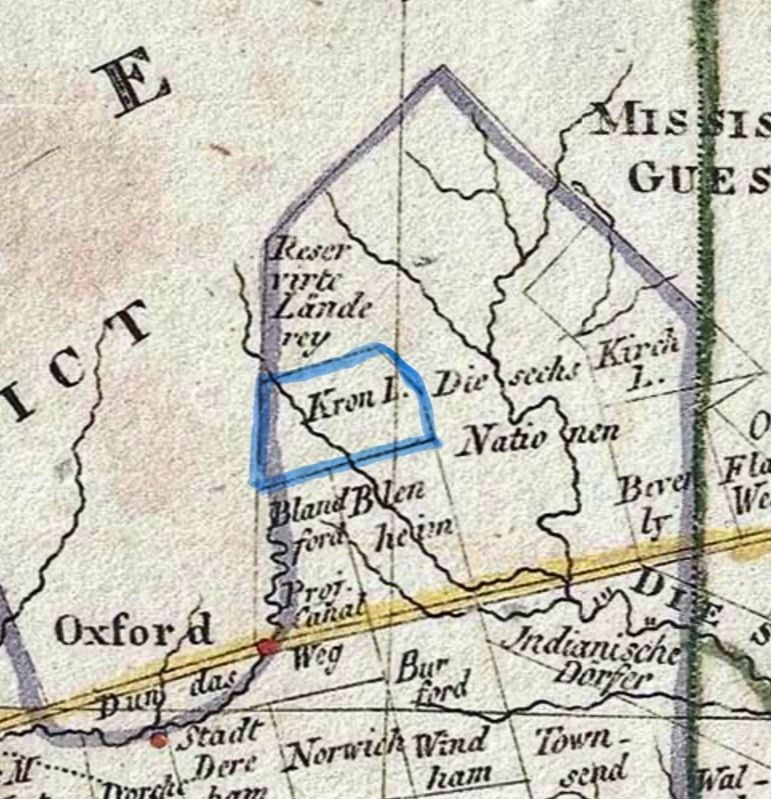
1820
3. German edition of a map of Upper Canada, 1820.
Highlighted is the “Kron Land” (crown Land) that would become the German Block, then Wilmot Township.
Credits. This page was last revised on September 29, 2025. It was originally submitted on June 17, 2024, by Tim Boyd of Hamilton, Ontario. This page has been viewed 504 times since then and 95 times this year. Last updated on September 10, 2025, by Kevin Westell of St. Catharines, Ontario. Photos: 1, 2, 3. submitted on June 17, 2024, by Tim Boyd of Hamilton, Ontario. • Devry Becker Jones was the editor who published this page.
