Rione VI Parione in Roma in Città metropolitana di Roma Capitale, Latium, Rome, Italy — Central Italy (Tyrrhenian Coast)
Parione
Rione VI
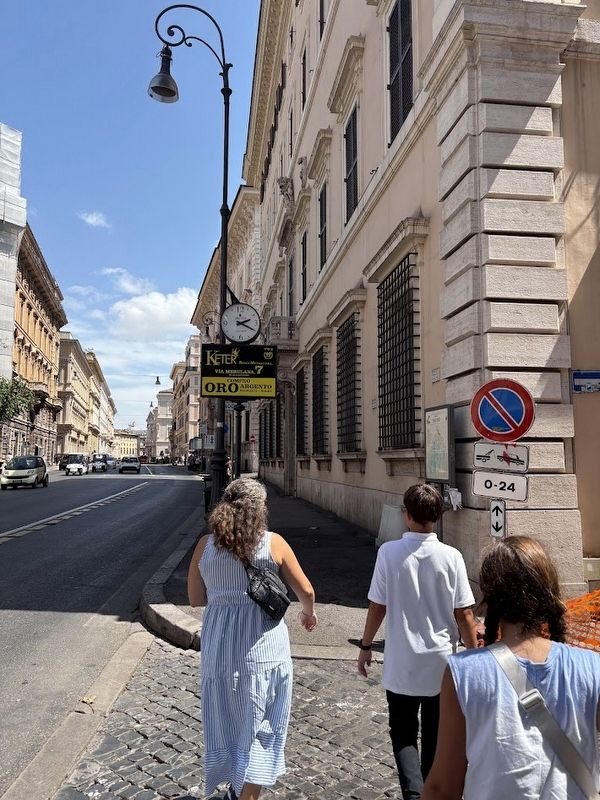
Photographed by Sean P. Flynn, August 3, 2025
1. Parione Marker
Inscription.
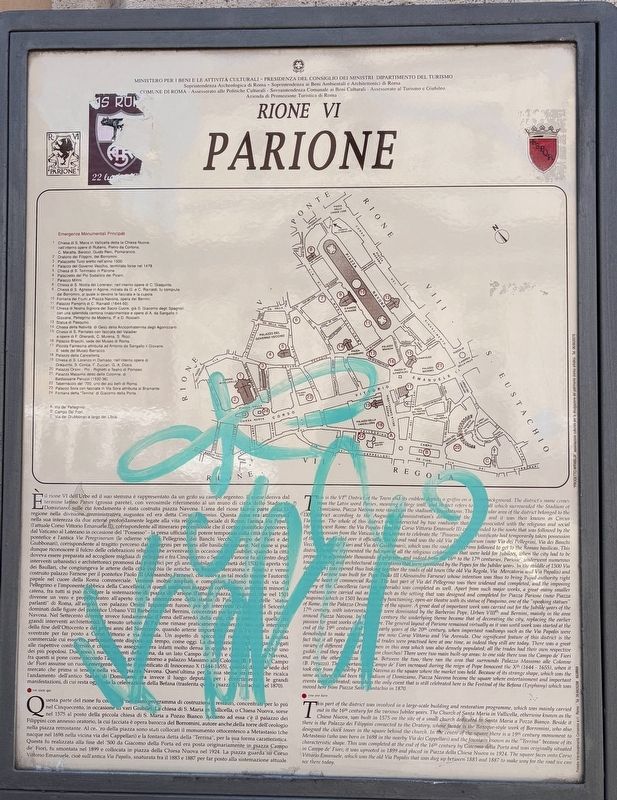
Parione. Rione VI. È il rione VI dell'Urbe ed il suo stemma è rappresentato da un grifo su campo argenteo. Il nome deriva dal termine latino Paries (grossa parete), con verosimile riferimento al un muro di cinta dello Stadio di Domiziano sulle cui fondamenta è stata costruita piazza Navona. L'area del rione faceva parte della IX regione nella divisione amministrativa augustea ed era detta Circus Flaminius. Questa zona era attraversata nella sua interezza da due arterie profondamente legate alla vita religiosa e sociale di Roma: l'antica Via Papalis (l'attuale Corso Vittorio Emanuele II), corrispondente all'itinerario processionale che il corteo pontificio percorreva dal Vaticano al Laterano in occasione del "Possesso" - la presa ufficiale del potere temporale sulla città da parte de pontefice e l'antica Via Peregrinorum (le odierne vie del Pellegrino, dei Banchi Vecchi, Campo de' Fiori e dei Giubbonari), corrispondente al tragitto percorso dai pellegrini per recarsi alle basiliche romane. Nel rione si può dunque riconoscere il fulcro delle celebrazioni religiose che avvenivano in occasione dei Giubilei, quando la città doveva essere preparata ad accogliere migliaia di pellegrini e fra Cinquecento e Seicento Parione fu al centro degli interventi urbanistici e architettonici promossi dai pontefici per gli anni giubilari. Alla metà del 1500 fu aperta via dei Baullari, che congiungeva le arterie della città vecchia (le antiche via Regola, Mercatoria e Papalis) e venne costruito palazzo Farnese per il pontefice Paolo III (Alessandro Farnese), che voleva in tal modo inserire l'autorità papale nel cuore della Roma commerciale. Vennero inoltre ampliati e completati l'ultimo tratto di via del Pellegrino e l'imponente fabbrica della Cancelleria. A questi interventi maggiori corrisposero interventi minori a catena, fra tutti si può ricordare la sistemazione di piazza di Parione (l'attuale piazza l'asquino), che nel 1501 divenne un vero e propri teatro all'aperto con la sistemazione della statua di Pasquino, una delle "statue parlanti" di Roma, all'angolo con palazzo Orsini. Inmportanti furono poi gli interventi giubilare del Seicento, dominati dalle figure del pontefice Urbano VIII Barberini e del Bernini, concentrati per lo piu nella zona di piazza Navona. Nel Settecento divenne invece fondamentale il tema dell'arredo della citta, che si [unreadble] a quello dei grandi interventi architettonici. Il tessuto urbano di Parione rimase practicamente inaltero fino agli interventi della fine dell'Ottocento e dei primi anni del Novecento, quando arterie importanti come la Via Papalis furono sventrate per far posto a Corso Vittorio e via Arenula. Un aspetto di spicco del rione riguarda la finalita commerciale cui esso era particolarmente disposto un tempo, come oggi. La distribuzione degli artigiani, legati alle rispettive confraternite e chiese loro assegnate era infatti molto densa in questo rione che era anche uno dei più popolosi. Due sono i nuclei salienti della zona, da un lato Campo de' Fiori e dall'altro piazza Navona, fra questi si pone come raccordo l'area che gravita intorno a palazzo Massimo alle Colonne (B. Peruzzi). Campo de' Fiori assunse un ruolo emergente durante il pontificato di Innocenzo X (1644-1655), quando divenne sede del mercato che prima si teneva nella vicina piazza Navona. Quest'ultima per la sua stessa struttura, che ricalca l'andamento dell'antico Stadio di Domiziano, era invece il luogo deputato per i divertimenti e le grandi manifestazioni, di cui resta oggi solo la celebrazione della Befana (trasferita qui da piazza S. Eustachio nel 1870). , , Questa parte del rione [unreadable] nel vasto programma di costruzioni restauri, concentrati per lo più nel Cinquecento, in occasione di vari Giubilei. La chiesa di S. Maria in Vallicella, o Chiesa Nuova, sorse nel 1575 al posto della piccola chiesa di S. Maria a Pozzo Bianco. Accanto ad essa c'è il palazzo dei Filippini con annesso oratorio, la cui facciata è opera barocca del Borromini, autore anche della torre dell'orologio nella piazza retrostante. Al ce. ro della piazza sono stati collocati il monumento ottocentesco a Metastasio (che nacque nel 1698 nella vicina via dei Cappellari) e la fontana detta della "Terrina", per la sua forma caratteristica. Questa fu realizzata alla fine del '500 da Giacomo della Porta ed era posta originariamente in piazza Campo de Fiori, fu smontata nel 1899 e collocata in piazza della Chiesa Nuova nel 1924. La piazza guarda su Corso Vittorio Emanuele, cioè sull'antica Via Papalis, snaturata fra il 1883 e 1887 per far posto alla sistemazione attuale. , , This is the VI District of the Town and its emblem depicts a griffin on a silver background. The district's name comes from the Latin word Paries, meaning a large wall, and in fact refers to the wall which surrounded the Stadium of Domiziano, Piazza Navona now stands on the stadium's foundations. This particular area of the district belonged to the IXth district according to the Augustan Administration's division of the town, and it was then known as Circus Flaninius. The whole of this district was intersected by two roadways that were associated with the religious and social life of Ancient Rome: the Via Papalis (now the Corso Vittorio Emanuele II) corresponded to the route that was followed by the Papal Procession from the Vatican to the Lateran to celebrate the "Possesso" - the Pontificate had temporarily taken possession of the city and ruled over it officially; the second road was the old Via Peregrinorum (now Via dei Pelligrini, Via dei Banchi Vecchi, Campo de' Fiori and Via dei Giubbonari), which was the road the pilgrims followedto get to the Roman basilicas. This district therefore represented the fulcrum of all the religious celebrations that were held for Jubilees, when the city had to be prepared to accommodate thousands of pilgrims, and indeed from the 16th to the 17th centuries, Parione underwent numerous town-planning and architectural interventions that were sponsored by the Popes for the Jubilee years. In the middle of 1500 Via dei Baullari was opened thus linking together the roads of old town (the old Via Regola, Via Mercatoria and Via Papalis) and Palazzo Farnese was built for Pope Paolo II (Alessandro Farnese) whose intention was thus to bring Papal authority right into the heart of commercial Rome. The last part of Via del Pellegrino was then widened and completed, and the imposing factory of the Cancelleria (writing materials) was completed as well. Apart from such major works, a great many smøller operations were carried out as well, such as the setting that was designed and completed for Piazza Parione (now Piazza Pasquino) which in 1501 became a fully functioning, open-air theatre with its statue of Pasquino, one of the "speaking statues" of Rome, on the Palazzo Orsini of the square. A great deal of important work was carried out for the Jubilee years of the 17th century, with interventions that were dominated by the Barberini Pope, Urban VIIIth, and Bernini, mainly in the area around Piazza Navona. In the 18th century the underlying theme became that of decorating the city, replacing the earlier passion for great works of architecture. The general layout of Parione remained virtually as it was until work was started at the end of the 19th century and in the early years of the 20th century, when important roadways such as the Via Papalis were demolished to make way for what are now Corso Vittorio and Via Aremula. One significant feature of this district is the fact that all types of business and trades were practised here at one time, as indeed they still are today. There was a great variety of different types of craftsmen in this area which was also densely populated; all the trades had their own respective guilds - and they even had their own churches! There were two main built-up areas: to one side there was the Campo de' Fiori and on the other, Piazza Navona. Between the two, there ran the area that surrounds Palazzo Massimo alle Colonne (B. Peruzzi). The importance of Campo de' Fiori increased during the reign of Pope Innocent the Xth (1644-1655), when it took over from the nearby Piazza Navona as the square where the market was held. Because of its strange shape, which was the same as when it had been the Stadium of Domiziano, Piazza Navona became the square where entertainment and important events were celebrated, nowadays the only event that is still celebrated here is the Festival of the Befana (Epiphany) which was moved here from Piazza Sant' Eustachio in 1870. , , This part of the district was involved in a large-scale building and restoration programme, which was mainly carried out in the 16th century for the various Jubilee years. The Church of Santa Maria in Vallicella, otherwise known as the Chiesa Nuova, was built in 1575 on the site of a small church dedicated to Santa Maria a Pozzo Bianco. Beside it there is the Palazzo dei Filippini connected to the Oratory, whose facade is the Baroque-style work of Borromini, who also designed the clock tower in the square behind the church. In the centre of the square there is a 19th century monument to Metastasio (who was born in 1698 in the nearby Via dei Cappellari) and the fountain known as the "Terrina" because of its characteristic shape. This was completed at the end of the 16th century by Cincomo della Porta and was originally situated in Campo de Fiori; it was uprooted in 1899 and placed in Piazza della Chiesa Nuova in 1924. The square faces onto Corso Vittorio Emanuele, which was the old Via Papolis that was dug up between 1883 and 1887 to make way for the road we can see there today.
È il rione VI dell'Urbe ed il suo stemma è rappresentato da un grifo su campo argenteo. Il nome deriva dal termine latino Paries (grossa parete), con verosimile riferimento al un muro di cinta dello Stadio di Domiziano sulle cui fondamenta è stata costruita piazza Navona. L'area del rione faceva parte della IX regione nella divisione amministrativa augustea ed era detta Circus Flaminius. Questa zona era attraversata nella sua interezza da due arterie profondamente legate alla vita religiosa e sociale di Roma: l'antica Via Papalis (l'attuale Corso Vittorio Emanuele II), corrispondente all'itinerario processionale che il corteo pontificio percorreva dal Vaticano al Laterano in occasione del "Possesso" - la presa ufficiale del potere temporale sulla città da parte de pontefice e l'antica Via Peregrinorum (le odierne vie del Pellegrino, dei Banchi Vecchi, Campo de' Fiori e dei Giubbonari), corrispondente al tragitto percorso dai pellegrini per recarsi alle basiliche romane. Nel rione si può dunque riconoscere il fulcro delle celebrazioni religiose che avvenivano in occasione dei Giubilei, quando la città doveva essere preparata ad accogliere migliaia di pellegrini e fra Cinquecento e Seicento Parione fu al centro degli interventi urbanistici e architettonici promossi dai pontefici per gli anni giubilari. Alla metà del 1500 fu
Click or scan to see this page online
aperta via dei Baullari, che congiungeva le arterie della città vecchia (le antiche via Regola, Mercatoria e Papalis) e venne costruito palazzo Farnese per il pontefice Paolo III (Alessandro Farnese), che voleva in tal modo inserire l'autorità papale nel cuore della Roma commerciale. Vennero inoltre ampliati e completati l'ultimo tratto di via del Pellegrino e l'imponente fabbrica della Cancelleria. A questi interventi maggiori corrisposero interventi minori a catena, fra tutti si può ricordare la sistemazione di piazza di Parione (l'attuale piazza l'asquino), che nel 1501 divenne un vero e propri teatro all'aperto con la sistemazione della statua di Pasquino, una delle "statue parlanti" di Roma, all'angolo con palazzo Orsini. Inmportanti furono poi gli interventi giubilare del Seicento, dominati dalle figure del pontefice Urbano VIII Barberini e del Bernini, concentrati per lo piu nella zona di piazza Navona. Nel Settecento divenne invece fondamentale il tema dell'arredo della citta, che si [unreadble] a quello dei grandi interventi architettonici. Il tessuto urbano di Parione rimase practicamente inaltero fino agli interventi della fine dell'Ottocento e dei primi anni del Novecento, quando arterie importanti come la Via Papalis furono sventrate per far posto a Corso Vittorio e via Arenula. Un aspetto di spicco del rione riguarda la finalita commerciale cui esso
Photographed by Sean P. Flynn, August 3, 2025
2. Parione Marker
era particolarmente disposto un tempo, come oggi. La distribuzione degli artigiani, legati alle rispettive confraternite e chiese loro assegnate era infatti molto densa in questo rione che era anche uno dei più popolosi. Due sono i nuclei salienti della zona, da un lato Campo de' Fiori e dall'altro piazza Navona, fra questi si pone come raccordo l'area che gravita intorno a palazzo Massimo alle Colonne (B. Peruzzi). Campo de' Fiori assunse un ruolo emergente durante il pontificato di Innocenzo X (1644-1655), quando divenne sede del mercato che prima si teneva nella vicina piazza Navona. Quest'ultima per la sua stessa struttura, che ricalca l'andamento dell'antico Stadio di Domiziano, era invece il luogo deputato per i divertimenti e le grandi manifestazioni, di cui resta oggi solo la celebrazione della Befana (trasferita qui da piazza S. Eustachio nel 1870).
Questa parte del rione [unreadable] nel vasto programma di costruzioni restauri, concentrati per lo più nel Cinquecento, in occasione di vari Giubilei. La chiesa di S. Maria in Vallicella, o Chiesa Nuova, sorse nel 1575 al posto della piccola chiesa di S. Maria a Pozzo Bianco. Accanto ad essa c'è il palazzo dei Filippini con annesso oratorio, la cui facciata è opera barocca del Borromini, autore anche della torre dell'orologio nella piazza retrostante. Al ce. ro della piazza sono stati collocati il monumento ottocentesco
a Metastasio (che nacque nel 1698 nella vicina via dei Cappellari) e la fontana detta della "Terrina", per la sua forma caratteristica. Questa fu realizzata alla fine del '500 da Giacomo della Porta ed era posta originariamente in piazza Campo de Fiori, fu smontata nel 1899 e collocata in piazza della Chiesa Nuova nel 1924. La piazza guarda su Corso Vittorio Emanuele, cioè sull'antica Via Papalis, snaturata fra il 1883 e 1887 per far posto alla sistemazione attuale.
This is the VI District of the Town and its emblem depicts a griffin on a silver background. The district's name comes from the Latin word Paries, meaning a large wall, and in fact refers to the wall which surrounded the Stadium of Domiziano, Piazza Navona now stands on the stadium's foundations. This particular area of the district belonged to the IXth district according to the Augustan Administration's division of the town, and it was then known as Circus Flaninius. The whole of this district was intersected by two roadways that were associated with the religious and social life of Ancient Rome: the Via Papalis (now the Corso Vittorio Emanuele II) corresponded to the route that was followed by the Papal Procession from the Vatican to the Lateran to celebrate the "Possesso" - the Pontificate had temporarily taken possession of the city and ruled over it officially; the second road was the old Via Peregrinorum (now Via dei Pelligrini, Via dei Banchi Vecchi, Campo de' Fiori and Via dei Giubbonari), which was the road the pilgrims followedto get to the Roman basilicas. This district therefore represented the fulcrum of all the religious celebrations that were held for Jubilees, when the city had to be prepared to accommodate thousands of pilgrims, and indeed from the 16th to the 17th centuries, Parione underwent numerous town-planning and architectural interventions that were sponsored by the Popes for the Jubilee years. In the middle of 1500 Via dei Baullari was opened thus linking together the roads of old town (the old Via Regola, Via Mercatoria and Via Papalis) and Palazzo Farnese was built for Pope Paolo II (Alessandro Farnese) whose intention was thus to bring Papal authority right into the heart of commercial Rome. The last part of Via del Pellegrino was then widened and completed, and the imposing factory of the Cancelleria (writing materials) was completed as well. Apart from such major works, a great many smøller operations were carried out as well, such as the setting that was designed and completed for Piazza Parione (now Piazza Pasquino) which in 1501 became a fully functioning, open-air theatre with its statue of Pasquino, one of the "speaking statues" of Rome, on the Palazzo Orsini of the square. A great deal of important work was carried out for the Jubilee years of the 17th century, with interventions that were dominated by the Barberini Pope, Urban VIIIth, and Bernini, mainly in the area around Piazza Navona. In the 18th century the underlying theme became that of decorating the city, replacing the earlier passion for great works of architecture. The general layout of Parione remained virtually as it was until work was started at the end of the 19th century and in the early years of the 20th century, when important roadways such as the Via Papalis were demolished to make way for what are now Corso Vittorio and Via Aremula. One significant feature of this district is the fact that all types of business and trades were practised here at one time, as indeed they still are today. There was a great variety of different types of craftsmen in this area which was also densely populated; all the trades had their own respective guilds - and they even had their own churches! There were two main built-up areas: to one side there was the Campo de' Fiori and on the other, Piazza Navona. Between the two, there ran the area that surrounds Palazzo Massimo alle Colonne (B. Peruzzi). The importance of Campo de' Fiori increased during the reign of Pope Innocent the Xth (1644-1655), when it took over from the nearby Piazza Navona as the square where the market was held. Because of its strange shape, which was the same as when it had been the Stadium of Domiziano, Piazza Navona became the square where entertainment and important events were celebrated, nowadays the only event that is still celebrated here is the Festival of the Befana (Epiphany) which was moved here from Piazza Sant' Eustachio in 1870.
This part of the district was involved in a large-scale building and restoration programme, which was mainly carried out in the 16th century for the various Jubilee years. The Church of Santa Maria in Vallicella, otherwise known as the Chiesa Nuova, was built in 1575 on the site of a small church dedicated to Santa Maria a Pozzo Bianco. Beside it there is the Palazzo dei Filippini connected to the Oratory, whose facade is the Baroque-style work of Borromini, who also designed the clock tower in the square behind the church. In the centre of the square there is a 19th century monument to Metastasio (who was born in 1698 in the nearby Via dei Cappellari) and the fountain known as the "Terrina" because of its characteristic shape. This was completed at the end of the 16th century by Cincomo della Porta and was originally situated in Campo de Fiori; it was uprooted in 1899 and placed in Piazza della Chiesa Nuova in 1924. The square faces onto Corso Vittorio Emanuele, which was the old Via Papolis that was dug up between 1883 and 1887 to make way for the road we can see there today.
Location. 41° 53.863′ N, 12° 28.133′ E. Marker is in Roma, Lazio (Latium, Rome), in Città metropolitana di Roma Capitale. It is in Rione VI Parione. It is at the intersection of Corso Vittorio Emanuele II and Via Largo, on the right on Corso Vittorio Emanuele II. Touch for map. Marker is at or near this postal address: Corso Vittorio Emanuele II 244, Roma, Lazio 00186, Italy. Touch for directions.

Regionally, it is in Europe, the European Union, the Schengen Area, a coastal Mediterranean country, and the Western World. Historically, it finds itself in what was once the Byzantine Empire and specifically also the Roman Empire.
Credits. This page was last revised on September 11, 2025. It was originally submitted on September 10, 2025, by Sean P. Flynn of Oak Park, Illinois. This page has been viewed 94 times since then and 27 times this year. Photos:1. submitted on September 10, 2025, by Sean P. Flynn of Oak Park, Illinois. 2. submitted on September 11, 2025, by Sean P. Flynn of Oak Park, Illinois.