Veyo in Washington County, Utah — The American Mountains (Southwest)
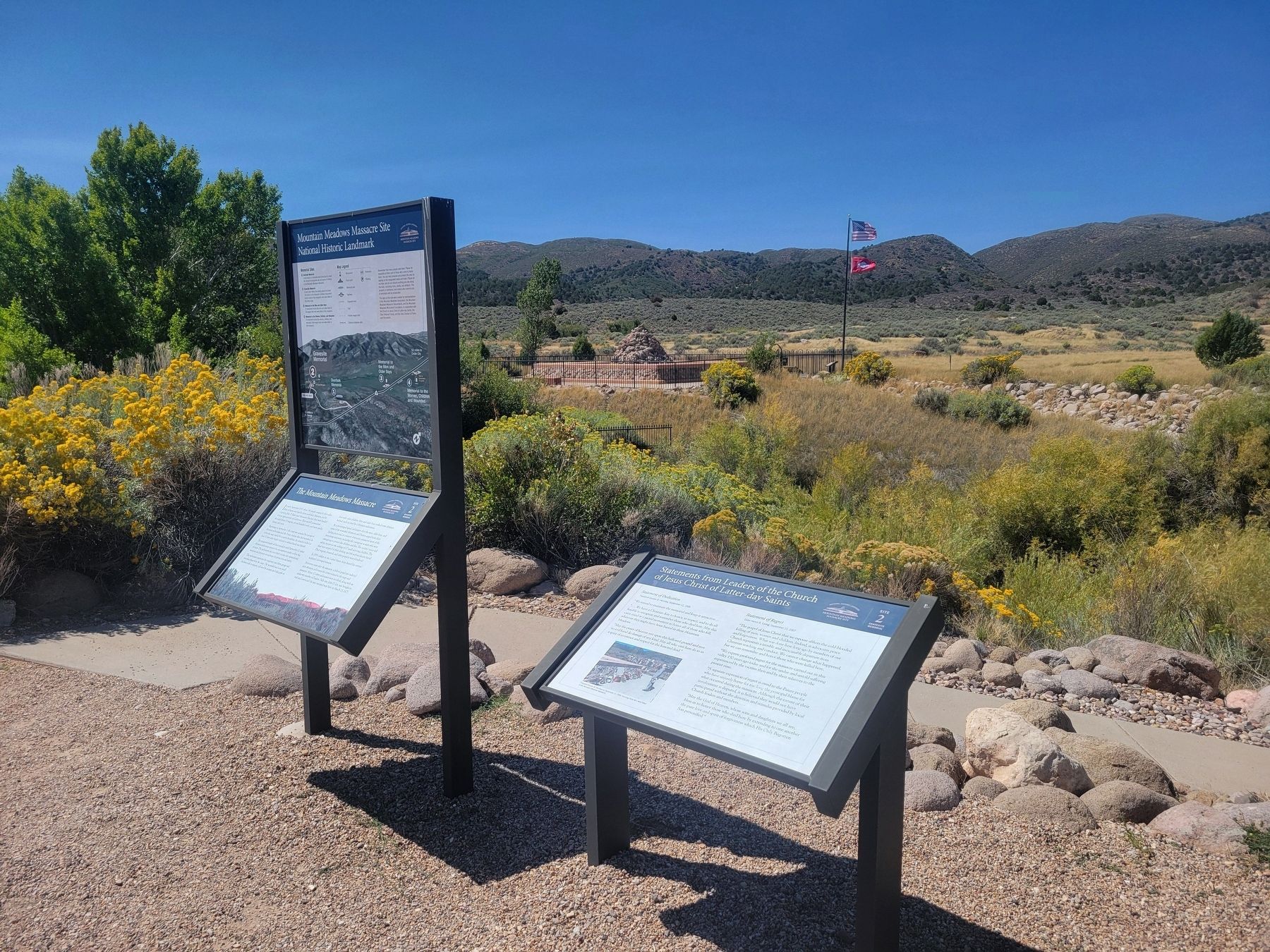
The Mountain Meadows Massacre
⎯⎯⎯
Statements from Leaders of the Church of Jesus Christ of Latter-day
Site 2: Graveyard Memorial
| — | National Historic Landmark | — |

Photographed by Jeremy Snow, September 11, 2025
1. The Mountain Meadows Massacre Marker
Mountain Meadows Massacre
In early September 1857, about 140 people camped in this valley. Most of them were families from northwest Arkansas. Led by Captains John T. Baker and Alexander Fancher, they were headed to new opportunities in California. Their worldly possessions included about 35 wagons, several hundred cattle, and many mules, horses, and oxen.
Beginning on September 7, the camp was attacked by a group of Mormon militiamen and the Paiute Indians they had recruited. In a five-day siege fueled by complex hostilities, the attackers killed at least 10 men who fought valiantly to defend family and friends.
The emigrants fought off their attackers until September 11, when Mormon militiamen entered the encampment under a white flag of truce. The militiamen deceived their victims into surrendering weapons and property in exchange for protection and safety.
The militiamen separated the emigrants into three groups and marched them from the camp. The wounded and some small children rode in wagons, followed by women and older girls on foot with other children. Men and older boys walked some distance behind, each
this page online
At a prearranged signal, militiamen shot the men, older boys, and some of the wounded. Mormons and Paiutes surged from their hiding places and, in a matter of minutes, massacred most of the remaining emigrants, including the courageous women who were attempting to protect the children and flee. The victims' voices fell silent, except for the sobbing of 17 small surviving children. The dead were stripped of their clothing and left without decent burial. Their wagons, livestock, and other property were plundered.
In 1859, soldiers in the United States Army buried the victims' scattered, scavenged remains.
Seventeen years after the massacre, a federal grand jury indicted nine Mormon militiamen for crimes related to the siege and massacre. About 50 other militiamen were involved, along with an unknown number of Paiutes. Only one, John D. Lee, was brought to trial and convicted. He was executed near here on March 23, 1877.
Statements from Leaders of the Church of Jesus Christ of Latter-day Saints
Statement of Dedication
President Gordon B. Hinckley, September 11, 1999
"We intend to maintain

Photographed by Jeremy Snow, September 11, 2025
2. Statements from Leaders of the Church of Jesus Christ of Latter-day Saints
"... We have a Christian duty to honor, to respect, and to do all feasible to recognize and remember those who died here. May this cairn stand as a sacred monument to honor all of those who fell, wherever they might have been buried in these Mountain Meadows....
"May the peace of heaven rest upon this hallowed ground and may no evil hand do damage of any kind. May all who visit here do so in a spirit of reverence and respect for the honored dead."
Statement of Regret
Elder Henry B. Eyring, September 11, 2007
"The gospel of Jesus Christ that we espouse abhors the cold-blooded killing of men, women and children. Indeed, it advocates peace and forgiveness. What was done here long ago by members of our Church represents a terrible and inexcusable departure from Christian teaching and conduct. We cannot change what happened, but we can remember and honor those who were killed here.
"We express profound regret for the massacre carried out in this valley 150 years ago today and for the undue and untold suffering experienced by the victims then and by their relatives to the present time..
"A
Photographed by Jeremy Snow, September 11, 2025
3. The Mountain Meadows Massacre Marker
"May the God of Heaven, whose sons and daughters we all are, bless us to honor those who died here by extending to one another the pure love and spirit of forgiveness which His Only Begotten Son personified."
Topics. This historical marker is listed in this topic list: Notable Events. A significant historical date for this entry is September 11, 1857.
Location. 37° 28.535′ N, 113° 38.581′ W. Marker is in Veyo, Utah, in Washington County. It is on Mountain Meadow Monument Trail, on the left when traveling south. Located at the edge of the parking lot. Touch for map. Marker is at or near this postal address: Mountain Meadow Monument Trail, Central UT 84722, United States of America. Touch for directions.

Regionally, this marker is in Utah’s Color Country. It is also in the American Southwest, in the Mountain West, and on the Colorado Plateau. Globally, it is in North America, the Rocky Mountains, the Western Hemisphere, the Western World, and the Anglosphere. Historically, it finds itself in what was once New Spain and also Mexico’s Alta California.
Other nearby markers. At least 8 other markers are within walking distance of this marker: Siege, Murder, and Burials at the Emigrants' Campsite (within shouting distance of this marker); Mountain Meadows Massacre Grave Site Memorial (within shouting distance of this marker); Execution at the Scene of the Crimes (about 400 feet away, measured in a direct line); The Burial Sites (approx. 0.6 miles away); The Arkansas Wagon Train (approx. 0.6 miles away); The Old Spanish Trail and The California Road (approx. 0.6 miles away); 1990 Mountain Meadows Monument (approx. 0.6 miles away); Leaders of the Arkansas Wagon Train (approx. 0.6 miles away).
Credits. This page was last revised on September 14, 2025. It was originally submitted on September 11, 2025, by Jeremy Snow of Cedar City, Utah. This page has been viewed 83 times since then and 34 times this year. Photos: 1, 2. submitted on September 11, 2025, by Jeremy Snow of Cedar City, Utah. 3. submitted on September 12, 2025, by Jeremy Snow of Cedar City, Utah. • Andrew Ruppenstein was the editor who published this page.
