Ridgecrest in Buncombe County, North Carolina — The American South (South Atlantic)
Swannanoa Gap Engagement
Blocking the Way
| — | Stoneman's Raid | — |
Photographed by Mike Stroud, May 19, 2012
1. Swannanoa Gap Engagement Marker
(preface) On March 24, 1865, Union Gen. George Stoneman led 6,000 cavalrymen from Tennessee into southwestern Virginia and western North Carolina to disrupt the Confederate supply line by destroying sections of the Virginia and Tennessee Railroad, the North Carolina Railroad, and the Piedmont Railroad. He struck at Boone on March 28, headed into Virginia on April 2, and returned into North Carolina a week later. Stoneman's Raid ended at Asheville on April 26, the day that Confederate Gen. Joseph E. Johnston surrendered to Union Gen. William T. Sherman near Durham.
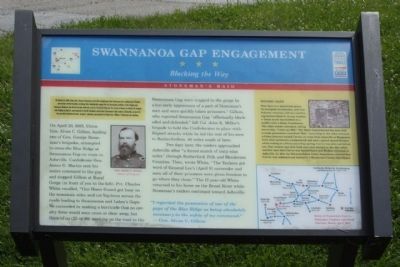
On April 20, 1865, Union Gen. Alvan C. Gillem, [picture included] leading two of Gen. George Stoneman's brigades, attempted to cross the Blue Ridge at Swannanoa Gap en route to Asheville. Confederate Gen. James G. Martin sent his entire command to the gap and stopped Gillem at Royal Gorge (in front of you to the left). Pvt. Charles White recalled, "Our Home Guard got busy on the mountain sides and cut big trees across the roads leading to Swannanoa and Lakey's Gaps. We succeeded in making a barricade that no cavalry force would soon cross or clear away, but
this page online
Two days later, the raiders approached Asheville after "a forced march of sixty-nine miles" through Rutherford, Polk, and Henderson Counties. Then, wrote White, "The Yankees got word of General Lee's [April 9] surrender and soon all of their prisoners were given freedom to where they chose. The 17 year-old White returned to his home on the Broad River while Stoneman's raiders continued toward Asheville.
"I regarded the possession of one of the gaps of the Blue Ridge as being absolutely necessary to the safety of my command." — Gen. Alvan Gillem(sidebar)
Mystery Grave
Near here is a mysterious grave. Its occupant is unknown, and Confederate veterans told two conflicting stories about it. In one version, a Union scout
Photographed by Mike Stroud, May 19, 2012
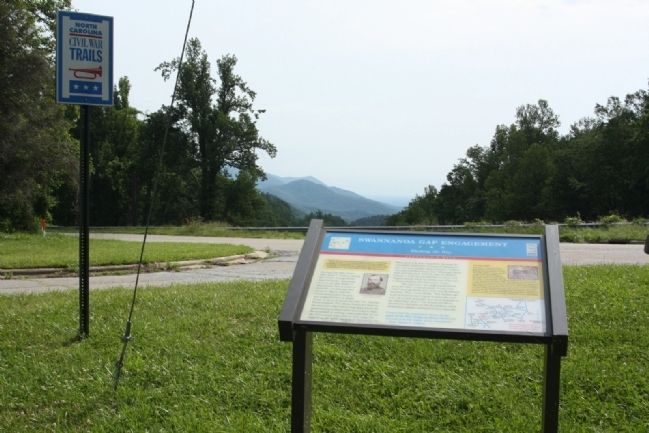
2. Swannanoa Gap Engagement Marker and Gap seen in background
Erected by North Carolina Civil War Trails.
Topics and series. This historical marker is listed in this topic list: War, US Civil. In addition, it is included in the North Carolina Civil War Trails series list. A significant historical date for this entry is April 20, 1865.
Location. This marker has been replaced by another marker nearby. It was located near 35° 37.33′ N, 82° 16.323′ W. Marker was in Ridgecrest, North Carolina, in Buncombe County. It was on Yates Avenue
Photographed by Mike Stroud, May 19, 2012
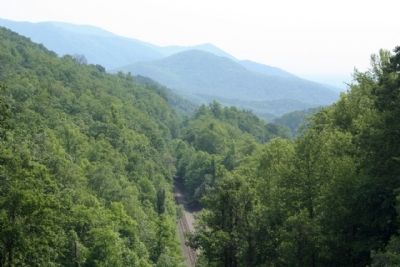
3. Swannanoa Gap
"Confederate Home Guard turned back elements of Stoneman’s raiders at Royal Gorge visible from here. On April 20, 1865, local Southerners blocked the road in the gorge with felled trees and other obstructions, causing the Union raiders to end their advance on Asheville (at least through here). The raiders detoured from here, however, and found another — much longer — way into the city."

Regionally, this marker was in the Mountains and in Greater Asheville. It was also in the American South, specifically in the Upper South, in Appalachia, and specifically in Southern Appalachia. Globally, it was in North America, the Western Hemisphere, the Western World, and the Anglosphere. Historically, it found itself in what was once the original Cherokee Nation, the territory of the Mississippian Culture, one of the original Thirteen Colonies, one of the Confederate States of America, and the Antebellum South.
Other nearby markers. At least 8 other markers are within walking distance of this location: A different marker also named Swannanoa Gap Engagement (here, next to this marker); All Day Long: Building the Western North Carolina Railroad (a few steps from this marker); Somebody's Dead: Swannanoa Tunnel (a few steps from this marker); Wind Blowed Cold, Babe: The Swannanoa Stockade (a few steps from this marker); Swannanoa Tunnel
Photographed by Swannanoa Gap Engagement Marker, `
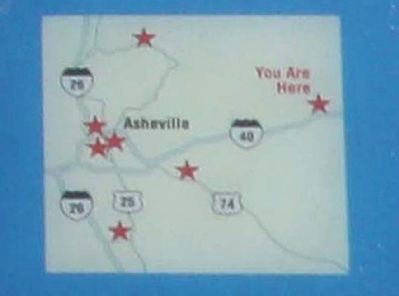
4. Swannanoa Gap Engagement Marker Map included
Related marker. Click here for another marker that is related to this marker. New CWT Marker At This Location also titled "Swannanoa Gap Engagement".
Also see . . .
1. George Stoneman, Jr. At the start of the Civil War Stoneman was in command of Fort Brown, Texas, and refused the order of Maj. Gen. David E. Twiggs to surrender to the newly established Confederate authorities there, escaping to the north with most of his command .... (Submitted on June 5, 2012, by Mike Stroud of Bluffton, South Carolina.)
2. Alvan Cullem Gillem. .With the outbreak of the Civil War, Gillem became a captain on May 14, 1861, initially serving under George H. Thomas. ... (Submitted on June 5, 2012, by Mike Stroud of Bluffton, South Carolina.)
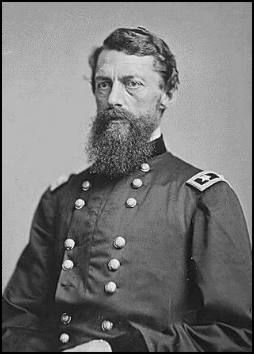
Photographed by American Civil War Photos, between 1860 and 1870
5. Union Gen. George Stoneman
led 6,000 cavalrymen from Tennessee into southwestern Virginia and western North Carolina
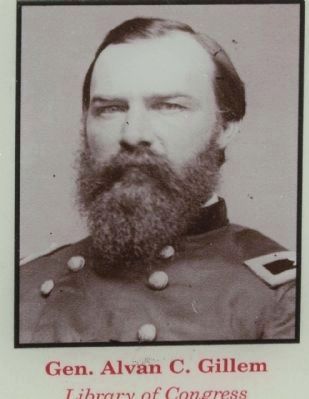
Library of Congress, `
6. Union Gen. Alvan C. Gillem
led two of Gen. George Stoneman's brigades, attempted to cross the Blue Ridge at Swannanoa Gap
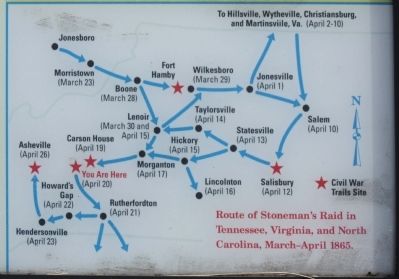
Photographed by Swannanoa Gap Engagement Marker, `
7. Map included: Route of Stoneman's Raid
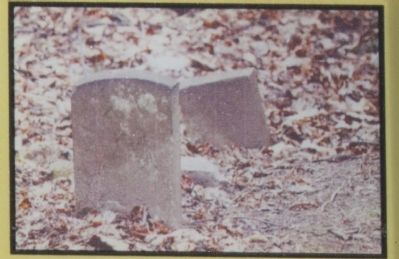
Photographed by Swannanoa Gap Engagement Marker, `
8. Mysterious grave, as mentioned
Credits. This page was last revised on September 17, 2025. It was originally submitted on June 4, 2012, by Mike Stroud of Bluffton, South Carolina. This page has been viewed 2,206 times since then and 84 times this year. Last updated on September 12, 2025, by Mark Parker of Hickory, North Carolina. Photos: 1. submitted on June 5, 2012, by Mike Stroud of Bluffton, South Carolina. 2, 3, 4, 5, 6, 7, 8. submitted on June 4, 2012, by Mike Stroud of Bluffton, South Carolina. • Bernard Fisher was the editor who published this page.
