Winnabow in Brunswick County, North Carolina — The American South (South Atlantic)
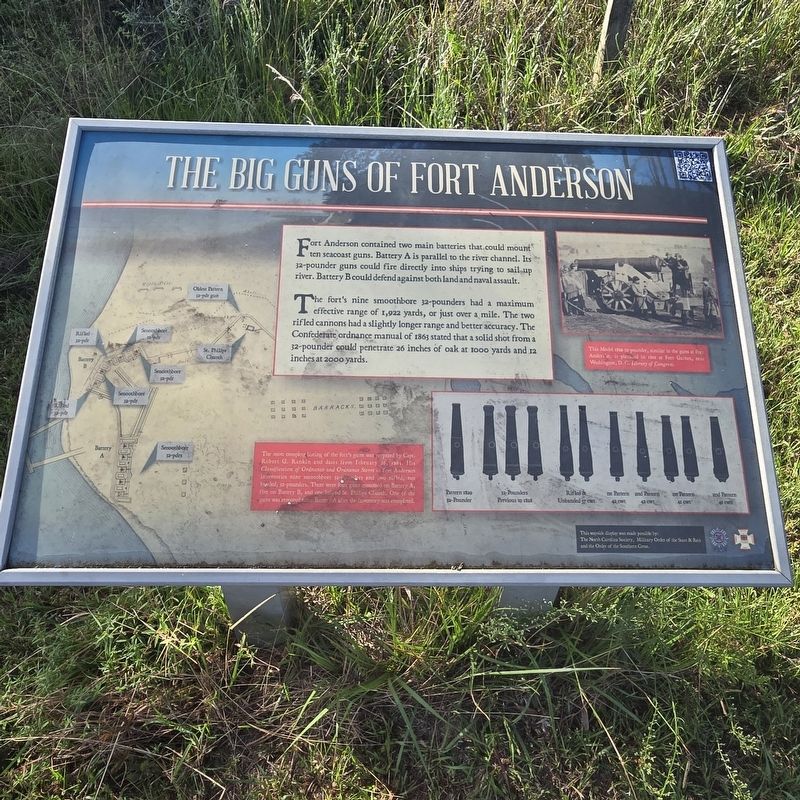
The Big Guns Of Fort Anderson
Photographed by Mike McKeown, September 12, 2025
1. The Big Guns of Fort Anderson Marker
Fort Anderson contained two main batteries that could mount ten seacoast guns. Battery A is parallel to the river channel. Its 32-pounder guns could fire directly into ships trying to sail up river. Battery B could defend against both land and naval assault.
The fort's nine smoothbore 32-pounders had a maximum effective range of 1,922 yards, or just over a. mile. The two rifled cannons had a slightly longer range and better accuracy. The Confederate ordnance manual of 1863 stated that a solid shot from a 32-pounder could penetrate 26 inches of oak at moo yards and 12 inches at 2000 yards.
The most complete listing of the fort's guns was prepared by Capt. Robert G. Rankin and dates from February 26, 1864. His Classification of Ordnance and Ordinance Stores at Fort Anderson inventories nine smoothbore 32-pounders and two rifled, not banded, 32-pounders. There were four guns mounted on Battery A, five on Battery B, and ne and one behind St. Phillips Church. One of the guns was removed from battery A after the inventory was completed.
This model 1829 32-pounder, similar to the guns at For Anderson, is pictured at
this page online
Pattern 1829 32-Pounder • 32-Pounders Previous to 1828 • Rifled & Unbanded 57 cwt • 1st Pattern 42 cwt • 2nd Pattern 42 cwt • 1st pattern 41 cwt • 2nd Pattern 41 cwt
Erected by North Carolina Society, Military Order of the Stars & Bars and the Order of the Southern Cross.
Topics. This historical marker is listed in these topic lists: Forts and Castles • War, US Civil. A significant historical date for this entry is February 26, 1864.
Location. 34° 2.36′ N, 77° 56.656′ W. Marker is in Winnabow, North Carolina, in Brunswick County. It can be reached from St Phillips Road SE 0.6 miles east of Plantation Road SE when traveling east. Along the Fort Anderson Trail behind the visitor center at the Brunswick Town/Fort Anderson State Historic Site. Touch for map. Marker is at or near this postal address: 8884 St Phillips Rd SE, Winnabow NC 28479, United States of America. Touch for directions.

Regionally, this marker is in the Coastal Plain and on the Cape Fear Coast. It is also in the American South, specifically in the Upper South, in the Tidewater, and on the Eastern Seaboard.

Photographed by Mike McKeown, September 12, 2025
2. The Big Guns of Fort Anderson Marker
Other nearby markers. At least 8 other markers are within walking distance of this marker: 32-Pounder Rifled Cannon (a few steps from this marker); Fort Anderson (within shouting distance of this marker); Yankee Catchers & Infernal Machines (within shouting distance of this marker); Capt. William Dry and the Spanish Attack (about 500 feet away, measured in a direct line); Brunswick Town State Historic Site (about 600 feet away); A Home at Brunswick: Hepburn-Reonolds Site (about 700 feet away); Margaret McCorkall: A Brunswick Woman (about 700 feet away); a different marker also named Fort Anderson (about 700 feet away). Touch for a list and map of all markers in Winnabow.
Also see . . .
1. 32 Pound 1829 Gun at Fort Morgan Alabama ( Santee1821: Naval Artifacts and Artillery). (Submitted on September 12, 2025, by Mike McKeown of Baltimore, Maryland.)
2. Fort Anderson Wikipedia.
Photographed by Mike McKeown, September 12, 2025
3. The Big Guns of Fort Anderson Marker
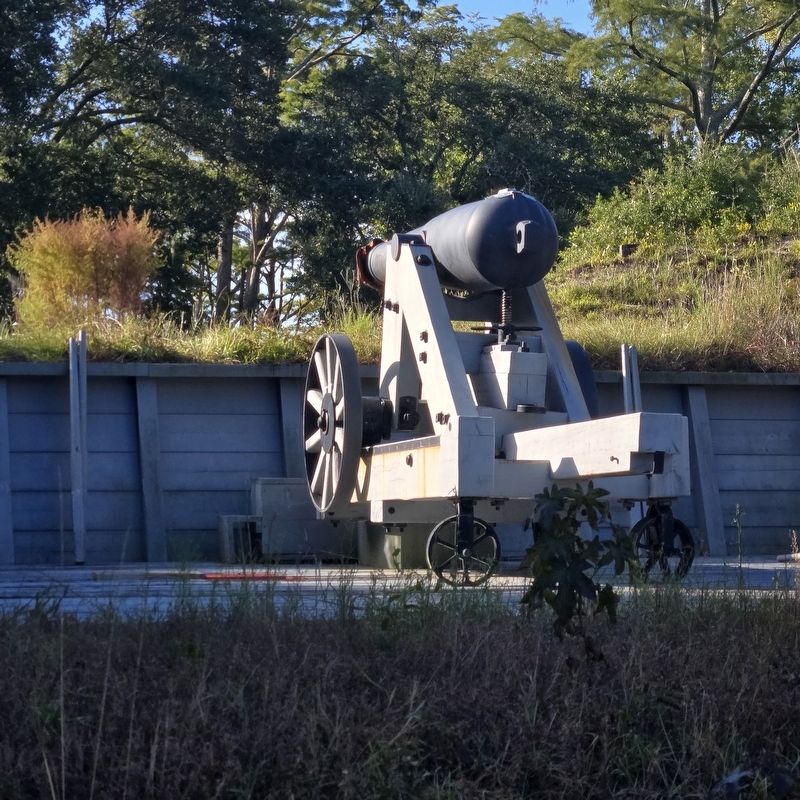
32 pound replica gun at Ft. Anderson
3. Brunswick Town/Fort Anderson (North Carolina Historic Sites). (Submitted on September 12, 2025, by Mike McKeown of Baltimore, Maryland.)
Credits. This page was last revised on September 13, 2025. It was originally submitted on September 12, 2025, by Mike McKeown of Baltimore, Maryland. This page has been viewed 99 times since then and 32 times this year. Photos: 1, 2, 3. submitted on September 12, 2025, by Mike McKeown of Baltimore, Maryland. • Bernard Fisher was the editor who published this page.
