Near Winnabow in Brunswick County, North Carolina — The American South (South Atlantic)
Fort Anderson
One Shovelful at a Time
| — | Confederate Lifeline | — |
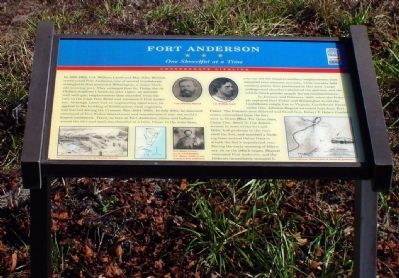
Photographed by J. J. Prats, January 15, 2008
1. Fort Anderson Marker
In January and February 1865, when the Federals captured Fort Fisher and Wilmington to cut the Confederate
this page online
Erected by North Carolina Civil War Trails.
Topics and series. This historical marker is listed in these topic lists: Forts and Castles • War, US Civil. In addition, it is included in the North Carolina Civil War Trails series list. A significant historical date for this entry is February 19, 1865.
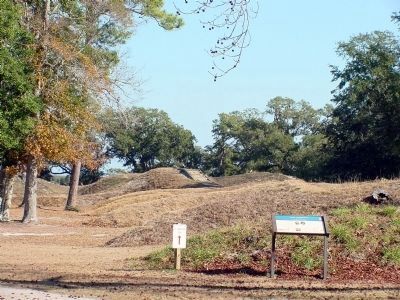
Location. 34° 2.343′ N, 77° 56.638′ W. Marker is near Winnabow, North Carolina, in Brunswick County. It can be reached from St. Philips Road SE 0.6 miles east of Plantation Road when traveling east. It is outside of the Brunswick Town Historic Site visitors center, facing the earthworks.
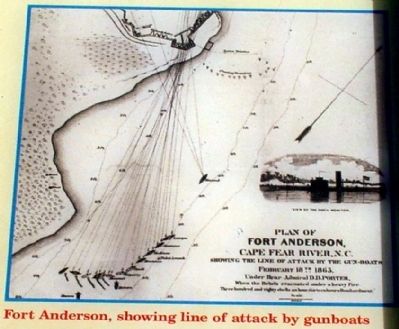
2. Detail of Marker

Regionally, this marker is in the Coastal Plain and on the Cape Fear Coast. It is also in the American South, specifically in the Upper South, in the Tidewater, and on the Eastern Seaboard. Globally, it is in the North Atlantic Region, North America, the Western Hemisphere, the Western World, and the Anglosphere. Historically, it finds itself in what was once the territory of the Mississippian Culture, one of the original Thirteen Colonies, one of the Confederate States of America, and the Antebellum South.
Other nearby markers. At least 8 other markers are within walking distance of this marker: Yankee Catchers & Infernal Machines (within shouting distance of this marker); 32-Pounder Rifled Cannon (within shouting distance of this marker); The Big Guns Of Fort Anderson (within shouting distance of this marker); Capt. William Dry and the Spanish Attack (about 500 feet away, measured in a direct line); A Home at Brunswick: Hepburn-Reonolds Site (about 700 feet away); Brunswick Town State Historic Site
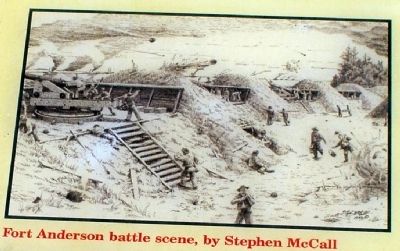
3. Detail of Marker
More about this marker. A drawing of a "Fort Anderson Battle scene, by Stephen McCall" is at the lower right; followed by a map of Cape Fear showing Roads to Wilmington, Fort Anderson and Fisher, and Hoke’s positions; and a portrait of "Pvt. James Croom, Co. B, 1st Battalion, N.C. Heavy Artillery stationed at Fort Anderson."
In the center of the marker are portraits of Gen. Johnson Hagood and Col. William Lamb. The lower right has a period map of “Fort Anderson, showing line of attack by gunboats.”
Regarding Fort Anderson. Fort Anderson protected the Confederacy’s most important blockade-running seaport, Wilmington, 13 miles upriver from the fort.
Also see . . .
1. Fort Anderson: The Battle for Wilmington. Book by Chris E. Fonvielle on Amazon.com with the “Search Inside” feature. (Submitted on March 23, 2008, by J. J. Prats of Powell, Ohio.)
2. Brunswick Town / Fort Anderson.
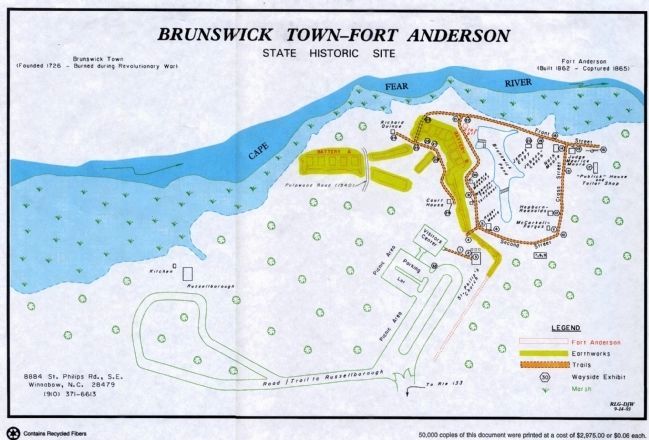
4. Map of Present-Day Historic Site
An 11" x 14" copy of this map is available at at the visitor’s center. Click on this image to enlarge.
Photographed by J. J. Prats, January 15, 2008
5. Marker and Some of the Earthworks
Credits. This page was last revised on September 13, 2025. It was originally submitted on March 23, 2008, by J. J. Prats of Powell, Ohio. This page has been viewed 3,745 times since then and 64 times this year. Last updated on September 12, 2025, by Mike McKeown of Baltimore, Maryland. Photos: 1, 2, 3. submitted on March 23, 2008, by J. J. Prats of Powell, Ohio. 4. submitted on August 12, 2008, by J. J. Prats of Powell, Ohio. 5. submitted on March 23, 2008, by J. J. Prats of Powell, Ohio. • Bernard Fisher was the editor who published this page.
