
McAlester in Pittsburg County, Oklahoma — The American South (West South Central)
Old Town Coal Mine Memorial
Photographed by James Hulse, September 10, 2025
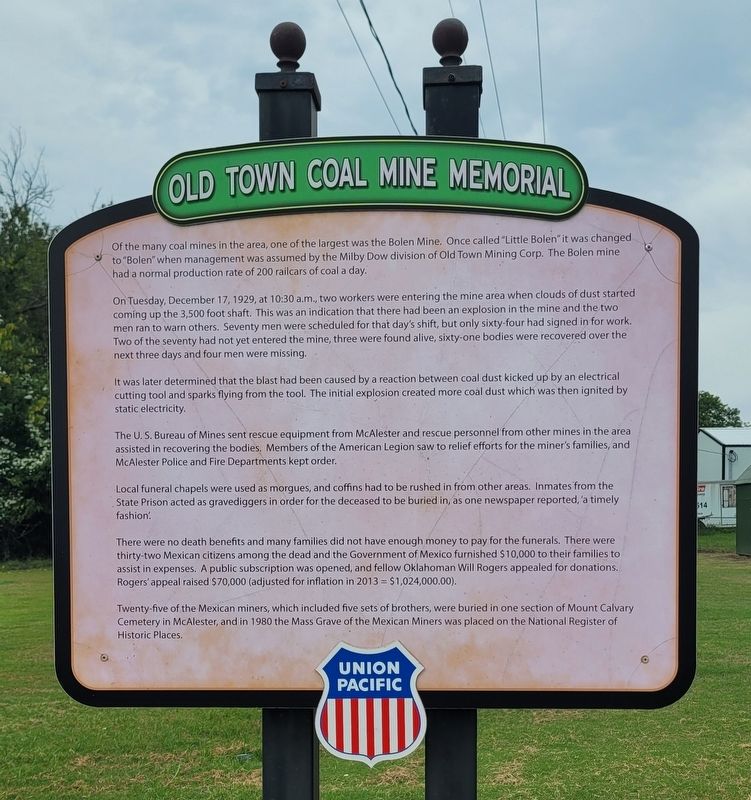
1. Old Town Coal Mine Memorial
On Tuesday, December 17, 1929, at 10:30 a.m., two workers were entering the mine area when clouds of dust started coming up the 3,500 foot shaft. This was an indication that there had been an explosion in the mine and the two men ran to warn others. Seventy men were scheduled for that day's shift, but only sixty-four had signed in for work. Two of the seventy had not yet entered the mine, three were found alive, sixty-one bodies were recovered over the next three days and four men were missing.
It was later determined that the blast had been caused by a reaction between coal dust kicked up by an electrical cutting tool and sparks flying from the tool. The initial explosion created more coal dust which was then ignited by static electricity.
The U.S. Bureau of Mines sent rescue equipment from McAlester and rescue personnel from other mines
this page online
Local funeral chapels were used as morgues, and coffins had to be rushed in from other areas. Inmates from the State Prison acted as gravediggers in order for the deceased to be buried in, as one newspaper reported, 'a timely fashion'.
There were no death benefits and many families did not have enough money to pay for the funerals. There were thirty-two Mexican citizens among the dead and the Government of Mexico furnished $10,000 to their families to assist in expenses. A public subscription was opened, and fellow Oklahoman Will Rogers appealed for donations. Rogers' appeal raised $70,000 (adjusted for inflation in 2013 = $1,024,000.00).
Twenty-five of the Mexican miners, which included five sets of brothers, were buried in one section of Mount Calvary Cemetery in McAlester, and in 1980 the Mass Grave of the Mexican Miners was placed on the National Register of Historic Places.
Erected by Union Pacific.
Topics. This historical marker and
Photographed by James Hulse, September 10, 2025
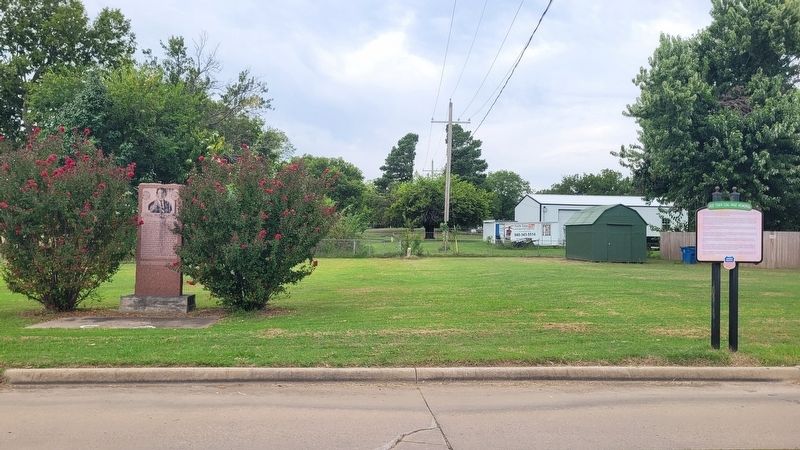
2. Old Town Coal Mine Memorial (right marker)
Location. 34° 57.056′ N, 95° 46.095′ W. Marker is in McAlester, Oklahoma, in Pittsburg County. It is at the intersection of North A Street and W Court Ave, on the left when traveling north on North A Street. The marker is located along the street next to another unrelated marker. Touch for map. Marker is at or near this postal address: 2300 N A St, McAlester OK 74501, United States of America. Touch for directions.

Regionally, this marker and memorial is in Oklahoma’s Choctaw Nation. It is also in the American South, specifically on the prairies, and on the Southern Plains. Globally, it is in North America, the Western Hemisphere, the Western World, and the Anglosphere. Historically, it finds itself in what was once the territory of the Mississippian Culture and also the Louisiana Purchase.
Other nearby markers. At least 8 other markers are within walking distance of this marker: Carl Bert Albert (a few steps from this marker); Masonic Lodge Building (approx. 0.4
Photographed by James Hulse, September 10, 2025
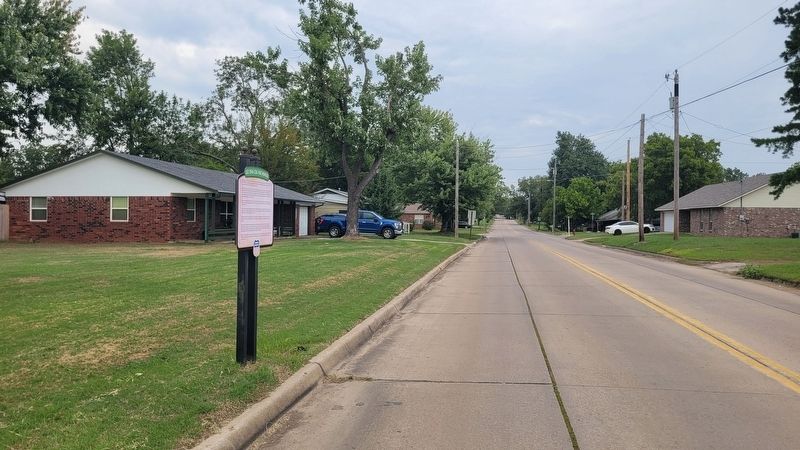
3. The view of the Old Town Coal Mine Memorial along the street
Also see . . . Coal Mining Disasters - The Encyclopedia of Oklahoma History and Culture. Oklahoma Historical Society
Always one of the most hazardous occupations, coal mining was particularly perilous in Oklahoma. From 1867 to 1906 Indian Territory's mines were the most dangerous in the United States, with more than thirteen miners dying per million tons of coal produced. Next door in Kansas, the ratio was less than half that in Indian Territory. In the Indian Territory period ten major coal-mining disasters killed 187 men, but this figure is misleading, as at least five men had to die for an accident to be considered a "major disaster." Hundreds more died alone or in small groups of two or three. Not until the miners organized and demanded safety improvements did Oklahoma's mines become a somewhat safer place to work.(Submitted on September 13, 2025, by James Hulse of Medina, Texas.)
Credits. This page was last revised on September 13, 2025. It was originally submitted on September 12, 2025, by James Hulse of Medina, Texas. This page has been viewed 110 times since then and 28 times this year. Photos: 1, 2, 3. submitted on September 13, 2025, by James Hulse of Medina, Texas.
