McAlester in Pittsburg County, Oklahoma — The American South (West South Central)
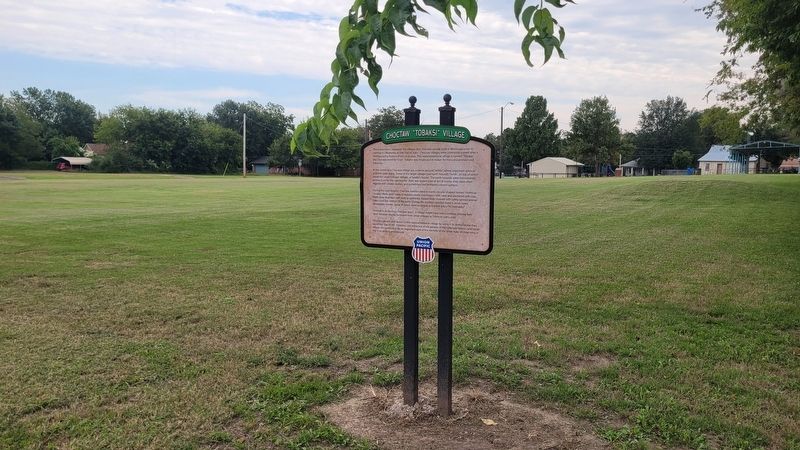
Choctaw "Tobaksi" Village

Photographed by James Hulse, September 10, 2025
1. Choctaw "Tobaksi" Village Marker
At the center of a Choctaw village was a dance ground "ahihla", where important spiritual activities took place. Some of the larger villages had earth mounds "nvnih", on top of which stood the council house, temple, or leader's house. The earth mounds were monumental architecture for the community. Built one basket load of dirt at a time, they were often aligned with cosmic bodies, and sometimes had brilliantly colored surfaces.
During the cool months, Choctaw families lived in warm, circular-shaped homes "Hvshtula Chukka". Walls were made of wooden posts, interwoven with cane and plastered with clay. Roofs were thatched with bark or palmetto. Raised beds covered with softly tanned animal hides lined the interior of the walls. During the summer, families
this page online
Stickball is an exciting Choctaw sport. A village might have had a stickball playing field "atoli" located nearby, for teams from other villages or Tribes to come play.
Choctaw people give honor to this representational village by using it to demonstrate their ancestors' way of life. However, the influence of the people of the Choctaw Nation (and other tribes) will continue to be an important part of the identity of the great state of Oklahoma in the 21st century and beyond.
Erected by Union Pacific.
Topics. This historical marker is listed in these topic lists: Indigenous Peoples and Communities • Settlements & Settlers.
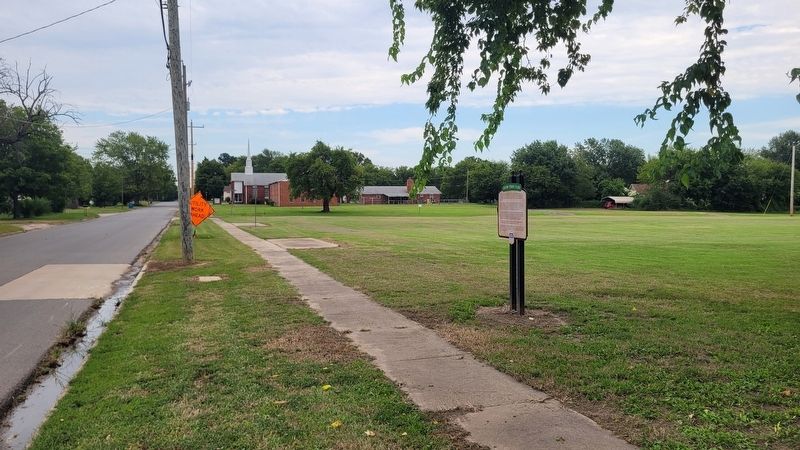
Location. 34° 57.361′ N, 95° 45.576′ W. Marker is in McAlester, Oklahoma, in Pittsburg County. It is on East Smith Avenue east of Main Street (Business U.S. 69), on the right when traveling east. The marker is located along the street. Touch for map. Marker is at or near this postal address: 33 E Smith Ave, McAlester OK 74501, United States of America.
Photographed by James Hulse, September 10, 2025
2. Choctaw "Tobaksi" Village Marker

Regionally, this marker is in the Choctaw Nation and in Southeast Oklahoma—Choctaw Country. It is also in the American South, specifically on the prairies, and on the Southern Plains. Globally, it is in North America, the Western Hemisphere, the Western World, and the Anglosphere. Historically, it finds itself in what was once the territory of the Mississippian Culture and also the Louisiana Purchase.
Other nearby markers. At least 8 other markers are within walking distance of this marker: J.J. McAlester Mansion (within shouting distance of this marker); Old Town Post Office (about 400 feet away, measured in a direct line); Tobucksy County Court House (about 400 feet away); The Great Fire of 1906 (about 500 feet away); 1893 J.J. McAlester Mercantile (about 500 feet away); J.J. McAlester Mercantile (about 600 feet away); MK&T Building (about 700 feet away); Masonic Lodge Building (approx. 0.2 miles away). Touch for a list and map of all markers in McAlester.
More about this marker. The village is not located at the marker
Also see . . . Choctaw - The Encyclopedia of Oklahoma History and Culture.
Photographed by James Hulse, September 10, 2025
3. The view of the Marker along the street
The history of the Choctaw Nation in Oklahoma began in 1820 when tribal leaders in central Mississippi signed the Treaty of Doak's Stand, ceding rich cotton lands in the delta region east of the Mississippi River for approximately thirteen million acres in the Canadian, Kiamichi, Arkansas, and Red River watersheds in southeastern Oklahoma. Although some families moved into the new land, the majority did not until Andrew Jackson pushed his Indian Removal Act through Congress in 1830. In that year Choctaw leaders signed the Dancing Rabbit Creek, ceding their remaining territory in Mississippi and agreeing to move west. During the fall and winter of 1831–32, more than six thousand Choctaw arrived in what was soon to be known as "the Indian Territory." They settled primarily around Boggy Depot in the western part of their new lands, Doaksville in the southeast, and Skullyville in the northeast. During 1832 and 1833 about five thousand more Choctaw arrived.(Submitted on September 13, 2025, by James Hulse of Medina, Texas.)
Credits. This page was last revised on September 13, 2025. It was originally submitted on September 13, 2025, by James Hulse of Medina, Texas. This page has been viewed 86 times since then and 20 times this year. Photos: 1, 2, 3. submitted on September 13, 2025, by James Hulse of Medina, Texas.
