Near Kinston in Lenoir County, North Carolina — The American South (South Atlantic)
Battle of Wyse Fork
Hoke's Attacks
| — | Carolinas Campaign | — |
Photographed by Kevin W., October 20, 2009
1. Battle of Wyse Fork Marker
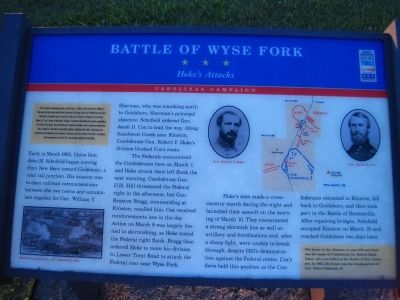
(preface) The Carolinas Campaign began on February 1, 1865, when Union Gen. William T. Sherman led his army north from Savannah, Georgia, after the “March to the Sea.” Sherman’s objective was to join Gen. Ulysses S. Grant in Virginia to crush Gen. Robert E. Lee’s Army of Northern Virginia. Scattered Confederate forces consolidated in North Carolina, the Confederacy’s logistical lifeline, where Sherman defeated Gen. Joseph E. Johnston’s last-ditch attack at Bentonville. After Sherman was reinforced at Goldsboro late in March, Johnston saw the futility of further resistance and surrendered on April 26, essentially ending the Civil War.
Early in March 1865, Union Gen. John M. Schofield began moving from New Bern to Goldsboro, a vital rail junction. His mission was to open railroad communications between the two cities and accumulate supplies for Gen. William T. Sherman, who was marching north to Goldsboro. Schofield ordered Gen. Jacob D. Cox to lead the way. Along Southwest Creek near Kinston, Confederate Gen. Robert F. Hoke’s division blocked Cox’s route.
The Federals encountered the Confederates here on March 7,
this page online
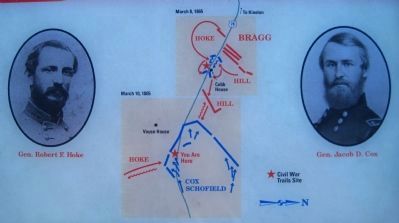
Hoke’s men made a cross-country march during the night and launched their assault on the morning of March 10. They encountered a strong skirmish line as well as artillery and fortifications and, after a sharp fight, were unable to break through, despite Hill’s demonstration against the Federal center. Cox’s force held this position as the Confederates retreated to Kinston, fell back to Goldsboro, and then took part in the Battle of Bentonville. After repairing bridges, Schofield occupied Kinston on March 19 and reached Goldsboro two days later.
(sidebar)
The house in the distance to your left and front was the home of Confederate Lt. Robert Bond Vause, who was killed at the Battle of Fort Anderson. In 1862, the house was the headquarters of Gen. Robert Ransom, Jr.
Erected by North
Photographed by Kevin W., October 20, 2009
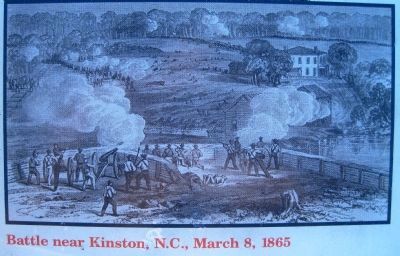
2. Picture of the Battle near Kinston, N.C., March 8, 1865
Topics. This historical marker is listed in this topic list: War, US Civil. A significant historical date for this entry is March 7, 1865.
Location. 35° 13.077′ N, 77° 30.726′ W. Marker is near Kinston, North Carolina, in Lenoir County. It is on New Bern Road (U.S. 70) west of Wyse Fork Road (County Road 1002), on the right when traveling east. Located at the west end of the Exxon station parking lot. Touch for map. Marker is in this post office area: Dover NC 28526, United States of America. Touch for directions.

Regionally, this marker is in the Coastal Plain. It is also in the American South and specifically in the Upper South. Globally, it is in North America, the Western Hemisphere, the Western World, and the Anglosphere. Historically, it finds itself in what was once the territory of the Mississippian Culture, one of the original Thirteen Colonies, one of the Confederate States of America, and the Antebellum South.
Other nearby markers. At least 8 other markers are within 5 miles of this marker, measured as the crow flies: North Carolina (here, next to this marker); a different marker also named Battle of Wyse Fork
Photographed by Kevin W., October 20, 2009
3. Generals Hoke and Cox
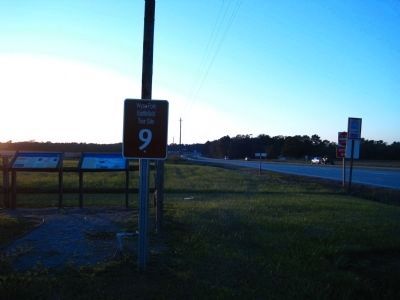
More about this marker. This is Wyse Fork Battle Tour Stop #9.
Photographed by Kevin W., October 20, 2009
4. Battle of Wyse Fork Marker
Credits. This page was last revised on September 17, 2025. It was originally submitted on October 29, 2009, by Kevin W. of Stafford, Virginia. This page has been viewed 2,234 times since then and 68 times this year. Last updated on September 13, 2025, by Mike McKeown of Baltimore, Maryland. Photos: 1, 2, 3, 4. submitted on October 29, 2009, by Kevin W. of Stafford, Virginia. • Bernard Fisher was the editor who published this page.
