Hillsborough in Orange County, North Carolina — The American South (South Atlantic)
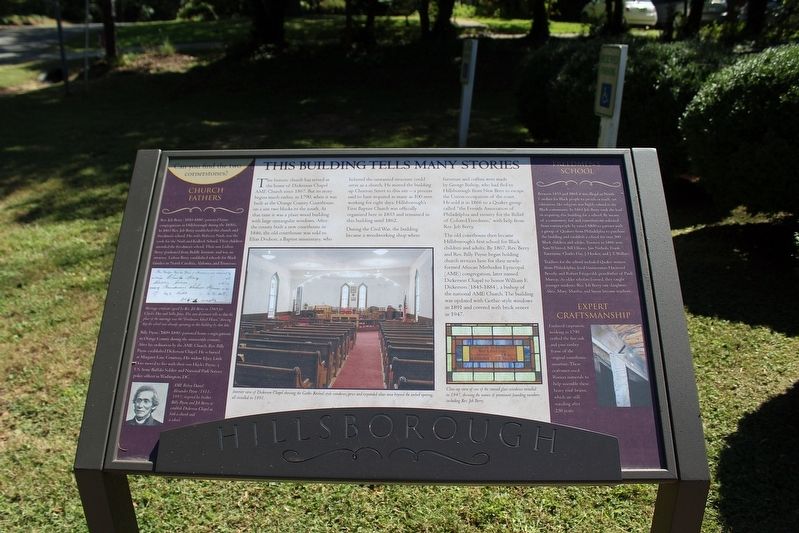
This Building Tells Many Stories
Photographed by Evan Dwyer, September 13, 2025
1. This Building Tells Many Stories Marker
During the Civil War, the building became a woodworking shop where furniture and coffins were made by George Bishop, who had fled to Hillsborough from New Bern to escape the Union occupation of the coast. He sold it in 1866 to a Quaker group called "the Friends Association of Philadelphia and vicinity for the Relief of Colored Freedmen," with help from Rev. Job Berry.
The old courthouse then became Hillsborough's
this page online
Church Fathers
Rev. Job Berry (1810-1880) pastored home congregations in Hillsborough during the 1850's. In 1865 Rev. Job Berry established this church and freedmen's school. His wife, Rebecca Nash, was the cook for the Nash and Kollock School. Their children attended the freedmen's school. Their son Lisbon Berry graduated from Biddle Institute and was an attorney. Lisbon Berry established schools for Black families in North Carolina, Alabama, and Tennessee.
Billy Payne (1809-1890) pastored home congregations in Orange County during the nineteenth century. After his ordination by the AME Church, Rev. Billy Payne established Dickerson Chapel. He is buried at Margaret Lane Cemetery. His widow Elsey Little Dove moved to live with their son
Photographed by Evan Dwyer, September 13, 2025
2. This Building Tells Many Stories Marker
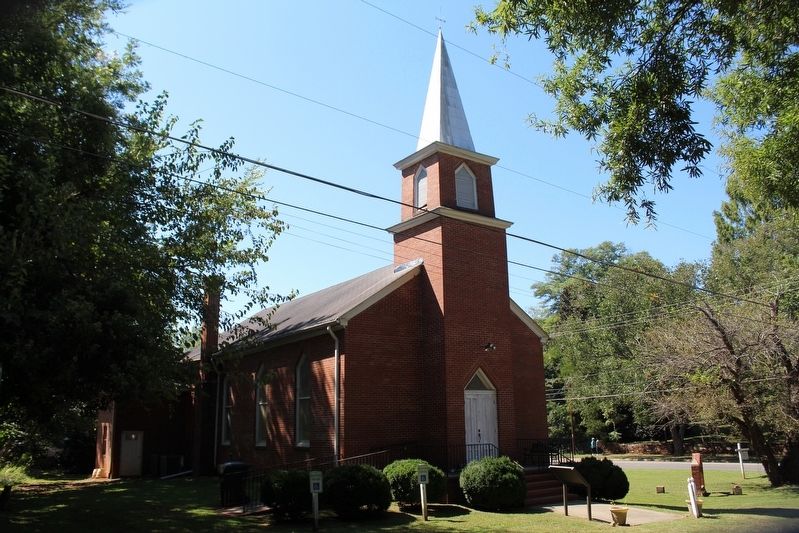
The bell tower was added to the building - it was not part of the 1790 courthouse.
Freedmen's School
Between 1835 and 1865 it was illegal in North Carolina for Black people to preach or teach, yet education, like religion, was highly valued in the Black community. In 1865 Job Berry took the lead in acquiring this building for a school. By means of a community fair and contributions solicited from townspeople he raised $800 to partner with a group of Quakers from Philadelphia to purchase the building and establish a school for over 300 Black children and adults. Trustees in 1866 were Sam Whitted, Bill Ellison, Jim Nichols, Frank Turrentine, Charles Day, J. Hooker, and J.T. Wallace.
Teachers for the school included Quaker women from Philadelphia, local businessman Haywood Beverly, and Robert Fitzgerald, grandfather of Pauli Murray. As older scholars learned, they taught younger students. Rev. Job Berry saw daughters Alice, Mary, Martha, and Susan become teachers.
Expert Craftmanship
Enslaved carpenters, working in 1790 crafted the fine oak and pine timber frame of the original courthouse structure. These craftsmen
Photographed by Evan Dwyer, September 13, 2025
3. Dickerson AME Chapel
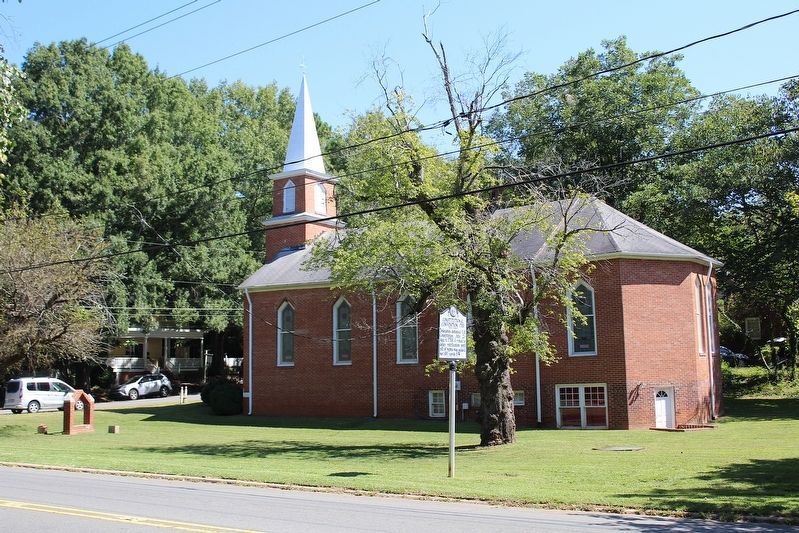
This view from southwest of the building across N Churtown Street shows how the building was modified to become a church, with the bell tower added as well as the ca. 1891 rear expansion. The logs of the original construction are not visible from the outside.
Topics. This historical marker is listed in these topic lists: African Americans • Architecture • Education • Religion & Religious Structures • War, US Civil. A significant historical year for this entry is 1790.
Location. 36° 4.717′ N, 79° 5.955′ W. Marker is in Hillsborough, North Carolina, in Orange County. It is at the intersection of East Queen Street and North Churton Street (North Carolina Route 86), on the right when traveling east on East Queen Street. Touch for map. Marker is at or near this postal address: 100 East Queen Street, Hillsborough NC 27278, United States of America. Touch for directions.

Regionally, this marker is in the Piedmont and in the Research Triangle. It is also in the American South and specifically in the Upper South. Globally, it is in North America, the Western Hemisphere, the Western World, and the Anglosphere. Historically, it finds itself in what was once the territory of the Mississippian Culture, one of the original Thirteen Colonies, one of the Confederate States of America, and the Antebellum South.
Other nearby markers. At least 8 other markers are within walking distance of this marker: Constitutional Convention, 1788 (within shouting distance of this marker); Thomas Burke (about 300 feet away, measured in a direct line); William Hooper (about 400 feet away); William Hooper Esquire (about 400 feet away); James Hogg (about 400 feet away); William A. Graham (about 400 feet away); Historic Corner (about 500 feet away); Francis Nash (about 500 feet away). Touch for a list and map of all markers in Hillsborough.
Another marker is no longer nearby. Archibald Debow Murphey (was about 500 feet away but has been permanently removed).
Also see . . . Dickerson’s Chapel AME Church orig.1790. Visit Hillsborough (Submitted on September 15, 2025.)
Credits. This page was last revised on September 15, 2025. It was originally submitted on September 14, 2025, by Evan Dwyer of Richmond, Virginia. This page has been viewed 154 times since then and 69 times this year. Photos: 1, 2, 3. submitted on September 14, 2025, by Evan Dwyer of Richmond, Virginia. • Bernard Fisher was the editor who published this page.
