Brehna in Sandersdorf-Brehna in Anhalt-Bitterfeld, Saxony-Anhalt, Germany — Central Europe
Stadt- und Klosterkirche Brehna
⎯⎯⎯
Brehna Town- and Convent Church
Photographed by Andrew Ruppenstein, September 2, 2025
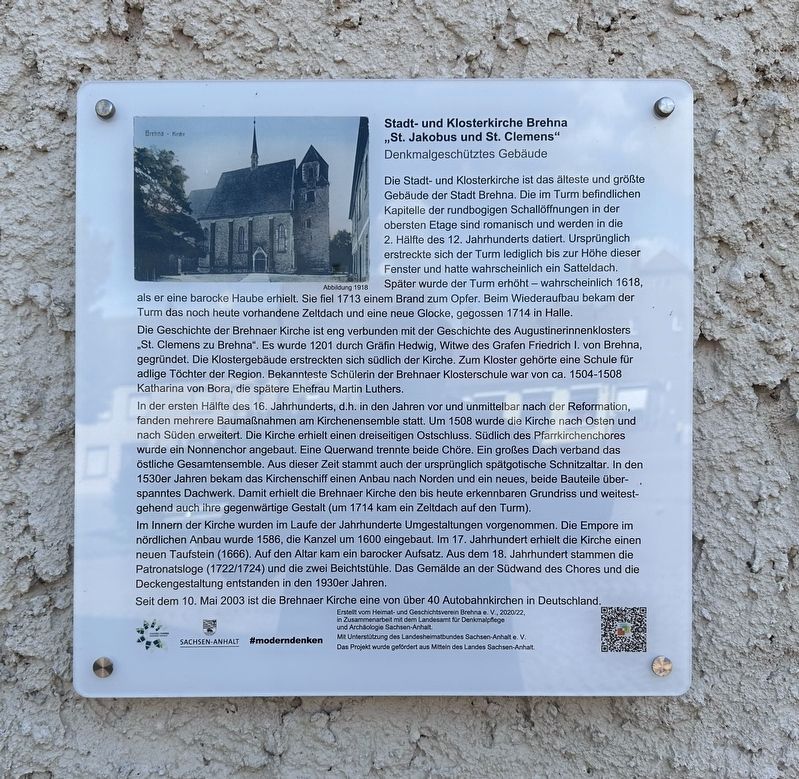
1. Stadt- und Klosterkirche Brehna / Brehna Town- and Convent Church Marker

„St. Jakobus und St. Clemens“
Denkmalgeschütztes Gebäude
Die Stadt- und Klosterkirche ist das älteste und größte Gebäude der Stadt Brehna. Die im Turm befindlichen Kapitelle der rundbogigen Schallöffnungen in der obersten Etage sind romanisch und werden in die 2. Hälfte des 12. Jahrhunderts datiert. Ursprünglich erstreckte sich der Turm lediglich bis zur Höhe dieser Fenster und hatte wahrscheinlich ein Satteldach. Später wurde der Turm erhöht - wahrscheinlich 1618, als er eine barocke Haube erhielt. Sie fiel 1713 einem Brand zum Opfer. Beim Wiederaufbau bekam der Turm das noch heute vorhandene Zeltdach und eine neue Glocke, gegossen 1714 in Halle.
Die Geschichte der Brehnaer Kirche ist eng verbunden mit der Geschichte des Augustinerinnenklosters „St. Clemens zu Brehna“. Es wurde 1201 durch Gräfin Hedwig, Witwe des Grafen Friedrich I. von Brehna, gegründet. Die Klostergebäude erstreckten sich südlich der Kirche. Zum Kloster gehörte eine Schule für adlige Töchter der Region. Bekannteste Schülerin der Brehnaer Klosterschule war von ca. 1504-1508 Katharina von Bora,
this page online
In der ersten Hälfte des 16. Jahrhunderts, d.h. in den Jahren vor und unmittelbar nach der Reformation, fanden mehrere Baumaßnahmen am Kirchenensemble statt. Um 1508 wurde die Kirche nach Osten und nach Süden erweitert. Die Kirche erhielt einen dreiseitigen Ostschluss. Südlich des Pfarrkirchenchores wurde ein Nonnenchor angebaut. Eine Querwand trennte beide Chöre. Ein großes Dach verband das östliche Gesamtensemble. Aus dieser Zeit stammt auch der ursprünglich spätgotische Schnitzaltar. In den 1530er Jahren bekam das Kirchenschiff einen Anbau nach Norden und ein neues, beide Bauteile überspanntes Dachwerk. Damit erhielt die Brehnaer Kirche den bis heute erkennbaren Grundriss und weitest- gehend auch ihre gegenwärtige Gestalt (um 1714 kam ein Zeltdach auf den Turm).
Im Innern der Kirche wurden im Laufe der Jahrhunderte Umgestaltungen vorgenommen. Die Empore im nördlichen Anbau wurde 1586, die Kanzel um 1600 eingebaut. Im 17. Jahrhundert erhielt die Kirche einen neuen Taufstein (1666). Auf den Altar kam ein barocker Aufsatz. Aus dem 18. Jahrhundert stammen die Patronatsloge (1722/1724) und
Photographed by Andrew Ruppenstein, September 2, 2025
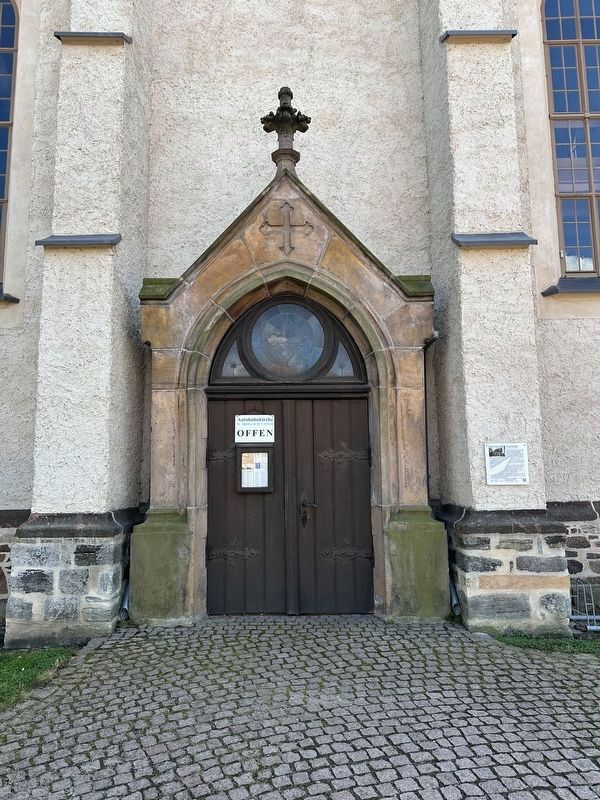
2. Brehna Town- and Convent Church Marker - wide view
Seit dem 10. Mai 2003 ist die Brehnaer Kirche eine von über 40 Autobahnkirchen in Deutschland.
Erstellt vom Heimat- und Geschichtsverein Brehna e. V., 2020/22, in Zusammenarbeit mit dem Landesamt für Denkmalpflege und Archäologie Sachsen-Anhalt
Mit Unterstützung des Landesheimatbundes Sachsen-Anhalt e. V.
Das Projekt wurde gefördert aus Mitteln des Landes Sachsen-Anhalt.
(English translation:)
Brehna Town- and Convent Church
"St. James and St. Clement"
Listed building
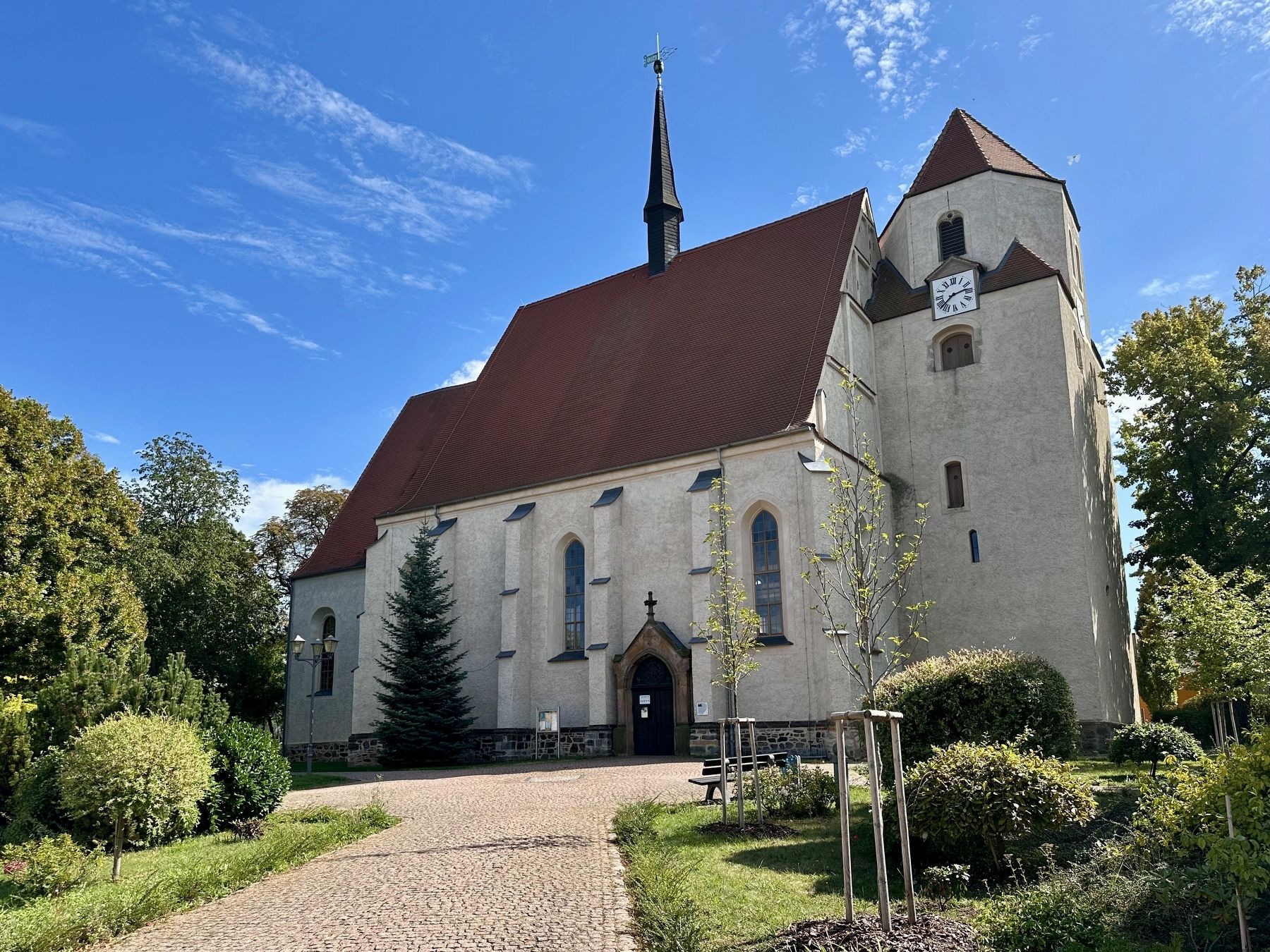
The town- and convent church is the oldest and largest building in the town of Brehna. The capitals of the round-arched sound openings on the top floor of the tower are Romanesque and date back to the second half of the 12th century. Originally, the tower only reached the height of these windows and likely had a gable roof. Later, the tower was raised—probably in 1618, when it received a Baroque cap. This cap was destroyed by fire in 1713. During reconstruction, the tower received the still-present tent roof and a new bell, cast in Halle
Photographed by Andrew Ruppenstein, September 2, 2025
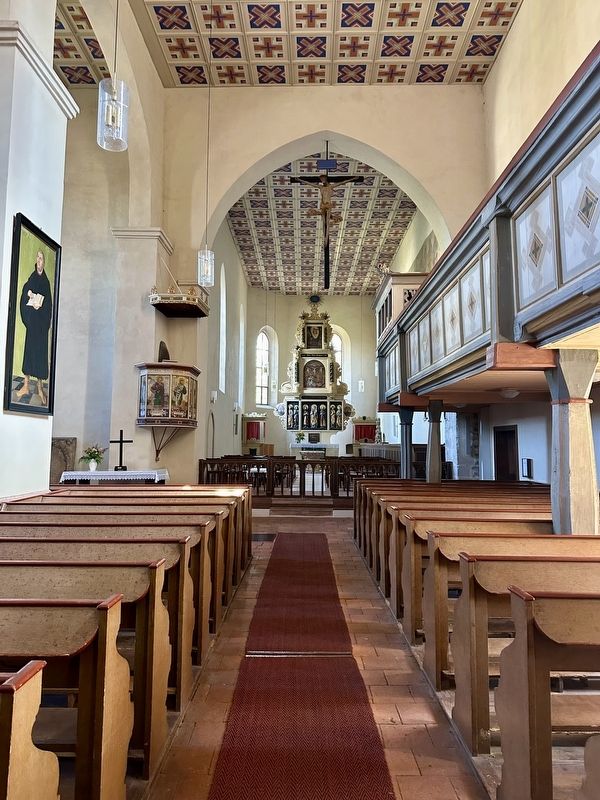
3. Church interior
The history of the Brehna church is closely linked to the history of the Augustinian convent "St. Clemens zu Brehna." It was founded in 1201 by Countess Hedwig, widow of Count Friedrich I of Brehna. The convent buildings extended south of the church. The convent housed a school for the daughters of noblemen of the region. The most famous student of the Brehna convent school from approximately 1504 to 1508 was Katharina Bora, the future wife of Martin Luther.
In the first half of the 16th century, i.e., in the years before and immediately after the Reformation, several construction projects were carried out on the church complex. Around 1508, the church was extended to the east and south. The church received a three-sided eastern end. A nuns' choir was added south of the parish church choir. A transverse wall separated the two choirs. A large roof connected the entire eastern ensemble. The originally late Gothic carved altar also dates from this period. In the 1530s, the nave was extended to the north and a new roof structure spanning both parts was added. This gave the Brehna church its current floor plan and, to a large
Photographed by Andrew Ruppenstein, September 2, 2025
4. Stadt- und Klosterkirche Brehna / Brehna Town- and Convent Church
The interior of the church has undergone modifications over the centuries. The gallery in the northern extension was added in 1586, and the pulpit around 1600. In the 17th century, the church received a new baptismal font (1666). A Baroque altarpiece was added. The patron's box (1722/1724) and the two confessionals date from the 18th century. The painting on the south wall of the chancel and the ceiling design were created in the 1930s.
Since May 10, 2003, the Brehna church has been one of over 40 Autobahn churches in Germany.
Created by the Brehna Local History and Heritage Association, 2020/22, in cooperation with the State Office for Monument Preservation and Archaeology of Saxony-Anhalt
With the support of the Saxony-Anhalt Local History Association.
The project was funded by the State of Saxony-Anhalt.
Erected 2020 by Heimat- und Geschichtsverein Brehna e. V.
Topics. This historical marker is listed in these topic lists: Religion & Religious Structures • Women. A significant historical year for this entry is 1618.
Location. 51° 33.424′ N, 12° 12.79′ E. Marker is in Sandersdorf-Brehna, Sachsen-Anhalt (Saxony-Anhalt), in Anhalt-Bitterfeld. It is in Brehna. It is at the intersection of Pestalozzi Straße and Bahnhofstraße, on the left when traveling south on Pestalozzi Straße. Touch for map. Marker is at or near this postal address: Pestalozzi Straße 2, Sandersdorf-Brehna ST 06796, Germany. Touch for directions.

Regionally, this marker is in Central Germany. Globally, it is in Europe, the European Union, Atlantic Europe, Central Europe, the Schengen Area, Western Europe, and the Western World. Historically, it finds itself in what was once the Holy Roman Empire and also the former East Germany.
Other nearby markers. At least 6 other markers are within walking distance of this marker: Pestalozzi-Schule Brehna / Pestalozzi School Brehna (within shouting distance of this marker); Kursächsische Postmeilensäule / Electoral Saxony Post Milestone (about 120 meters away, measured in a direct line); Altes Rathaus / Old Town Hall (about 180 meters away); Brehna (about 180 meters away); Neues Rathaus (ehemaliges Gutshaus) / New Town Hall (former manor house) (approx. 0.4 kilometers away); “Schmidt-Mühle” (Bockwindmühle) / “Schmidt Mill” (Post Windmill) (approx. half a kilometer away).
Credits. This page was last revised on September 15, 2025. It was originally submitted on September 15, 2025, by Andrew Ruppenstein of Lamorinda, California. This page has been viewed 84 times since then and 24 times this year. Photos: 1, 2, 3, 4. submitted on September 15, 2025, by Andrew Ruppenstein of Lamorinda, California.
